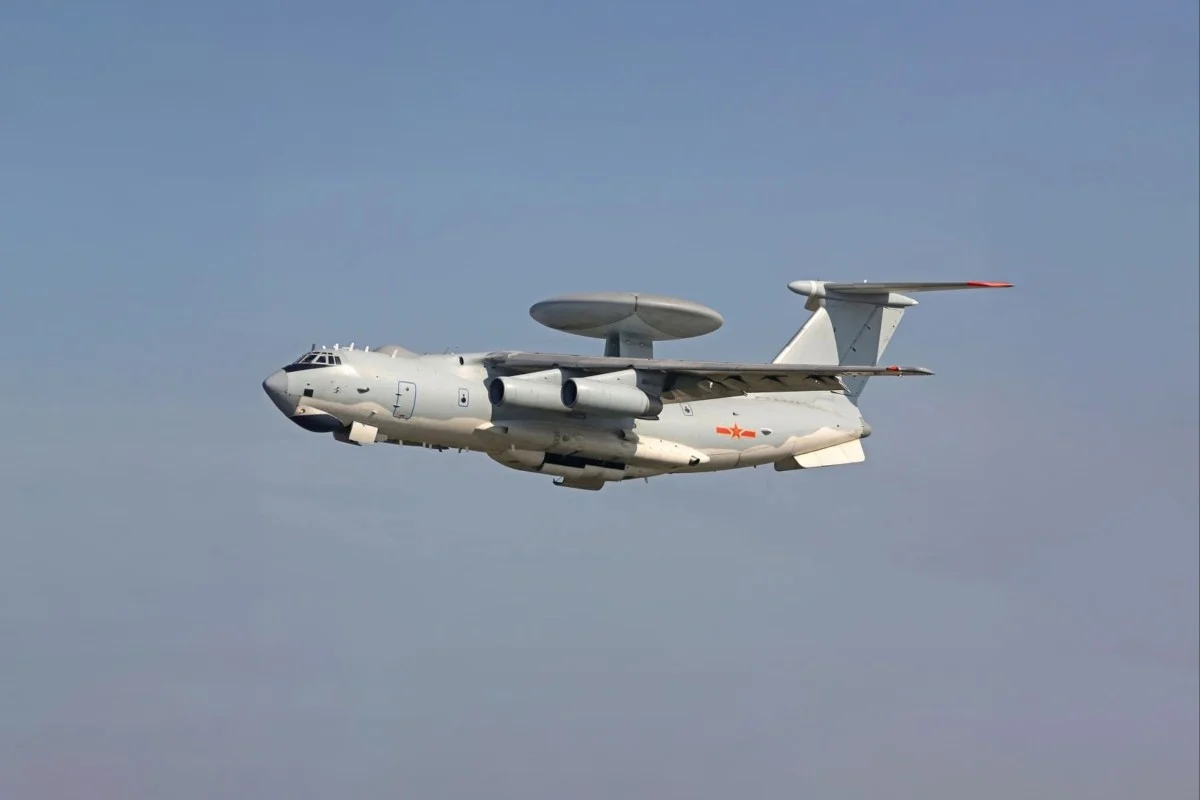
China may have begun limited production of the KJ-3000 airborne early warning and control (AEW&C) aircraft, according to commercial satellite imagery of the Xian-Yanliang aviation complex in Shaanxi province. Imagery captured on October 5, 2026, by US geospatial intelligence company Vantor and reported by The War Zone (TWZ) showed four KJ-3000s on site, while a fifth had been identified there in April. According to an imagery analyst, three of the five airframes lack the serial numbers carried by known prototypes.
The People’s Liberation Army Air Force (PLAAF) operates the KJ-2000, a heavy radar aircraft built on Russian-made Il-76 transports and introduced roughly two decades ago; only four were produced. The KJ-3000, built on the domestically produced Y-20B transport airframe, could eventually replace it, and two prototypes are known. A production-standard aircraft would help the PLA detect threats, track targets, and coordinate air operations across the western Pacific, including during a potential conflict over Taiwan involving US and allied forces.
Satellite Imagery Points to Early KJ-3000 Production at Xian
The October 5 imagery placed three KJ-3000s near the Xian Aircraft Industrial Corporation (XAIC) factory and a fourth, a prototype, at the neighboring China Flight Test Establishment (CFTE). Janes reported on May 15 that satellite imagery showed a fifth KJ-3000 airframe at Xian-Yanliang in April.
An imagery analyst who requested anonymity told the South China Morning Post (SCMP) that three of the five airframes lack the 78XX serial numbers carried by the two known prototypes, 7821 and 7822, and could belong to an initial production batch. He said the three aircraft parked at the factory appear to have remained since April in an XAIC area normally used for aircraft awaiting delivery, rather than moving to the flight-test ramp. The analyst also questioned why China would need three additional prototypes when the KJ-3000 uses the established Y-20B airframe, arguing that the mission systems, not the mature airframe, are what is being tested.
The evidence stops short of confirming deliveries. Prototype 7821 was absent from the October imagery, and the analyst said he had seen no evidence of KJ-3000s at operational PLAAF bases. Andreas Rupprecht, a specialist in Chinese military aviation, told SCMP that factory-fresh aircraft usually remain at XAIC for months before delivery in batches, possibly while receiving units prepare, and that some airframes could be awaiting additional systems, although the imagery cannot establish why they have remained there. TWZ reported that J. Michael Dahm, a senior fellow at the Mitchell Institute for Aerospace Studies, believes serial production has started, while cautioning that the imagery alone cannot confirm it. The planned fleet size remains unknown.
Y-20B Airframe and Digital Radar: How KJ-3000 Compares to KJ-2000
The KJ-3000 replaces the Il-76 with the domestically produced Y-20B airframe and Chinese-made WS-20 engines, giving Beijing greater control over production and upgrades. A refueling probe could also extend its time in the air on operations.
TWZ attributed the KJ-2000 fleet’s limit of four aircraft to a shortage of suitable airframes. Rupprecht disputes that reading, arguing that the KJ-2000’s specialized strategic role as a command, control, communications, computers, intelligence, surveillance and reconnaissance (C4ISR) node, not Il-76 shortages, kept numbers low. China could have converted more Il-76s if needed, he said, while the smaller KJ-500 handles most tactical airborne early warning missions. He expects the KJ-3000 to serve as a similar node and does not anticipate significant competition for Y-20 production capacity with transports and tankers, given the limited quantities likely required.
Janes reported in 2025 that markings on the prototype’s radome suggested two back-to-back antenna arrays, although the configuration and performance remain unconfirmed. The Pentagon assessed in December 2025 that the KJ-3000 would probably use digital radar with anti-jamming, passive-detection, and target-identification capabilities.
Analysis: The KJ-3000’s potential value extends beyond early warning to long-range targeting. In May 2025, Chinese state television reported that the Type 055 destroyer Lhasa had used data from an airborne early warning aircraft to extend its detection range and engage targets without relying solely on its own radars; the aircraft was not identified as a KJ-3000. A heavy AEW&C node could extend that kind of airborne cueing to naval strikes well beyond the reach of shipborne radars. An April 2026 Mitchell Institute report, built on a wargame of a hypothetical 2035 Taiwan conflict, identified KJ-3000s and KJ-500s as high-value targets because of their role in PLA long-range targeting. Each additional airframe raises the premium on US and allied counter-air weapons able to reach these aircraft behind China’s fighter screen.
The next indicators are the appearance of unnumbered KJ-3000s at operational PLAAF bases, the assignment of unit serials, and any movement of the three airframes held at XAIC. Radar configuration, fleet size, and a service entry date all remain unconfirmed. Until deliveries are observed, the KJ-3000 is best assessed as a program moving from flight test toward limited production, not a fielded capability.