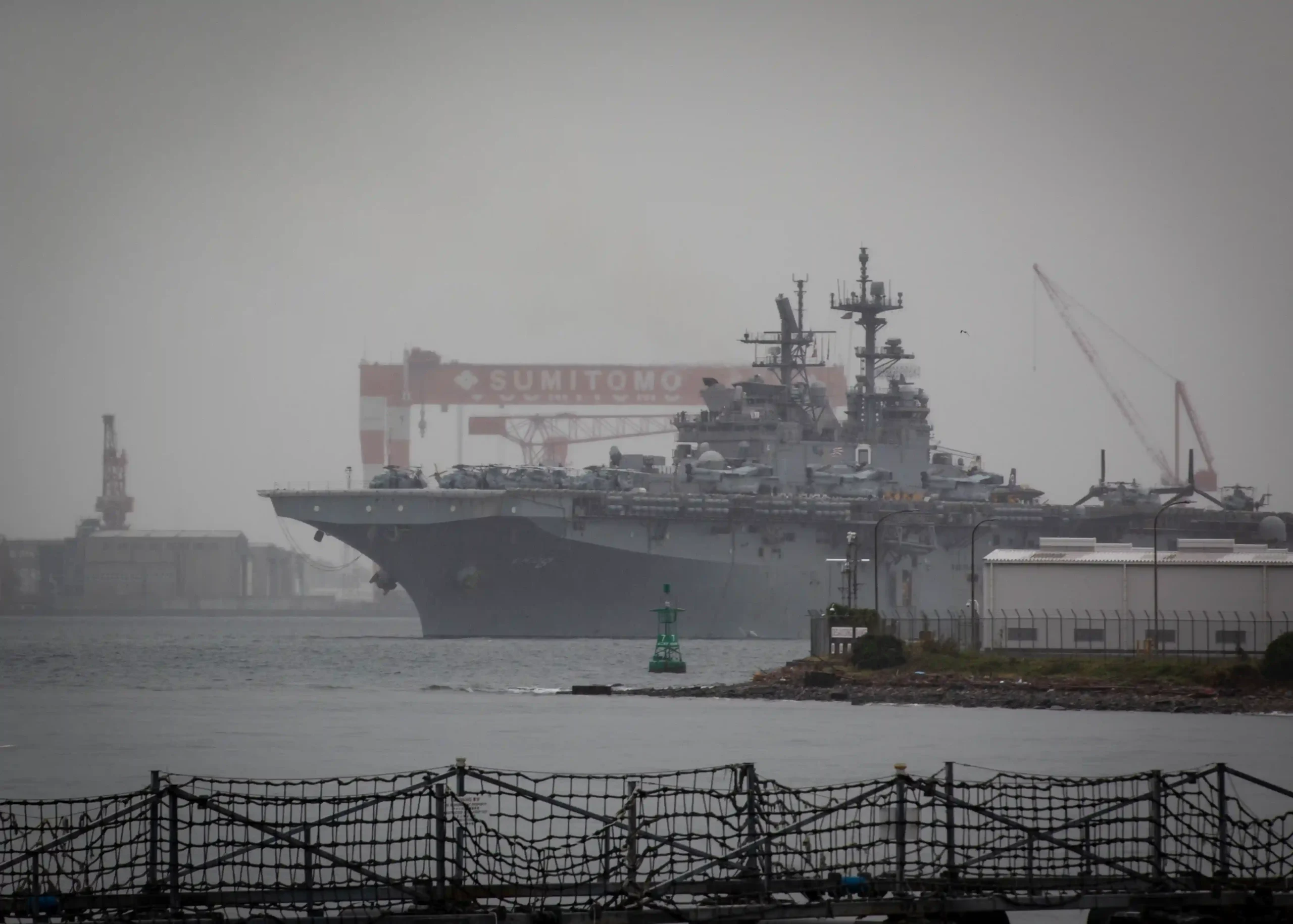
The U.S. Navy’s Makin Island Amphibious Ready Group (ARG) and the embarked 13th Marine Expeditionary Unit (MEU) arrived at Commander, Fleet Activities Yokosuka (CFAY), Japan, on October 26, 2026, for maintenance and resupply, according to U.S. 7th Fleet. The group comprises the Wasp-class amphibious assault ship USS Makin Island (LHD 8), the San Antonio-class amphibious transport docks USS Anchorage (LPD 23) and USS John P. Murtha (LPD 26), the staff of Amphibious Squadron (PHIBRON) 7, and the 13th MEU’s aviation, logistics and ground combat elements.
The port call is the first official confirmation of the group’s position since it left Naval Base San Diego on September 28, 2026. The Navy announced neither the departure nor a destination, and press reports citing U.S. officials pointed to a possible reinforcement of U.S. forces in the Middle East, where the Boxer ARG and 11th MEU have operated since arriving on June 30 amid the conflict with Iran. The Navy now describes the ARG/MEU as conducting routine operations in the 7th Fleet area of operations.
Makin Island ARG Ships and 13th MEU Embarked Capabilities
Commissioned in October 2009, Makin Island is the eighth and final Wasp-class hull and the only one with hybrid propulsion. Publicly available specifications indicate a length of 847 feet, a full-load displacement of about 41,000 long tons, and two General Electric LM2500+ gas turbines paired with an auxiliary propulsion system that drives the shafts through electric motors at low speed. That mode cuts fuel burn at loiter speeds, extending time on station and easing demand on oilers.
The ship’s flight deck supports a 13th MEU Aviation Combat Element typically built around an MV-22B Osprey squadron with CH-53E, AH-1Z and UH-1Y detachments, and Makin Island has operated a full F-35B squadron on a previous deployment. The Navy has not disclosed the full air wing, including whether F-35Bs are embarked.
Anchorage, commissioned in 2013, and John P. Murtha, commissioned in 2016, each displace roughly 25,000 tons at full load per publicly available data and can carry about 700 Marines. Each has a well deck for two Landing Craft Air Cushion and a flight deck for MV-22Bs, giving the ARG three dispersed launch points for ship-to-shore movement. A MEU typically numbers about 2,200 Marines; embarked strength for this deployment has not been released.
Why the Yokosuka Port Call Matters for 7th Fleet
Yokosuka is home to 7th Fleet’s forward-deployed naval forces and its ship repair facility, a natural stop for voyage repairs, stores and fuel after a four-week transit. 7th Fleet framed the visit as a chance to use the base’s port facilities and to build ties with the Japan Maritime Self-Defense Force (JMSDF). Commanders also reminded crews to maintain good order and discipline, follow liberty policy and respect their Japanese hosts, a standard instruction that carries particular weight in Japan.
The arrival follows a broader reshuffling of West Coast assets. The carrier USS Theodore Roosevelt (CVN 71), which deployed from San Diego one day before the ARG, pulled into Yokosuka on October 16, 2026, ahead of the bilateral U.S.-Japan exercise Keen Sword, and could later relieve USS George Washington (CVN 73), sent to the Middle East in August. The Navy has not said whether the ARG/MEU will join Keen Sword, which runs through October 29.
Analysis: Two West Coast formations initially reported as Middle East reinforcements have now surfaced in Yokosuka, showing how Central Command demand and Indo-Pacific presence draw on the same finite pool of Pacific Fleet hulls. An ARG in the western Pacific keeps both options open: it sustains amphibious presence near Japan while remaining within weeks of the Arabian Sea. The precedent cuts both ways, since this same ARG/MEU pairing spent its 2022-2023 deployment entirely in the Indo-Pacific.
The Navy has not disclosed how long the group will stay in Yokosuka, its next port of call or its eventual theater. The indicators to watch are whether the ARG integrates into 7th Fleet’s exercise schedule or moves west toward the Indian Ocean and U.S. 5th Fleet, and whether U.S. strikes against Iran resume after the November midterm elections, a possibility the President has publicly raised.