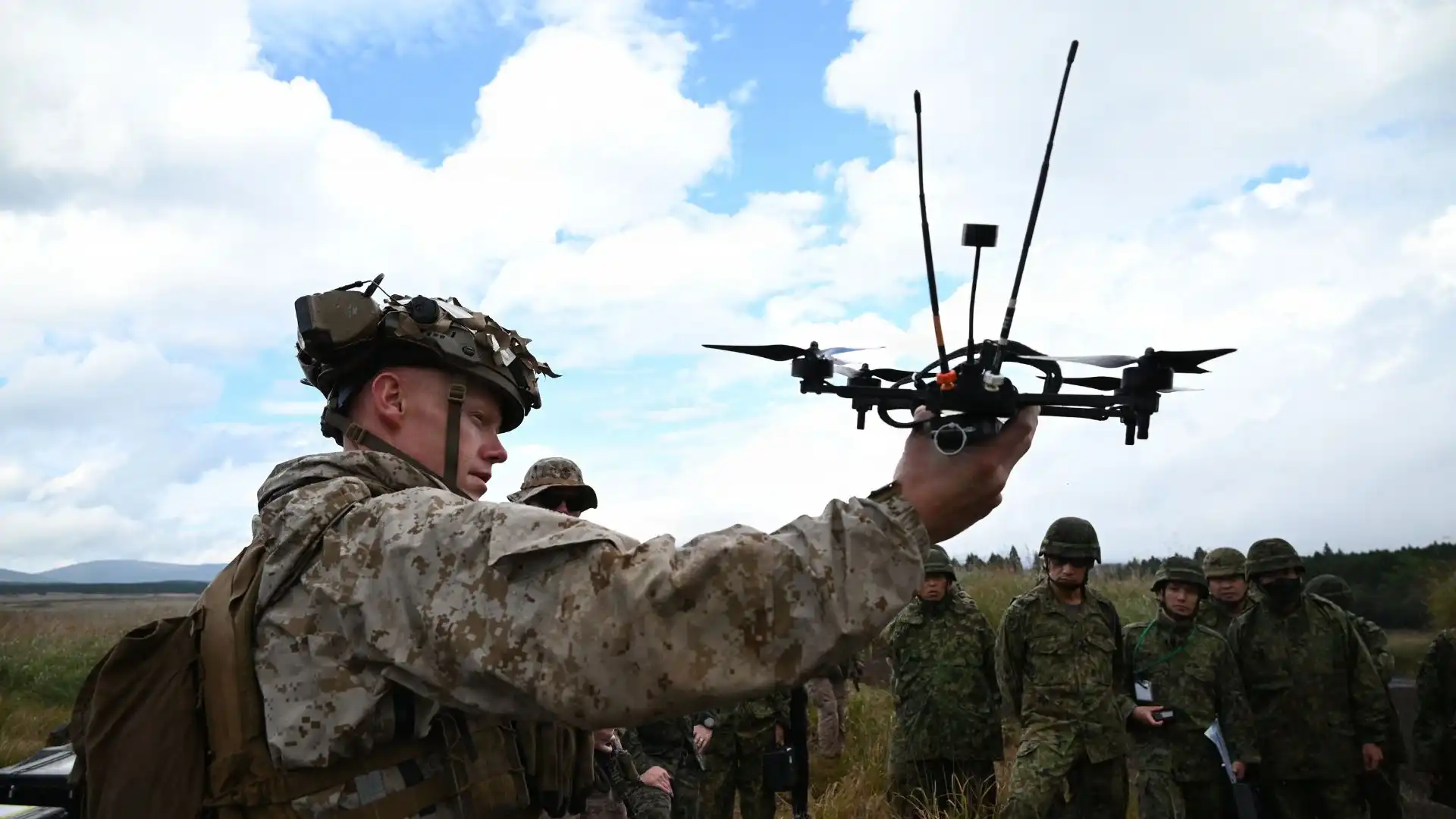
US Marines with Battalion Landing Team (BLT) 1/1, 31st Marine Expeditionary Unit (MEU), flew Neros Archer Strike first-person view (FPV) one-way attack drones in a live kinetic test at Combined Arms Training Center (CATC) Camp Fuji, Japan, on October 20, 2026, the system’s first use at the range near Mount Fuji. Both flights ended in detonations on target, and explosive ordnance disposal (EOD) technicians recovered no unexploded ordnance (UXO).
The test was part of the Fuji Viper exercise series, Bilbo told Stars and Stripes, and comes as the Marine Corps pushes FPV strike drones from experimentation into the Fleet Marine Force. Neros Technologies, of El Segundo, California, received a Marine Corps delivery order in November 2025 for strike-capable Archer systems bundled with operator training, and the US Army followed on June 30, 2026, with an indefinite-delivery/indefinite-quantity (IDIQ) contract worth up to $500 million under its Purpose-Built Attritable Systems (PBAS) program. Chief Warrant Officer 2 Stephen Bilbo, Camp Fuji’s gunner and range control officer, described Archer as the Marine Corps’ current program of record for one-way attack drones flown by a first-person view pilot.
Neros Archer Strike Specifications, Payloads, and Range Envelope
The Archer is a quadcopter built for volume production without Chinese components and cleared under the Pentagon’s Blue UAS framework. The Archer Strike variant pairs the airframe with the Terminus modular mission payload system from Kraken Kinetics. The aircraft is a terminal munition: the operator steers it into the target through a live video feed, and it is consumed on impact. “They fly, they blow up and they are done,” Bilbo told Stars and Stripes.
Manufacturer figures for the 8-inch rotor configuration flown at Camp Fuji cite a range of about 10 miles (16 km) and a payload of roughly 5 pounds (2.3 kg). Other company material cites a 2 kg payload over approximately 20 km. The spread reflects battery and payload trade-offs, and Neros has not published a single performance sheet for the Marine configuration. A Marine battalion commander said in December 2025 that the service fields three Archer warheads: anti-personnel, anti-materiel, and an explosively formed penetrator (EFP) for anti-armor work. The Fuji anti-armor ambush scenario aligns with the EFP role, although the Marines did not say which payload flew on either sortie.
Control runs through Neros’ Crossbow ground control station, whose Block 2 version offers a displaced radio configuration that places the antennas away from the pilot, a key survivability factor against an adversary that hunts operators by their emissions. Archer Block 2, unveiled March 2, 2026, adds field-swappable sensor payloads for day, night, and urban missions, with AI-enabled terminal guidance and aerial repeater functions on the roadmap. A fiber-optic variant, Archer Fiber, targets environments where radio links are jammed. Reported unit costs run about $2,000 per drone, a fraction of the cost of a Javelin anti-tank missile.
How BLT 1/1 Is Building FPV Strike Into Hunter-Killer Teams
The Camp Fuji event served as a proof of concept for Weapons Company’s hunter-killer teams. Master Sgt. Glenn Dayton, company operations chief with Weapons Company, BLT 1/1, said the goal was for the drone to be “an extension of our hunter-killers’ capabilities with defeating armor and a means of ground line communication within our adversary force.” Dayton said the scenario differed from earlier training at the battalion’s home station, Marine Corps Base Camp Pendleton, California.
A few dozen observers, including members of the Japan Ground Self-Defense Force (JGSDF), watched two flights against targets positioned on berms; one simulated an anti-armor ambush, and the second scenario was not described. CATC Camp Fuji EOD technicians stood by because a strike drone that loses its link and falls without detonating becomes UXO. “That falls under our bread and butter,” said Staff Sgt. Francisco Melandez, a CATC Camp Fuji EOD technician.
Unit leadership hand-picks operators for a three-week course, and the only stated prerequisite is no prior drone experience. The pilots are lance corporals through sergeants, pay grades E-3 to E-5, in the battalion commanded by Lt. Col. Clark Smith. “Our lower enlisted are the ones we rely on to master this craft,” Dayton said. Bilbo said the Marines had already trained extensively with one-way attack drones before bringing Archer Strike to Fuji, and are also rehearsing defenses against similar aircraft fielded by US adversaries.
Analysis: The weight of the Camp Fuji test lies in who flew the drone and where. Putting a one-way attack capability in the hands of E-3 to E-5 Marines inside a forward-deployed MEU’s landing team gives the force an organic precision fire option against armor at squad and platoon level, without calling on artillery, aviation, or a six-figure anti-tank missile. Ukraine has shown that similar drones reward the side that trains operators at scale and sustains production. The Marine Corps is tackling the first problem with short, enlisted-centric courses; the second depends on whether Neros can sustain domestic output across concurrent Army PBAS, Marine Corps, and Pentagon Drone Dominance demand.
Unknowns remain. Marine Corps Warfighting Laboratory officials described the initial 2025 buy as a one-time procurement of 3,200 Archers, so how the program of record cited at Fuji is structured and funded in coming budget cycles is unclear. Milestones to watch include Block 2 fielding, the arrival of AI-enabled terminal guidance, and whether 31st MEU units employ Archer teams in bilateral training with the JGSDF.