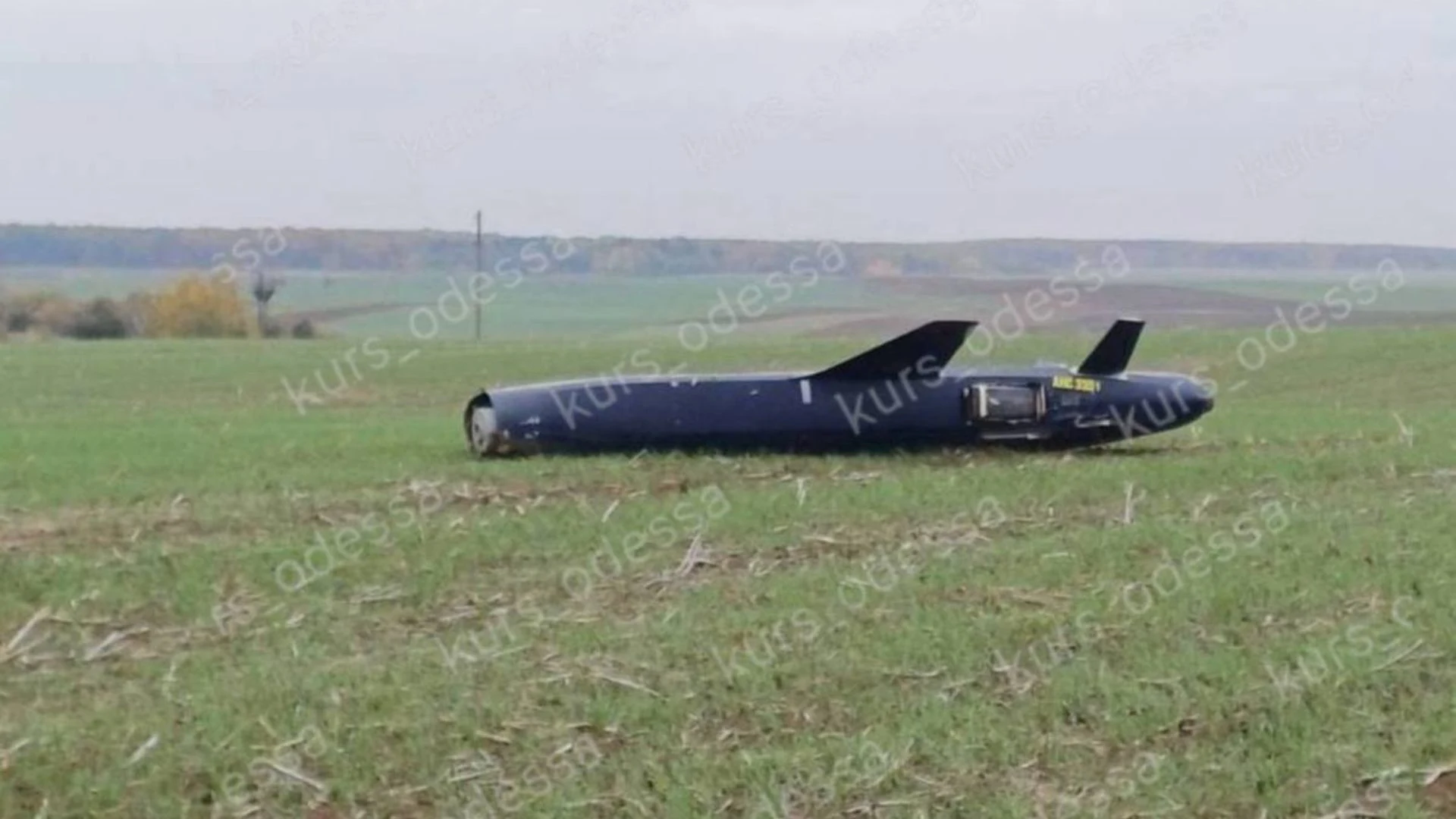
A Russian Geran-5 K5-K, the latest variant of Moscow’s jet-powered one-way attack drone, has come down in a field in Ukraine’s Odesa region, according to photos that circulated on October 27, 2026. The airframe appears largely intact and carries an ANS-series serial number. Ukrainian officials have not commented on the find, and it remains unclear whether the weapon was hit by air defenses, defeated by electronic warfare or failed on its own.
The crash comes days after Serhii “Flash” Beskrestnov, an adviser to President Volodymyr Zelenskyy on defense technology, said Russia had used the K5-K in an attack on October 22 and that Ukrainian forces first recorded the variant roughly a month earlier. Russia introduced the baseline Geran-5 in combined strikes in early January 2026, and the type has since become a priority target: in September alone, a Ukrainian F-16, border guards and interceptor drone crews all claimed kills.
Geran-5 K5-K Design Changes: Internal Engine and New Wings
Ukrainian sources describe the K5-K as a substantial rework of the original airframe. The fuselage has been modified, the wings are smaller and swept back, the tail surfaces have been redesigned, and the turbojet has moved from an external pod above the fuselage into the body of the airframe. Burying the engine cuts drag and is consistent with the reported gains in speed, range and altitude, although Ukrainian officials have not published performance figures. Reports indicate the designers are targeting speeds of up to 900 km/h, a figure that remains unconfirmed.
The more consequential change is navigation. Beskrestnov says the K5-K carries an autonomous optical system that compares imagery of the terrain below with stored reference data to correct its course without satellite signals. A Ukrainian monitoring channel described an earlier K5 variant in late September as fitted with a Digital Scene Matching Area Correlation (DSMAC) module, comparing it in principle to the navigation used on the Kh-101 cruise missile, while Russian military correspondent Andrei Filatov said Geran drones already use an autonomous terrain-matching system called “Susanin.” That architecture directly targets Ukraine’s reliance on satellite jamming and spoofing to defeat Geran-family weapons.
Baseline Geran-5 Specifications and Alabuga Production Capacity
According to Ukraine’s Defence Intelligence (HUR), the baseline Geran-5 is a turbojet-powered weapon in a conventional cruise-missile layout, roughly 6 to 6.5 meters long, with a maximum takeoff weight of 850 kg, a warhead of about 90 kg and a range of about 950 km. It cruises at 450 to 600 km/h and can reach altitudes of up to 6 km. Power comes from a Chinese Telefly TF-TJ2000A turbojet, while navigation relies on a Kometa-M12 anti-jam satellite receiver and an inertial unit. HUR assessed the design as closely resembling Iran’s Karrar and found electronic components sourced from China, the United States and Germany.
Open-source estimates put the unit cost at around $100,000, a fraction of the price of a conventional cruise missile. Ukrainian military intelligence says Russia produces about 3,000 jet-powered Geran-4 and Geran-5 drones per month, with serial production established at a facility in Tatarstan’s Alabuga special economic zone. Satellite imagery analyzed by open-source researchers shows new construction at the site since May 2026, and Ukraine’s commander-in-chief, Gen. Oleksandr Syrskyi, said in June that jet-powered drones could eventually make up half of Russia’s attack drones.
Analysis: The K5-K addresses the two weaknesses Ukraine has exploited most against the Geran family: dependence on satellite navigation and low speed. Scene-matching guidance blunts the jamming and spoofing that have diverted large numbers of Shahed-type drones, while speeds approaching 900 km/h would push the weapon beyond the reach of most interceptor drones and mobile fire groups, forcing defenders onto scarcer surface-to-air missiles and fighter aircraft. At an estimated $100,000 per round and Alabuga-scale volumes, Russia is fielding a weapon with performance edging toward a cruise missile and a cost that remains much closer to a drone.
The recovered airframe gives Ukrainian intelligence a chance to examine the optical navigation module, the internal engine installation and any foreign components. A HUR breakdown, as published for earlier Geran models, would establish the K5-K’s actual performance. Key unknowns remain the cause of the crash, the variant’s production rate and how quickly Ukraine can adapt its layered air defenses to a faster, jam-resistant threat.