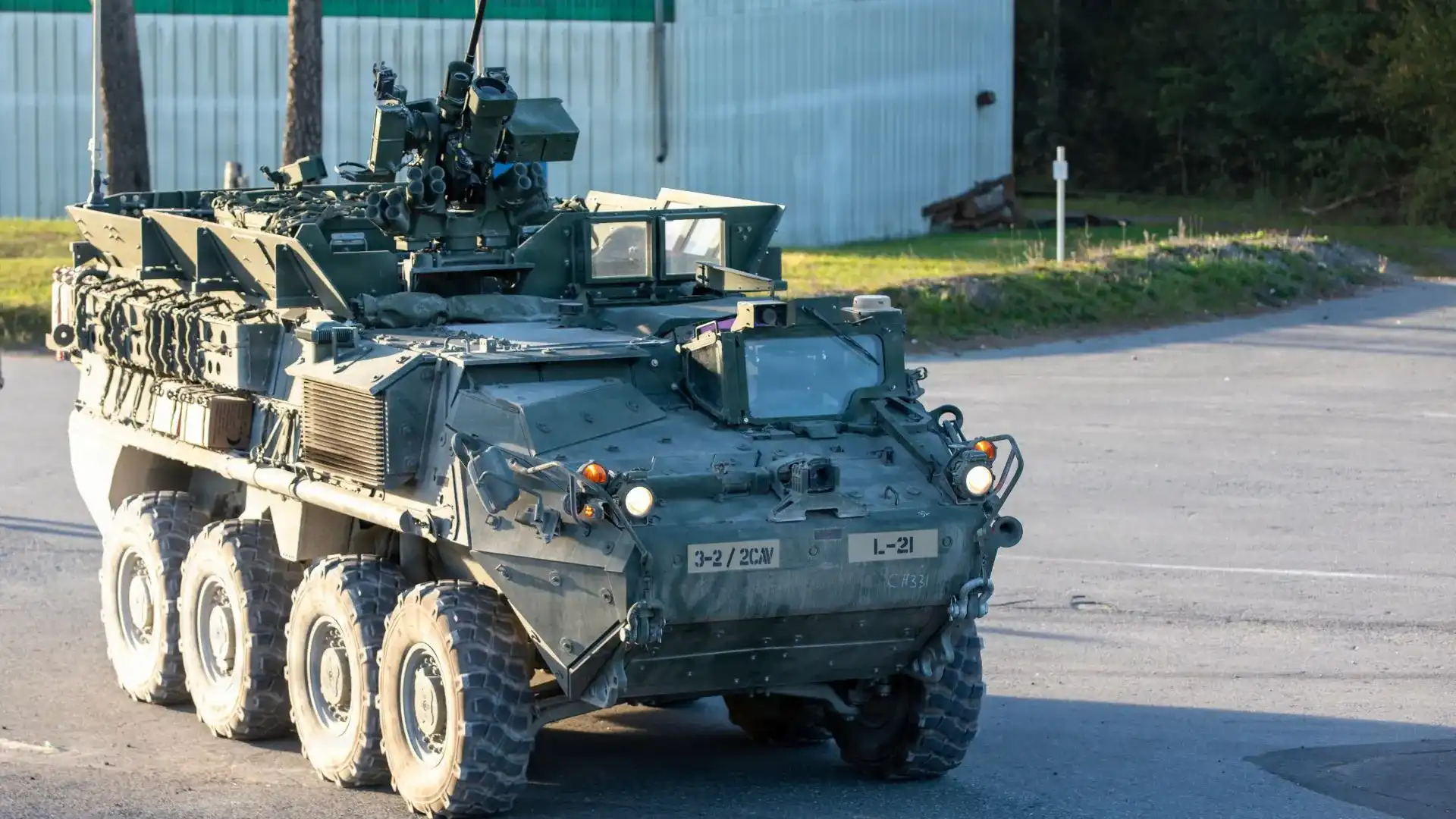
General Dynamics Land Systems has received a $135,940,076 contract modification from the US Army to establish pricing for complete Stryker Enhanced Power Distribution Unit (EPDU) Version 2 retrofit kits, the Pentagon announced on October 26, 2026. The modification, P00005 to contract W912CH-25-D-0050, raises the contract’s cumulative face value to $162,413,191, with work expected to run through August 8, 2030. Army Contracting Command, Detroit Arsenal, Michigan, is the contracting activity.
Before this action, the contract’s face value stood at roughly $26.5 million, so the new pricing lifts it more than sixfold. The EPDU sits at the core of the Stryker Double V-Hull A1 (DVH A1) electrical architecture, and the retrofit lands in an unusual budget setting: the Army’s fiscal 2026 request halted further DVH A1 procurement under the Army Transformation Initiative (ATI), yet the service has kept buying A1 vehicles with congressionally added funds and financing upgrades for hulls already in the fleet.
Inside the Stryker Power Distribution Unit and the DVH A1 Electrical Backbone
The original EPDU entered the fleet with the DVH A1 engineering change proposal (ECP), which the Army pursued to recover the mobility, power, and network capacity lost to the heavier double V-hull. According to Pentagon test reporting from the Director, Operational Test and Evaluation (DOT&E), a single EPDU replaced the legacy Power Distribution Panel (PDP) and Power Distribution Panel 2 (PDP2), while a 910-amp alternator replaced the previous 570-amp unit, sized for future network upgrades with 20 percent growth margin.
The electrical rework came with a mechanical one. Publicly available specifications indicate the ECP swapped the 350-horsepower Caterpillar C7 diesel for a 450-horsepower Caterpillar C9, improved power pack thermal management, and raised gross vehicle weight rating from 55,000 to 63,000 pounds. It also added an in-vehicle network built to the Army’s Vehicular Integration for C4ISR/EW Interoperability (VICTORY) standards, with gigabit Ethernet shared across crew stations. In its fiscal 2019 assessment, DOT&E found that DVH A1 power generation could run all mission command systems with margin left for future network integration.
The EPDU is what allocates that margin. It routes alternator and battery power to radios, mission command computers, sensors, and mission equipment packages across seven A1 variants, from the M1256A1 Infantry Carrier Vehicle to the M1252A1 Mortar Carrier Vehicle, and the Maneuver Short-Range Air Defense (M-SHORAD) Increment 1 system shares the same A1 power architecture. Distribution capacity, not alternator output alone, helps determine how much new equipment a vehicle can absorb.
The announcement does not describe the V2 configuration, and no public technical data on it has been released. Kit quantities, unit cost, installation sites, and the brigades slated to receive the retrofit are also unknown.
Retrofit Kits Arrive as the Army Reshapes Its Stryker Brigades
The contract is sole-source and order-driven. The Army solicited one bid and received one, consistent with General Dynamics Land Systems’ role as Stryker original equipment manufacturer. Work locations and funding will be set with each order, so the figure establishes pricing rather than obligating funds for a fixed quantity. The reference to a complete kit suggests a full installation package rather than standalone spares, though the announcement does not itemize its contents.
The award extends a steady run of 2026 Stryker spending. In April, General Dynamics received a $44.4 million modification for Maintenance and Training Module and Squad Leader Display Version 3 kits for DVH A1 vehicles. In May, it won $230 million to build 50 DVH A1 vehicles, followed in August by a $54.3 million sustainment contract running through August 24, 2031. In September, a $49.3 million modification for additional DVH A1 vehicles brought a contract awarded earlier in the year to $278.9 million.
Force structure is moving in two directions. The Pennsylvania Army National Guard’s 56th Stryker Brigade Combat Team became a Mobile Brigade Combat Team in March 2026, trading Strykers for Infantry Squad Vehicles, and Washington’s 81st Stryker Brigade Combat Team is following the same path. In the active force, the 3rd Armored Brigade Combat Team, 4th Infantry Division, is converting from Abrams tanks and Bradley Fighting Vehicles to Strykers. The Government Accountability Office has also reported that the Stryker fleet missed its mission-capable goal in each of the 10 years it reviewed, a readiness backdrop the retrofit cannot ignore.
Analysis: The money is following electrical headroom rather than hull count. At $135.9 million, the EPDU V2 pricing equals more than half the May award for 50 new vehicles, suggesting the Army is prioritizing the power backbone of a fleet it intends to keep. Counter-unmanned aircraft systems, electronic warfare kits, and Next Generation Command and Control (NGC2) nodes all compete for the same onboard power, and the Army’s 50-kilowatt Directed Energy M-SHORAD prototypes needed dedicated power management and cooling to operate on a Stryker. A modernized distribution layer should let the service insert such payloads across existing brigades without reopening a DVH A1 line it sought to wind down. The tradeoff is dependence: with a single bidder and no public V2 specifications, cost discipline rests on order-by-order negotiations.
The first delivery orders should clarify kit quantities, unit pricing, funding sources, and installation sites. Upcoming Army budget justification documents may also show whether EPDU V2 is tied to specific mission packages, such as M-SHORAD or NGC2, and whether the converting 4th Infantry Division brigade will receive it. The effort runs through August 2030, leaving its final scope exposed to further ATI force structure decisions.