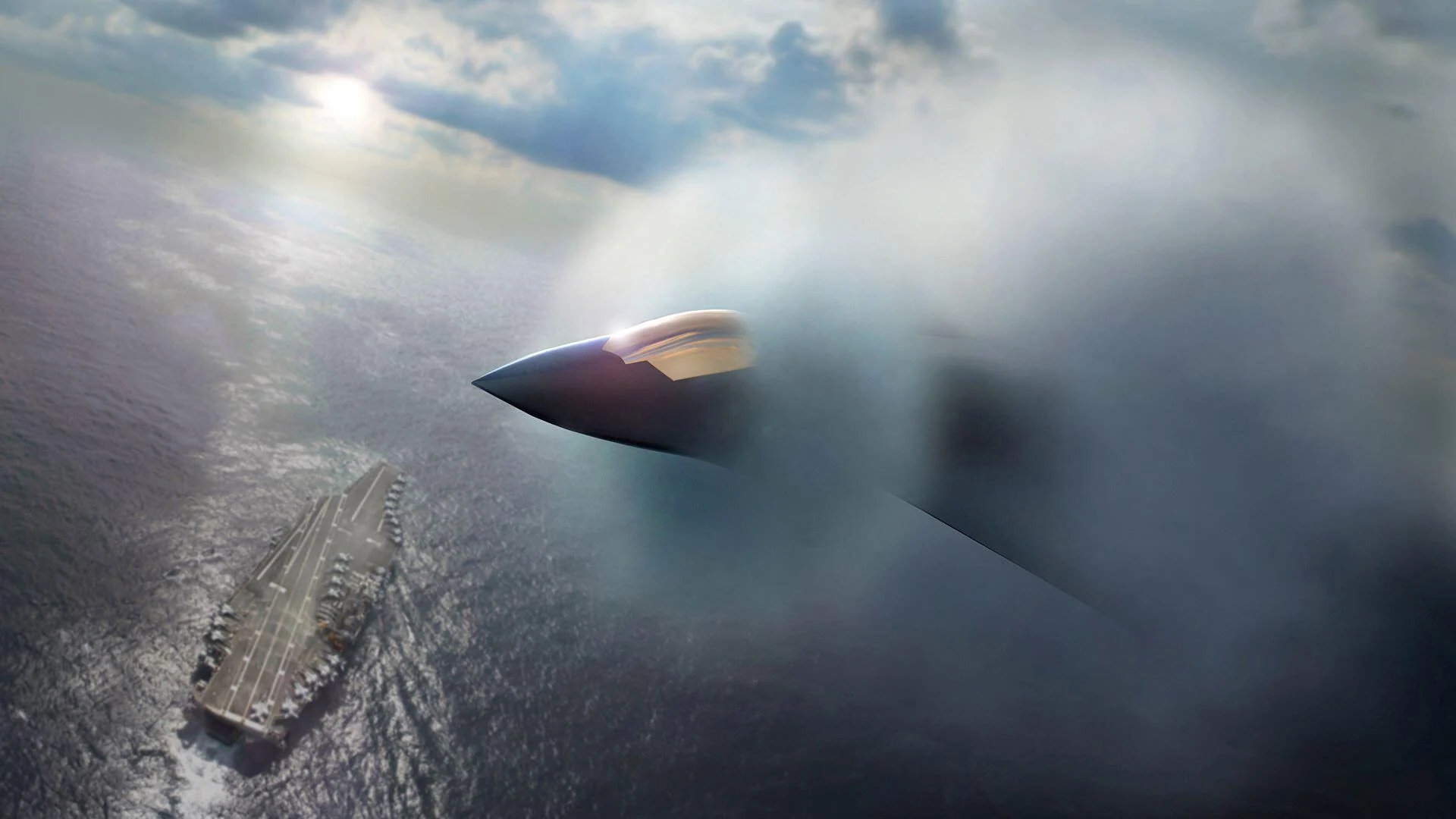
Boeing’s Defense, Space & Security (BDS) segment reported third-quarter 2026 revenue of $7.94 billion on October 27, 2026, a 15 percent increase year over year, while segment operating earnings rose to $492 million from $114 million and backlog reached a record $101 billion. That backlog does not yet include the U.S. Navy’s F/A-XX sixth-generation fighter, which Boeing will book only after the service completes its source selection and evaluation review.
The defense numbers landed inside a company still in recovery. Boeing posted total revenue of $24.19 billion, up 4 percent, and GAAP operating earnings of $354 million against a $4.78 billion loss a year earlier, when a 777X charge hit the books. Total backlog climbed to a record $745 billion. BDS now generates 33 percent of company revenue, and it grew while Boeing Commercial Airplanes (BCA) lost another $697 million on $10.72 billion in sales.
Boeing Defense Revenue and Margins: What Drove the Third Quarter
BDS operating margin reached 6.2 percent, up from 1.7 percent a year earlier, but the headline flatters the underlying business. The figure includes a $252 million gain on the sale of HRL Laboratories, the research venture Boeing co-owned with General Motors, to IBM, a transaction IBM completed in August 2026. Stripping out that gain leaves roughly $240 million in earnings and an operating margin near 3.0 percent. That still beats the prior-year quarter, but it confirms BDS remains a low-margin business; year to date, the segment earned $710 million on $23.02 billion, a 3.1 percent margin.
BDS delivered 33 aircraft and satellites in the quarter, against 32 a year earlier. KC-46A Pegasus tanker deliveries rose to seven from four, bringing the nine-month total to 15 versus nine in 2025. Apache output shifted toward remanufacture, with 12 remanufactured AH-64s and three new aircraft, compared with seven and eight. The quarter also included two F-15s, two F/A-18s and three CH-47 Chinooks; no P-8 Poseidon was delivered.
F/A-XX Award, PAC-3 Seeker Expansion, and a Record Defense Backlog
The U.S. Navy announced on September 29, 2026, that Boeing had won the F/A-XX competition against Northrop Grumman. The full-scale development contract, valued at more than $20 billion, covers multiple test aircraft for the carrier-based fighter, which is expected to begin replacing the F/A-18E/F Super Hornet and EA-18G Growler in the 2030s. The award follows the U.S. Air Force’s selection of Boeing for the F-47 Next Generation Air Dominance (NGAD) fighter in March 2025, leaving one company in charge of both crewed U.S. sixth-generation fighter programs. The Navy has disclosed few specific capabilities, saying they remain under development.
The capital load is already visible. Company-wide additions to property, plant and equipment reached $1.03 billion in the quarter and $3.04 billion over nine months, up from $1.99 billion, with Boeing citing higher investment at its St. Louis and Charleston, South Carolina, sites. In St. Louis, Boeing is building a secure fighter production facility it describes as the largest in the United States.
Missile defense supplies a second growth vector. BDS secured a seven-year contract to expand production of the PAC-3 seeker, the Ka-band radar seeker Boeing builds in Huntsville, Alabama, for the PAC-3 Missile Segment Enhancement (MSE) interceptor fired by Patriot batteries. With interceptor demand elevated by U.S. stockpile replenishment and allied orders, the seeker line offers multi-year revenue visibility. BDS backlog rose to $100.5 billion from $84.8 billion at the end of 2025, an 18.5 percent increase in nine months, with 23 percent, or roughly $23 billion, from international customers.
Boeing Global Services (BGS) added a U.S. Army Apache fleet maintenance award and earned $1.02 billion at an 18.3 percent margin.
Analysis: Government-facing work now carries Boeing. BDS and BGS together generated $1.51 billion in segment operating earnings, more than offsetting the BCA loss and exceeding Boeing’s total GAAP operating earnings of $354 million. Yet the defense recovery remains thin. An underlying margin near 3 percent leaves little cushion for developing F-47 and F/A-XX concurrently from the same St. Louis workforce and supply base, while fixed-price programs such as the KC-46A and T-7A Red Hawk still carry execution risk. With $45.9 billion in consolidated debt against $20.7 billion in cash and marketable securities, Boeing has limited room to absorb another round of program losses. How the Navy structures F/A-XX risk sharing will shape BDS profitability for the next decade.
The next milestone is completion of the Navy’s source selection and evaluation review, which will allow Boeing to book F/A-XX and reveal more of its scale. A first-flight date has not been disclosed. Commercially, Boeing is moving 737 production toward 47 per month and targets first 777X delivery in 2027. Chief Executive Officer Kelly Ortberg said the company is “not done,” naming Lean and disciplined execution as the priority. Fourth-quarter results will show whether BDS can sustain margin gains without one-time divestiture income.