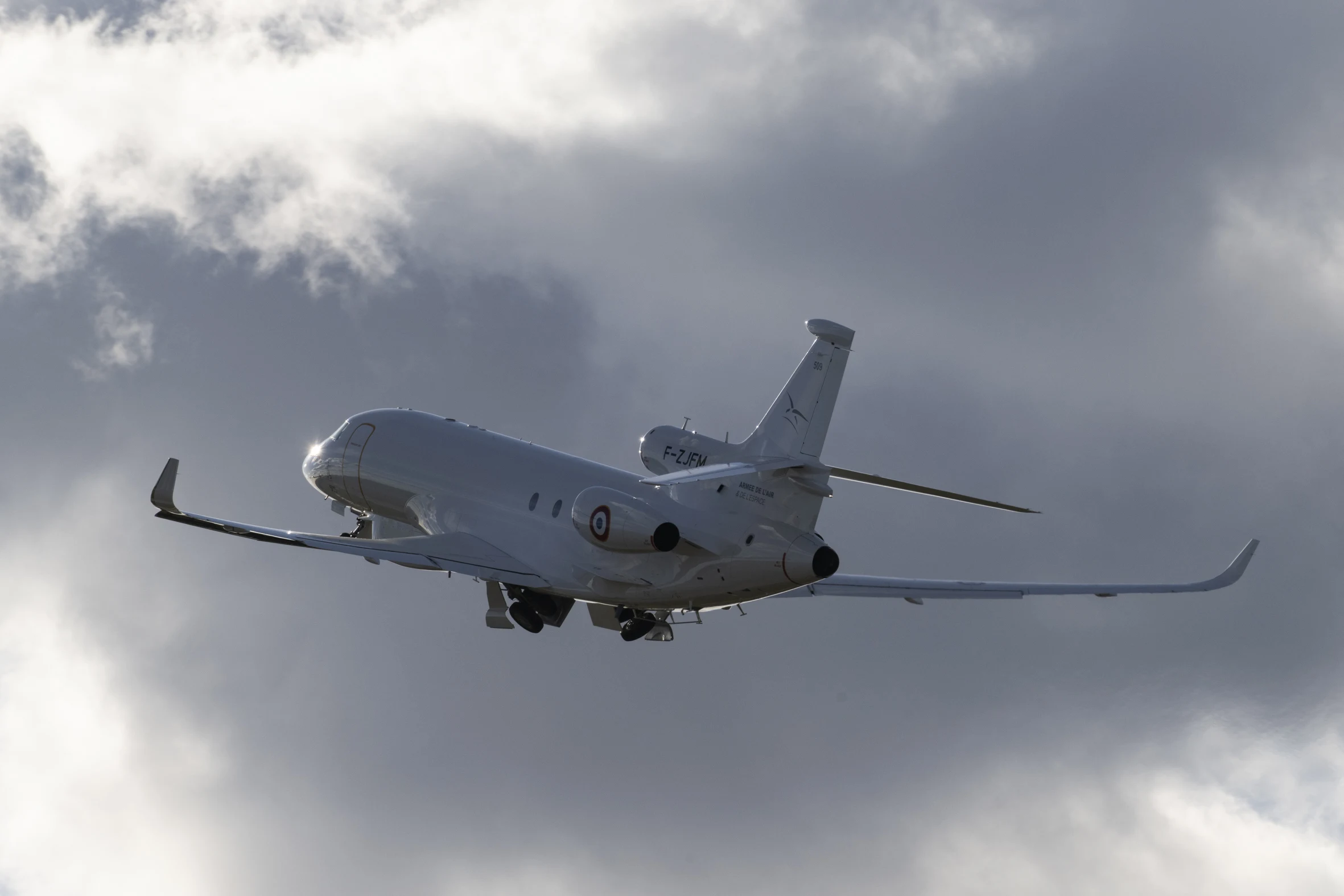
France’s Falcon 8X ARCHANGE signals intelligence aircraft landed for the first time at Air Base (BA) 105 Évreux on October 7, 2026, the Normandy base from which the French Air and Space Force (Armée de l’Air et de l’Espace, AAE) will operate it. The Air Warfare Center (Centre d’expertise aérienne militaire, CEAM) conducted loading and operating trials of operational equipment on the jet at its future home station.
ARCHANGE (Avions de Renseignement à CHArge utile de Nouvelle GEnération) is meant to close a gap the AAE has carried since 2022, when it retired its two Transall C-160G Gabriel electronic intelligence aircraft. Then-Armed Forces Minister Florence Parly launched the program in November 2019, and the Directorate General of Armaments (Direction générale de l’armement, DGA) awarded Thales and Dassault Aviation the contract on December 30, 2019, initially covering two airframes. Planning under the 2019-2025 military programming law targeted a first system from 2025. The current objective, per the Ministry of the Armed Forces, is delivery of three aircraft and three ground systems around 2028-2029.
Falcon 8X ARCHANGE Mission: Rebuilding French Airborne SIGINT
The AAE assigns ARCHANGE a strategic signals intelligence (SIGINT) role, which French doctrine terms ROEM (renseignement d’origine électromagnétique): collecting and exploiting adversary electromagnetic emissions to map an opponent’s force posture and operating environment. According to the AAE, the system will update and disseminate the adversary electronic order of battle in real time and feed the electronic warfare databases and libraries used to prepare air missions.
That second function carries the larger operational payoff. Threat libraries determine how radar warning receivers and self-protection suites identify and respond to emitters. Outdated libraries degrade aircrew survivability in precisely the contested airspace the AAE cites as a priority for ARCHANGE, notably during air raids.
The mission payload is the Thales Universal Electronic Warfare Capability (Capacité universelle de guerre électronique, CUGE), matured under several DGA advanced study programs. Thales produces all payload sensors and acts as overall system integrator aboard the Dassault airframe. Published program information describes multi-polarization antennas and artificial intelligence-assisted automated processing, allowing the system to detect and analyze radar and communications signals simultaneously, covering both electronic intelligence (ELINT) and communications intelligence (COMINT) in a single payload. Ministry documentation adds that CUGE connectivity supports near-real-time processing in flight and on the ground, along with onward sharing of collected data. Frequency coverage, sensitivity, geolocation accuracy, and the number of operator stations have not been disclosed.
Falcon 8X Airframe and Évreux Trials on the Road to Service
The carrier is Dassault’s Falcon 8X, a long-range trijet derived from the Falcon 7X. Publicly available specifications indicate three Pratt & Whitney Canada PW307D turbofans rated at 6,722 lbf of thrust each, a 51,000 ft (15,545 m) maximum operating altitude, and a range of 6,450 nautical miles in business configuration. The Ministry of the Armed Forces lists a maximum speed of Mach 0.9 at 15,500 m for the ARCHANGE variant. No absolute endurance figure has been published for the SIGINT configuration; the Ministry states only that on-station endurance will be two to three times that of the C-160G. Imagery of the aircraft shows an extended ventral fairing under the fuselage housing mission antennas.
Compared with the turboprop C-160G it replaces, the jet transits faster and operates far higher, which widens collection reach. Basic radio-horizon geometry gives a platform at 40,000 ft line of sight to surface emitters beyond 400 km, enabling standoff collection from outside many ground-based air defense envelopes.
The Évreux trials were run by the CEAM’s ARCHANGE ROEM 11.334 test team, working with DGA Flight Testing (DGA Essais en vol), Dassault Aviation, and Thales, with support from Airborne Electronic Squadron (Escadron électronique aéroporté) 5/64 “Dunkerque.” The team is leading the program’s technical-operational experimentation, verifying that system performance matches force requirements and defining the conditions for operational employment. On October 8, 2026, the aircraft and its mission system were presented to the AAE Chief of Staff and senior military and civilian officials during an AAE capabilities presentation organized at Évreux by the Institute for Higher National Defense Studies (Institut des hautes études de la défense nationale, IHEDN). The ARCHANGE configuration made its first flight in July 2025.
Analysis: ARCHANGE’s arrival at Évreux confirms progress, but the timeline remains the program’s main vulnerability. France retired the Gabriel in 2022, three years earlier than originally planned, and fielding of the full ARCHANGE fleet is now pegged to 2028-2029, leaving a six-to-seven-year gap before a strategic successor enters service. The Ministry has bridged part of it with the SOLAR contract, which the Director of Military Intelligence told the National Assembly in 2023 would provide a leased airborne electromagnetic intelligence capability over 2024-2028, alongside the CERES electronic intelligence satellite constellation. The choice of a business-jet carrier aligns France with Germany, whose PEGASUS program places a Hensoldt SIGINT system on the Bombardier Global 6000. With only three airframes, availability rates and crew generation will determine how much persistent coverage the AAE can actually sustain.
Next steps are the completion of CEAM experimentation and the delivery of three aircraft and three ground systems targeted for 2028-2029, alongside the ground-based training platform included in the program. Several parameters remain undisclosed: total program cost, mission-configuration endurance, crew composition, and a firm initial operational capability date.