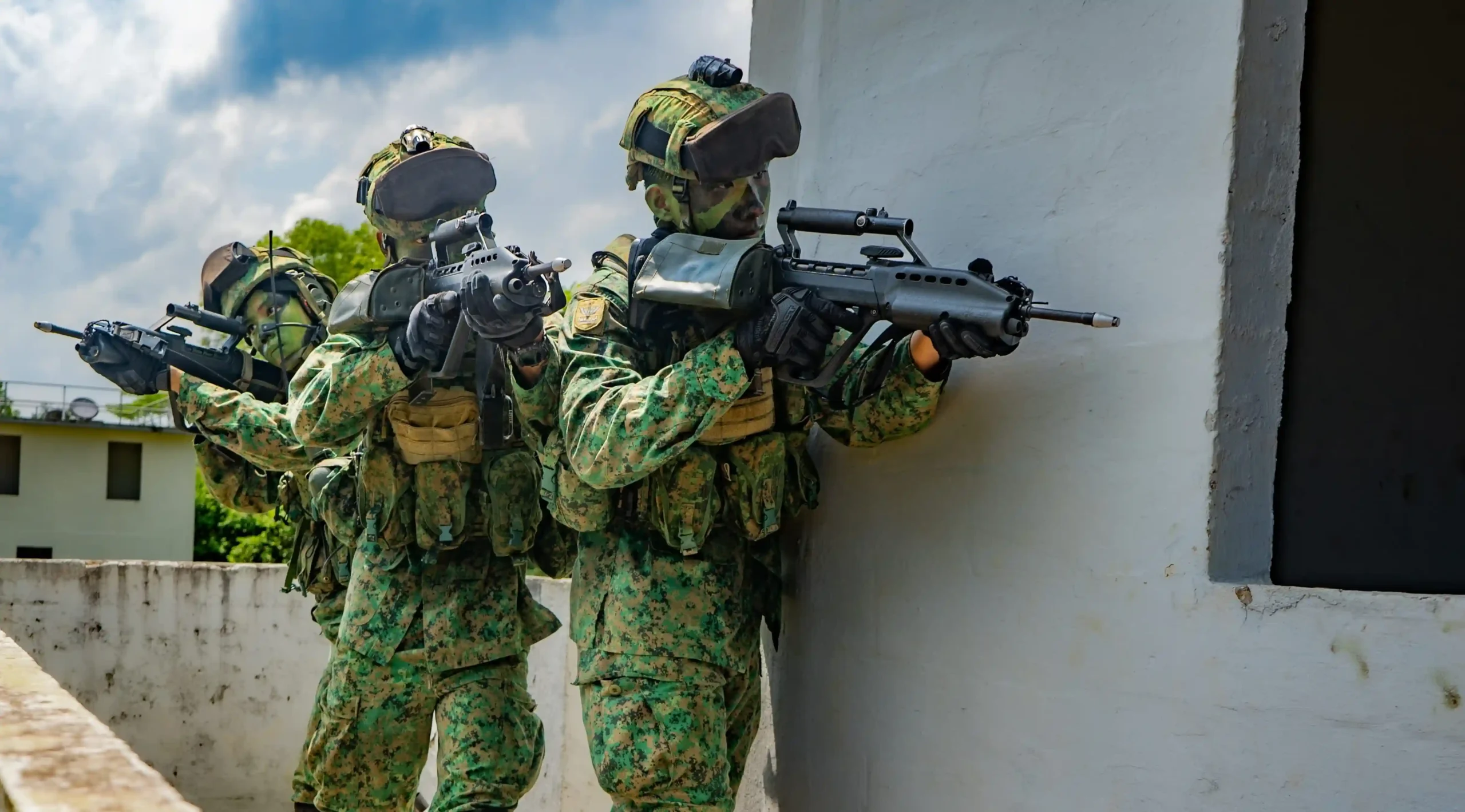
The Singapore Army has unveiled its Next Generation Infantry Battalion (NGIB), a restructured infantry formation that splits each rifle company into five platoons of two six-man sections and adds two dedicated drone sections per company, the Ministry of Defence (MINDEF) announced on October 26, 2026. The 5th Battalion, Singapore Infantry Regiment (5 SIR) is validating the full construct at Exercise Wallaby, held at the Shoalwater Bay Training Area in Queensland, Australia.
The NGIB is the infantry component of the Next Gen Singapore Armed Forces (SAF) plan, which MINDEF outlined in March 2022 as a force taking shape by 2040. It follows the 2011 conversion of 2 SIR into the Army’s first motorized battalion on Terrex infantry carrier vehicles, and a drone push that has seen every Basic Military Training recruit learn to fly and counter drones since July 2025. MINDEF frames the NGIB around three ideas: fight smarter, integrate better and stay future ready.
Next Generation Infantry Battalion Company Structure: Five Platoons, 10 Sections
Under the previous motorized structure, a rifle company fielded three platoons of three seven-man sections, or nine sections. The NGIB company fields 10 rifle sections of six soldiers each, grouped in five platoons. MINDEF’s fact sheet illustrates the intent: one platoon secures a building, a second clears a route and a third covers a key junction, while two remain in reserve. Sub-units regroup as the situation changes, giving commanders more maneuver elements.
Each company also gains two Steel Net Sections dedicated to unmanned systems, including surveillance and attack drones, which can themselves be task-organized by mission. Reporting from the exercise indicates that each Steel Net Section comprises two three-person teams partly crewed by reassigned general-purpose machine gun operators, and that company strength and Terrex allocation are unchanged, with one vehicle per section. MINDEF has not published full battalion establishment tables.
Chief Infantry Officer Brigadier-General Fairoz Hassan has described the underlying logic as machine-first: unmanned systems take on reconnaissance and strike tasks in high-risk areas before soldiers are committed. Army officials have stressed that the goal is more capability per soldier, not a smaller force.
Vesper and Artos Drones: Building a Company-Level Sensor-to-Shooter Chain
The Steel Net Sections operate the Vesper unmanned aerial system from US firm Vantage Robotics and the Artos attack drone from ST Engineering as a surveillance-and-strike pair: Vesper locates the target, then Artos delivers a payload. Manufacturer specifications describe Vesper as a quadcopter of roughly 700 grams with up to 50 minutes of endurance, a top speed of 72 km/h and a video datalink range of 4 km with a standard antenna or 8 km with a directional antenna. Its stabilized gimbal pairs dual electro-optical cameras with a thermal imager, giving the company organic night detection. MINDEF has not released Artos performance figures; the Army confirms only that its payload is configurable by mission.
The connective tissue matters as much as the airframes. The RC3 universal controller, a joint project of the Defence Science and Technology Agency (DSTA) and the Army, pairs with every drone type in the NGIB inventory, cutting training load and field logistics. Every section commander now carries the handheld Battlefield Management System (BMS) (Soldier), which shares friendly and enemy positions, danger areas and routes in real time and sustains coordination when voice radio fails. DSTA has said a future objective is drone control directly from vehicles. Above the battalion, the NGIB draws on Armour, Combat Engineers, Intelligence, Fires and air support across the SAF.
Colt LMG and Titan IFV Anchor the NGIB Hardware Roadmap
The fact sheet names two hardware programs. The new Light Machine Gun (LMG) is the Colt Infantry Automatic Rifle 6940E-SG, which replaced ST Engineering’s 5.56 mm Ultimax 100 Section Automatic Weapon, in service since 1982. Fielded from April 2024, it reached all active units by July 2024. DSTA lists a 600 m effective range for the closed-bolt weapon, which is shorter and lighter than its predecessor and carries a red dot sight, a 3x magnifier and a four-mode laser aiming device.
The second is the Next-Generation Infantry Fighting Vehicle (NG IFV), named Titan. MINDEF awarded ST Engineering a production contract in December 2025 for IFVs based on the Terrex s5 8×8, with deliveries from 2028; quantity and value were not disclosed. Publicly available specifications indicate a 35,000 kg gross vehicle weight with 13,000 kg of payload, a 711 hp turbo diesel, a 120 km/h top speed, roughly 1,000 km of road range and seating for two crew plus 10 troops. MINDEF said in March 2025 that the vehicle will carry a 30 mm cannon on its remote weapon station with counter-drone capability. Whether Singapore ordered the hybrid electric drive option, which offers 50 km of silent running, remains unconfirmed.
Analysis: The NGIB is less a technology insertion than a reallocation of combat power inside the rifle company. Section size drops from seven to six and, per exercise reporting, belt-fed gunners move into drone teams, so the Army is betting that an organic surveillance-strike pair with several kilometers of reach does more for a company commander than another machine gun in the line. The Colt rifle and vehicle-mounted weapons will have to carry more of the suppression load. The bet suits a force built for urban and close terrain, but it shifts risk onto the electromagnetic spectrum: MINDEF has said nothing public about the datalink resilience or electronic warfare hardening of the Steel Net kit, and the Chief Infantry Officer has acknowledged that powering drones in the field remains an open problem.
Next, 5 SIR is scheduled to conduct platoon urban operations live-firing at the training area’s Urban Operations Live-Fire Facilities on October 28, the first time full-time National Servicemen will fire there, before Exercise Wallaby closes on November 2. MINDEF has set no fixed timeline for converting other battalions or reservist units. The Titan arrives from 2028, while DSTA and industry work on swarm drones, counter-unmanned aerial systems (C-UAS) and unmanned ground vehicles (UGVs) for future NGIB iterations.