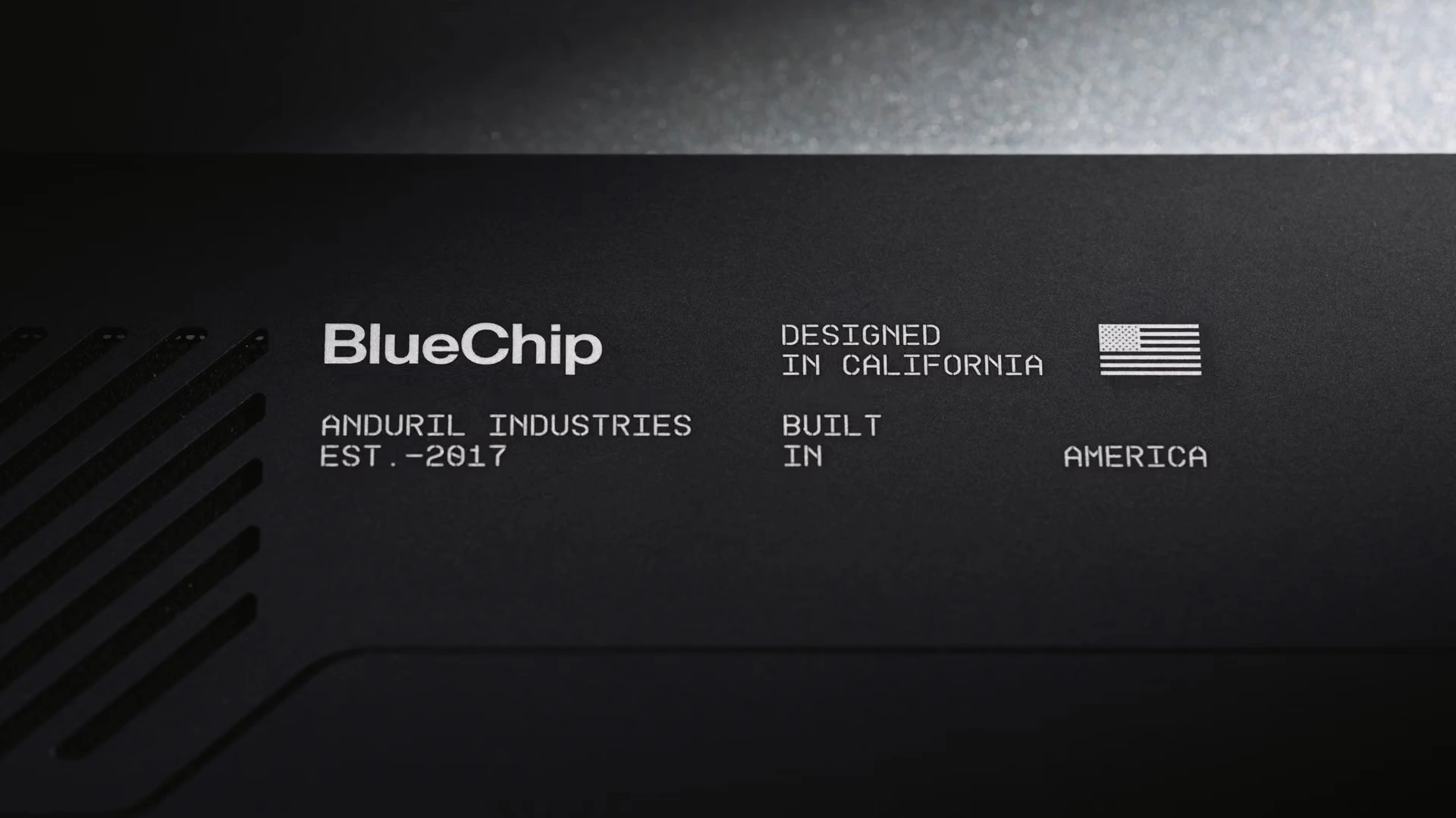
Anduril Industries and Qualcomm Technologies unveiled BlueChip on October 27, 2026, a computing product line intended to rebuild domestic computer manufacturing, starting with a ruggedized laptop designed and assembled in the United States for government, defense, first responder, and public safety users. Anduril has built functional prototypes and plans to begin taking orders in 2027, with Qualcomm’s Snapdragon X Series supplying general-purpose processing, graphics, and on-device artificial intelligence (AI).
The launch formalizes a concept Anduril co-founder Palmer Luckey first floated in July 2025 at the Reindustrialize summit in Detroit, when he asked the audience how many of them would buy a more expensive American-made computer. The two companies frame BlueChip as a response to a national security vulnerability: decades of offshoring have left US government networks and critical infrastructure dependent on foreign-built computers and components, a supply that a conflict or trade disruption could cut off. The effort is privately funded: according to Luckey, no US government contract or subsidy has been awarded.
Anduril BlueChip Laptop: Snapdragon X Architecture and Rugged Design
The Snapdragon X Series is Qualcomm’s Arm-based PC platform, integrating Oryon CPU cores, an Adreno graphics processor, and a Hexagon neural processing unit (NPU) on a single system-on-chip. Publicly available specifications indicate first-generation Snapdragon X chips carry an NPU rated at 45 trillion operations per second (TOPS), and second-generation Snapdragon X2 Elite parts reach 80 TOPS. Which tier BlueChip uses has not been disclosed.
That NPU is central to the defense use case. Luckey described the chips as well suited to AI inference rather than model training, and said he already runs local models on his own BlueChip unit for information he is not permitted to send to cloud services. For users handling controlled or classified data, onboard inference removes the dependency on a connected data center.
Military requirements set the design baseline. “This is aimed squarely at the defense side of things,” Luckey told reporters, citing the most demanding security, environmental, shock, and vibration conditions. Anduril has not published a ruggedization standard such as MIL-STD-810H, nor weight, display size, battery capacity, or pricing. Luckey has estimated a premium of about 20 percent over typical high-end PCs.
Software compatibility is the practical test. The prototypes run Windows and two Linux distributions widely used across the US military, with Anduril validating drivers and applications on each. That matters because much legacy defense software is built for x86 processors, not Arm. Anduril has also integrated its Lattice platform, in both its local-processing version and the version that commands systems operating at the edge. Lattice underpins initiatives including the Army’s Next Generation Command and Control (NGC2) effort.
Arsenal-1, TSMC Arizona, and the 90 Percent Supply Chain Target
Circuit board assembly is planned at Arsenal-1, Anduril’s production campus in Ohio, where the company is also building the Fury YFQ-44A for the Air Force’s Collaborative Combat Aircraft (CCA) program. Qualcomm president and CEO Cristiano Amon said the processors will be fabricated at TSMC’s facility in Arizona. Other sites, including in California, are involved, and the split of manufacturing steps remains in flux.
Components from US and allied suppliers account for more than 90 percent of the prototypes’ component procurement cost, according to Anduril, and Luckey said the goal is 100 percent. Some components, including the display, are made only in China, according to Luckey, although he has found a US supplier for the display glass. The companies describe a phased approach: expand domestic sourcing and manufacturing first, then eliminate reliance on foreign suppliers, reusing designs and supplier relationships from the first laptop for later BlueChip products.
Production remains at an early stage. Anduril is running a small prototyping line to build out the manufacturing process and will not enter full-rate production until 2027. Luckey declined to give quantities, citing uncertainty in manufacturing and among vendors, and Anduril has not finished contracting with all of its component suppliers.
Analysis: BlueChip’s strategic value lies less in a single laptop than in the supplier base it forces into existence. The gap between “assembled in America” and “made in America” sits in the remaining share of the bill of materials, under 10 percent by cost, which the companies have not itemized beyond Luckey’s example of the display, a component he said is made only in China. Requalifying those parts domestically is where cost and schedule risk concentrate. For the Pentagon, a trusted Arm-based edge computer running Lattice locally fits tightening scrutiny of foreign-origin electronics, but without a program of record BlueChip must compete in an established rugged market against Panasonic, Dell, and Getac on price and certification, not on provenance alone.
Orders open in 2027. The next markers are disclosed production quantities, signed supplier agreements, a published ruggedization and security certification baseline, final pricing, and a first contract from a military service or federal agency. Luckey framed the floor case as a low-volume product for government and critical industries, and said future BlueChip form factors will likely be built at other facilities.