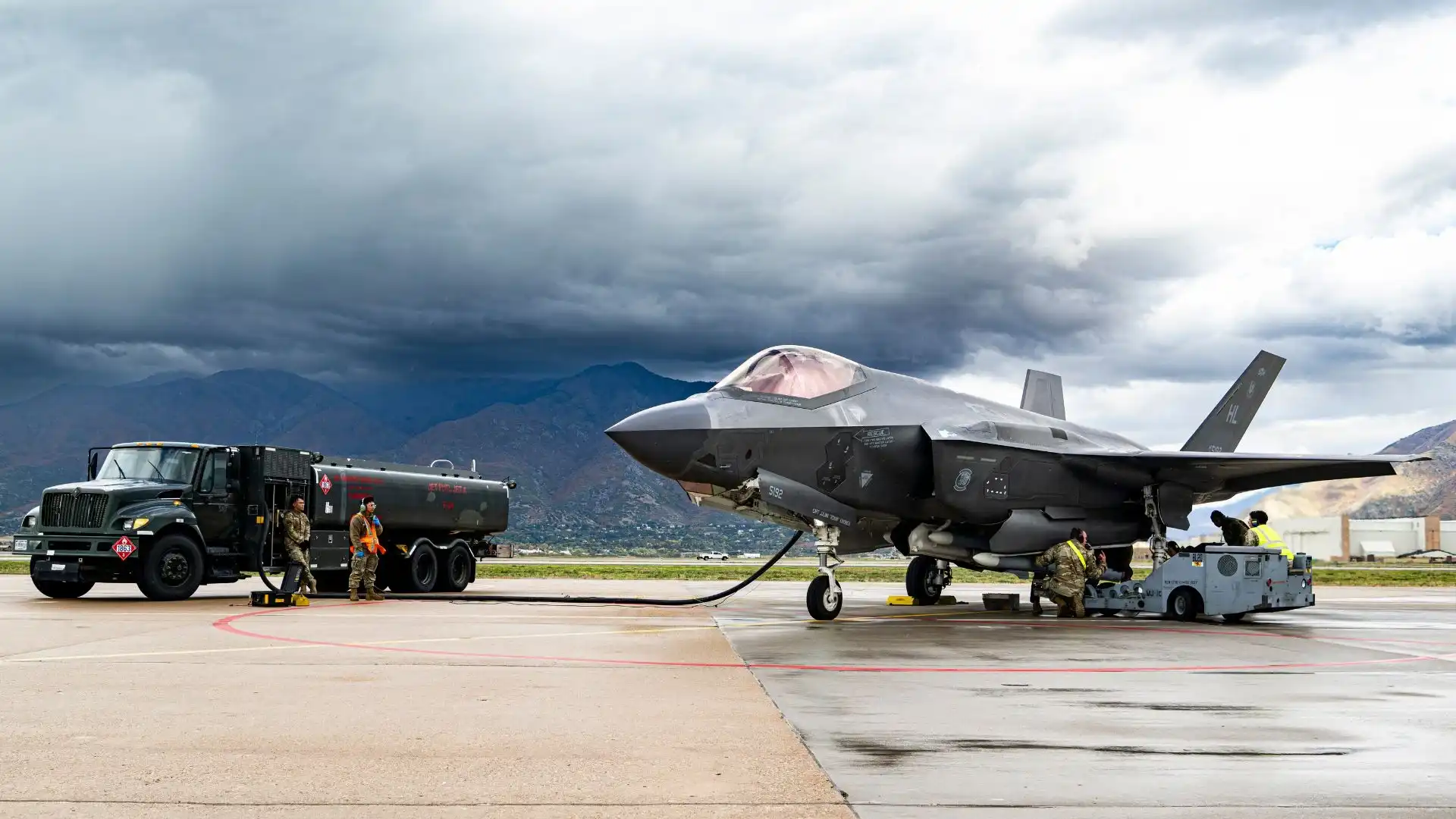
Naval Air Systems Command (NAVAIR) awarded Lockheed Martin a $13.26 million cost-plus-fixed-fee, level-of-effort modification on October 27, 2026, to continue integrating the F135 Engine Core Upgrade (ECU) into the F-35 Lightning II and to move the fighter’s power thermal management upgrade into preliminary design. Modification P00006 definitizes an undefinitized contract action under delivery order N0001925F0120 and adds 50,000 labor hours, with completion scheduled for April 2027, according to the Pentagon.
The award binds together the two propulsion-side fixes the F-35 needs for Block 4 and beyond. The Government Accountability Office (GAO) has found that the jet’s existing Power and Thermal Management System (PTMS) is overtasked, forcing the F135 to operate beyond its design parameters, which increases engine wear, shortens engine life and could add about $38 billion in maintenance costs. The Department of Defense selected the ECU in March 2023 over a GE adaptive engine developed under the Adaptive Engine Transition Program (AETP), which the GAO found would not fit the F-35B without a major redesign.
F135 Engine Core Upgrade Integration Moves Toward Ground Testing
The modification falls under basic ordering agreement N0001924G0010. As F-35 prime contractor, Lockheed Martin integrates the upgraded core into all three variants: the conventional takeoff F-35A, the short takeoff and vertical landing F-35B and the carrier-based F-35C. At $13.26 million for 50,000 hours, the order averages roughly $265 per labor hour. No funds were obligated at award, and the action was not competitively procured.
The effort supports the US Air Force, Marine Corps and Navy as well as the F-35 Cooperative Program Partners. Fort Worth, Texas, carries 47 percent of the work, followed by Torrance, California, at 13 percent. Two British sites, Blackburn and Cheltenham, account for 6 percent each, with the remainder spread across California, Texas, Indiana, Connecticut, Illinois and Florida.
The ECU itself is a drop-in modification of the F135 core rather than a new engine, designed to restore full engine life while adding thrust, electrical power and thermal capacity. Pratt & Whitney announced on September 15, 2026, that the upgrade had completed its Risk Reduction Design Review. A separate $240.8 million modification awarded to the engine maker in late August 2026 moves the ECU into engineering and manufacturing development. The Air Force expects ground testing in late 2027 and flight tests around 2030, while the GAO expects production to begin in 2031.
F-35 Power Thermal Management Upgrade Heads Into Preliminary Design
The second line of effort covers the Power and Thermal Management Unit (PTMU) upgrade. Honeywell describes the PTMS as performing 14 mission- and safety-critical functions, acting as auxiliary power unit, emergency power unit, environmental control system and thermal management system. The in-service system delivers about 32 kilowatts of cooling, against an 80-kilowatt objective the F-35 Joint Program Office (JPO) set in a request for information.
Honeywell Aerospace, the incumbent, announced a P40 upgrade on September 22, 2026, that raises capacity to 40 kilowatts through software changes and liquid-cooling improvements, expects fielding between 2029 and 2030 and says the architecture could eventually support 62 kilowatts or more. Collins Aerospace, an RTX business like Pratt & Whitney, offers the Enhanced Power and Cooling System (EPACS) as a replacement for the current PTMS. EPACS demonstrated 80 kilowatts of cooling capacity in January 2024 and completed altitude testing in August 2026.
The JPO said in October 2024 that Lockheed Martin was the only entity capable of leading the next phase of the upgrade. The contract notice does not identify which architecture, Honeywell’s or Collins’, enters preliminary design.
Analysis: The value of this award lies in what it couples, not in its size. Lockheed Martin found as early as 2008 that the PTMS needed more engine bleed air than planned, and the F135 has carried that penalty ever since. A new core paired with an unchanged cooling system would see part of its margin consumed by that legacy penalty. By funding both integration streams on one Lockheed Martin vehicle, the program is treating engine and cooling as a single package. The GAO has noted that engine and cooling upgrades expected in the early 2030s would arrive a few years after Block 4, now projected to finish in 2029, so any slip in the PTMU decision widens that gap across the fleet.
The current order runs through April 2027. Near-term decision points include the PTMU architecture selection and its preliminary design review. The Air Force has requested $317.5 million for the F-35 propulsion enterprise in fiscal 2027, up from about $121 million in fiscal 2026, with much of the increase going to the ECU and the power and thermal management upgrade. Congressional action on that request will determine whether the 2030 flight-test target holds.