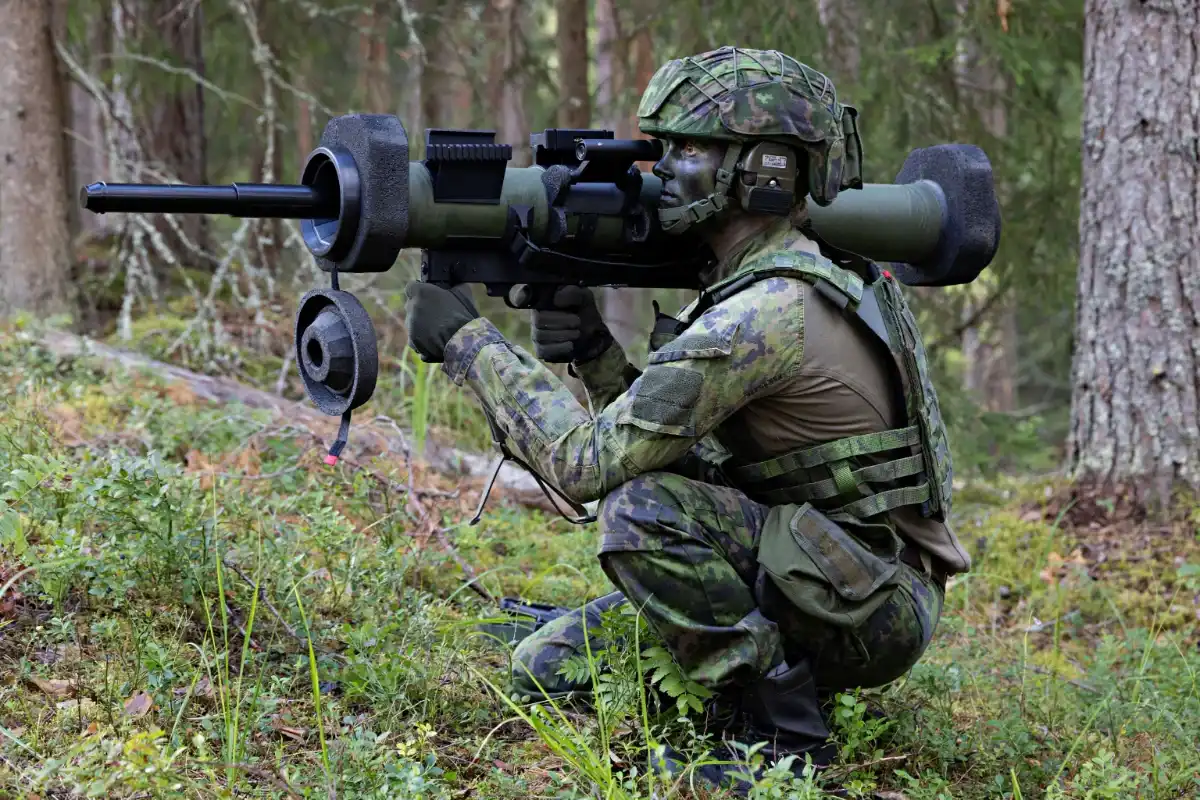
Finland’s Ministry of Defence announced on October 28, 2026, that Defence Minister Antti Häkkänen has authorized the Finnish Defence Forces to procure the RGW110 heavy disposable anti-tank weapon from Germany’s Dynamit Nobel Defence (DND). The procurement is valued at about €84.5 million excluding value-added tax, with deliveries of the system, training equipment and instruction beginning in 2027. The RGW110 will replace the French-designed APILAS, the Finnish Army’s heavy close-range anti-tank weapon since the 1980s.
The order reflects a shift in Finnish procurement toward the Army. Häkkänen said the focus of materiel spending is moving to land forces, calling the investment strategic for Finland’s defense system as a whole. Col. Ari Mure, inspector of infantry at Finnish Army Command, said the main battle tank will remain a battlefield threat and that the new system is designed to destroy tanks at close range. Neither the ministry nor the Army disclosed how many launchers are being ordered.
How the RGW110 Anti-Tank Weapon Defeats Reactive Armor
Penetration drove the selection. The Finnish Army said a modern anti-tank weapon must first clear a tank’s explosive reactive armor (ERA), then carry a caliber large enough to transfer sufficient energy through the main armor behind it. The Finnish Defence Forces compared available systems, tested the one meeting its criteria against a target with realistic armor protection, and then worked with the manufacturer to further develop the warhead. Observations from the war in Ukraine, the Army said, confirmed its earlier assessments of adversary tank protection.
The baseline RGW110 HH-T (HEAT/HESH-Tandem) fires a 110 mm tandem warhead in which a precursor charge initiates the ERA before the main shaped charge strikes. Manufacturer data indicate penetration of about 1,000 mm of rolled homogeneous armor equivalent (RHAe) behind ERA, while a HESH mode engages fortifications and lightly armored vehicles. Publicly available specifications give an effective range of up to 800 m, roughly double that of the Panzerfaust 3 the RGW110 was developed to succeed, at a weight 3 to 4 kg lighter. Finland has not said whether its order includes fire control sights such as Hensoldt’s reusable Dynahawk, which DND has displayed with the weapon.
The step up from APILAS is substantial. The 112 mm French launcher, designated 112 RSKE APILAS in Finnish service, weighs about 9 kg, and open-source figures credit its single shaped-charge warhead with roughly 700 to 750 mm of armor penetration at an effective range commonly cited at 300 to 350 m. That warhead type is precisely what ERA packages such as Kontakt-5 and Relikt, fitted to modern Russian main battle tanks, are designed to defeat.
Where the RGW110 Fits in Finland’s Layered Anti-Armor Defense
The Army describes the RGW110 as an every-unit weapon complementing a layered anti-tank capability that spans mines, main battle tanks, guided missiles and loitering munitions. Fired once and discarded, the launcher can be carried like ammunition, letting units mass fire on one target from several positions at once with a lighter logistics footprint and soldier load than crew-served guided systems. The unguided round cannot be jammed and works in any light or weather, from built-up areas to forest, in both attack and defense.
The Army acknowledged the trade-off: engagement range is relatively short. It argued that Finland’s broken, heavily forested terrain compensates by letting infantry close on armor under cover. The RGW110 sits below guided systems already in Finnish service or on order, including the Saab NLAW and Rafael’s Spike SR, LR2 and ER2, ordered in December 2022 for €223.6 million.
Hungary became the RGW110’s launch customer in 2022 through a joint venture between DND and state-owned N7 Holding, which builds components locally while warheads remain in production at DND’s plant in Burbach, Germany. Hungarian troops have since begun live-fire training with the weapon. DND is owned by Israel’s Rafael Advanced Defense Systems, co-developer of the David’s Sling air defense system Finland has also selected.
Analysis: The RGW110 purchase is about scale. Spike and NLAW give Finnish infantry reach and precision, but they are costly and stocks are finite. A disposable 110 mm round able to defeat ERA-equipped tanks at up to 800 m lets every rifle section threaten armor without drawing down scarce missile inventories, a lesson reinforced in Ukraine, where massed, inexpensive anti-armor fires have proven as relevant as high-end systems. Refining the warhead against a realistic armor target shows the Army sized this requirement against the specific protection levels it expects to face, not a generic threat.
Deliveries and training start in 2027. Key unknowns remain the quantity ordered, which will determine how widely the weapon is distributed across the force, the delivery schedule beyond 2027, and whether Finland later adopts fire control sights or the counter-active protection system and extended-range variants DND has said it is developing.