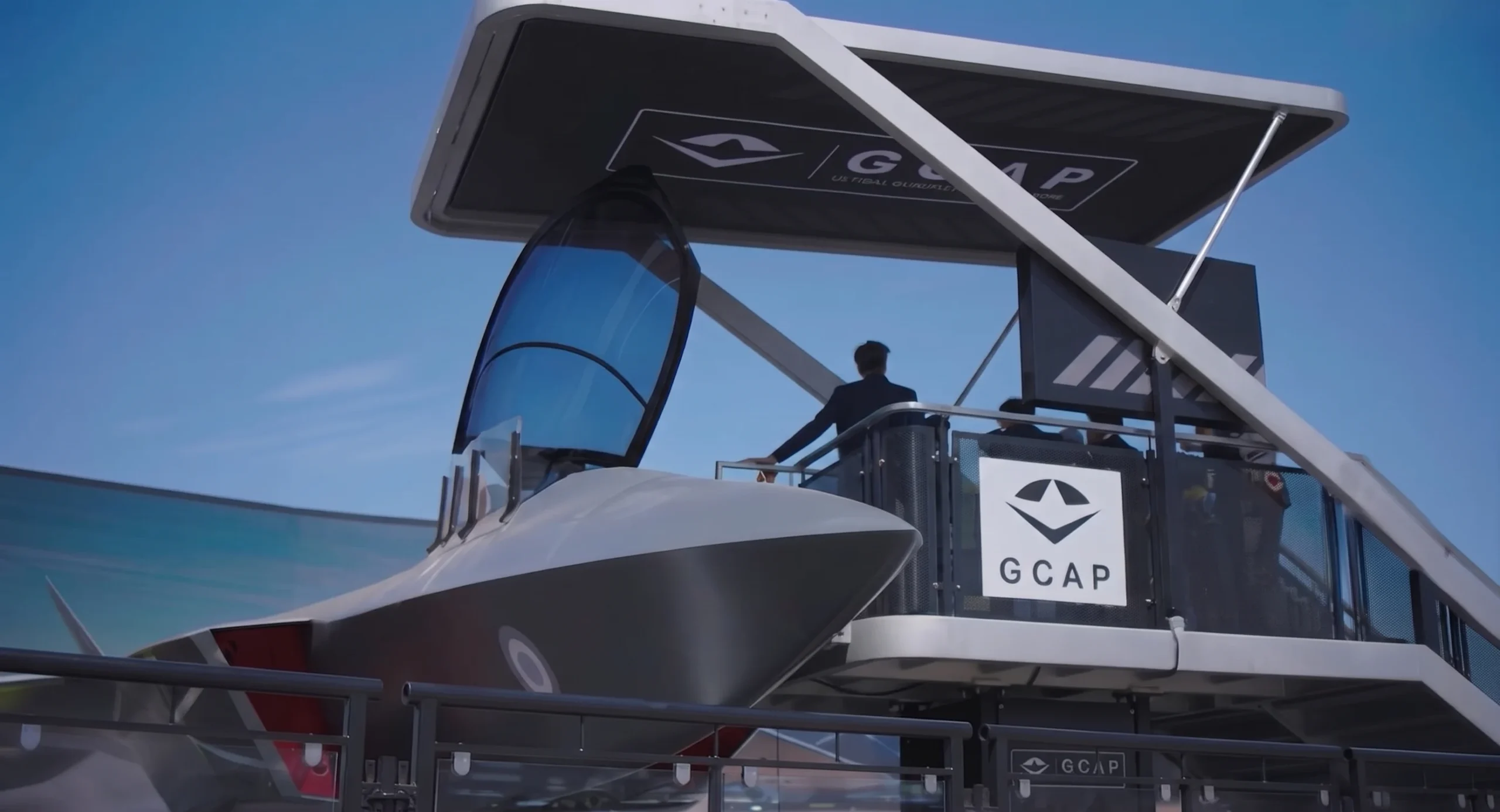
Bombardier and BAE Systems signed a Memorandum of Understanding (MOU) on October 28, 2026, to explore cooperation on next-generation combat air capabilities in Canada. The non-binding agreement pairs the Montreal-based business jet manufacturer with the British Eurofighter Typhoon partner company that is also a core industrial partner in the Global Combat Air Programme (GCAP), and it frames the effort explicitly around the aims of Canada’s Defence Industrial Strategy.
The agreement follows Canada’s first step toward GCAP. On July 21, 2026, Ottawa became the first observer nation in the trilateral United Kingdom, Italy and Japan program to field a sixth-generation fighter around 2035. According to the joint statement announcing it, observer status gives Canada enhanced insight into the program’s governance, capabilities and industrial framework. It also coincides with Prime Minister Mark Carney’s review of the planned 88-aircraft Lockheed Martin F-35A buy, ordered in March 2025 and still unresolved. Only 16 jets are firmly committed. Canadian officials confirmed on October 22, 2026, that the Royal Canadian Air Force (RCAF) had received its first two at Luke Air Force Base, Arizona, while Saab continues to pitch the Gripen E, with final assembly in Canada tied to an order of at least 40 aircraft.
Scope of the Bombardier and BAE Systems Combat Air Framework
According to BAE Systems, areas of focus may include aircraft and mission-system design, systems integration, digital engineering and digital thread technologies, advanced manufacturing, and long-term product support, sustainment and security. Bombardier’s own announcement lists research and development, systems integration, workforce and supply chain development, industrialization and in-service lifecycle management. The two companies say they will now build a framework of practical cooperation areas and assess future opportunities against capability requirements, government priorities and industrial objectives.
The stated end state is broad: an enduring set of capabilities spanning the full lifecycle of a combat aircraft, from early design and digital development through manufacturing and in-service support, to develop what the partners describe as long-term sovereign combat air capabilities in Canada and for international markets. Neither company named a specific aircraft program, work package, investment value or timeline. The MOU text released by BAE Systems does not reference GCAP directly, although Bombardier’s announcement cites Canada’s observer status in the program.
“This agreement marks an important step in our ambition to strengthen international partnerships that support the future of combat air,” said Simon Barnes, Group Managing Director of BAE Systems’ Air Sector, who tied the cooperation to Canada’s Defence Industrial Strategy. Stephen McCullough, Bombardier’s Executive Vice President of Engineering, Product Development and Bombardier Defense, said the MOU provides “a clear framework to explore how these capabilities can support next-generation defence programmes, while strengthening industrial capacity, high-value jobs and long-term aerospace leadership.”
Defence Industrial Strategy Puts Aerospace at the Core of Sovereign Capability
Ottawa released Security, Sovereignty and Prosperity: Canada’s Defence Industrial Strategy on February 17, 2026. It names ten Key Sovereign Capabilities to be prioritized for domestic build, including aerospace platforms, avionics and aircraft communications, with in-service support listed as a separate line. Under its Build, Partner, Buy model, the new Defence Investment Agency will steer procurement toward Canadian firms where domestic strength exists and attach reinvestment conditions to foreign purchases. The strategy targets 125,000 new jobs and a 50 percent increase in defence exports by 2035.
Bombardier brings a platform integrator’s record rather than a fighter design pedigree. Its Bombardier Defense unit converts Global and Challenger business jets into special-mission aircraft, and publicly available information indicates the Global 6000 and 6500 airframes underpin Saab’s GlobalEye airborne early warning platform and the U.S. Army’s High Accuracy Detection and Exploitation System (HADES) intelligence aircraft. The company’s link to fast jets runs through its Canadair heritage: Canadair licence-built the CF-104 Starfighter and CF-5 for Canadian forces before Bombardier acquired it in 1986.
BAE Systems supplies the combat air depth Bombardier lacks: Typhoon production and support, the aft fuselage it builds for every F-35, and its stake in Edgewing, the British, Italian and Japanese joint venture awarded a £4.6 billion ($6.1 billion) contract on July 3, 2026 to complete GCAP’s advanced concept and assessment phase. That dual position matters in Ottawa. BAE stands to gain whether Canada keeps a large F-35 fleet or shifts future investment toward GCAP.
Analysis: The MOU commits neither company to funding or production, so its value is positional. For BAE Systems, a credible Canadian industrial anchor strengthens the case for moving Ottawa from GCAP observer to contributing partner, mirroring the industrial participation logic Saab has used to keep the Gripen E in Canada’s fighter debate. For Bombardier, it opens a path into combat aircraft engineering and sustainment that maps directly onto the aerospace and in-service support lines of the Defence Industrial Strategy. The binding constraint is political rather than industrial: any GCAP role beyond observer status would require Canadian development funding, and Ottawa has yet to settle how many F-35As it will buy.
The next indicators are the outcome of the F-35 review, now more than a year past its original summer 2025 deadline, any Canadian move to negotiate a contributing role in GCAP, and whether Bombardier and BAE Systems convert the framework into named work packages. The UK’s Combat Air Flying Demonstrator, expected to fly in 2027, marks the program’s next visible technical milestone.