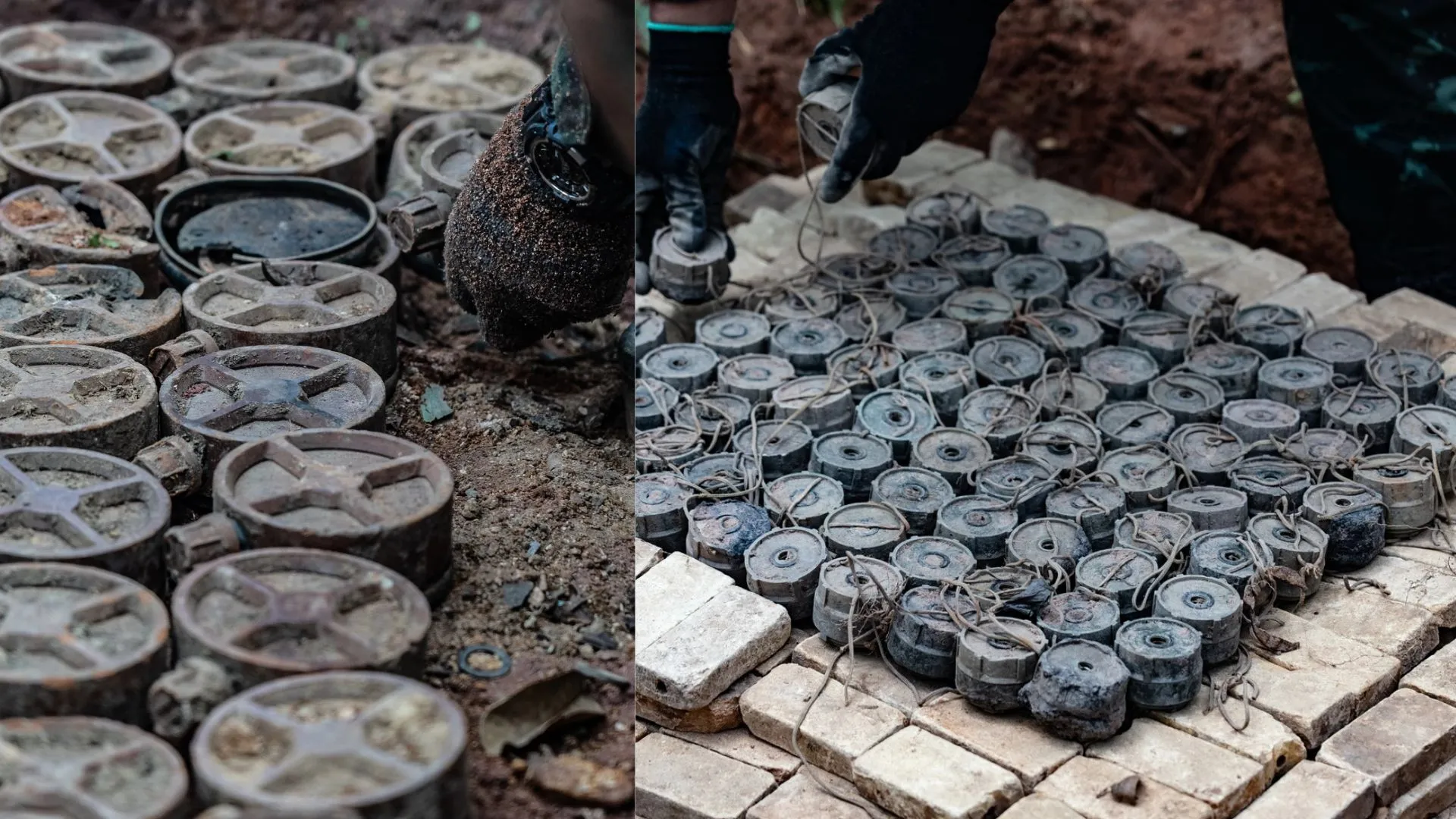
Finland is preparing to procure roughly one million domestically manufactured anti-personnel mines, with production in Finland slated to begin in 2028, according to the Finnish Army Command. The program, budgeted at about $110 million and now in its preparatory and market review phase, follows Helsinki’s withdrawal from the Ottawa Convention, which took effect on January 10, 2026.
The decision reverses more than a decade of Finnish policy. Finland acceded to the convention on January 9, 2012, and destroyed a stockpile of slightly more than one million anti-personnel mines by the end of 2015, retaining 15,509 for training and research as of December 2024. Poland, Lithuania, Latvia, and Estonia have also left the treaty, a coordinated shift along NATO’s eastern flank driven by Russia’s war in Ukraine, where both sides have used anti-personnel mines extensively. Neither the United States nor Russia is party to the convention.
Anti-Personnel Mine Production: Finland’s Timeline to the 2030s
Col. Riku Mikkonen, inspector of engineers at the Finnish Army Command, said the materiel procurement project is drafting technical specifications in parallel with its market review. Requests for tenders will follow, opening a competitive bidding process that leads to contract awards. No contracts have been signed. The Finnish Defence Forces intend to return the anti-personnel mine stockpile to its pre-2012 level, which the convention-era destruction figures place at roughly one million mines.
The Finnish Defence Forces expect the first new mines and associated training equipment to become available during 2027, with production in Finland beginning in 2028 and final deliveries scheduled in the 2030s. The $110 million envelope implies an average cost of roughly $110 per mine, training equipment included, consistent with the Army’s stated requirement for simple, affordable, and easy-to-use weapons.
Industrial capacity is the critical path. Finland has not manufactured anti-personnel mines since 1981, and no Finnish company currently produces them, so industry must stand up new production lines. The Finnish Defence Forces list the ability to produce mines quickly under emergency conditions as a planning factor alongside peacetime stockpile quantities, signaling that surge capacity matters as much as the initial inventory.
Until new mines arrive, training relies on directed fragmentation charges already in service. Publicly available information indicates these Claymore-type munitions project fragments out to roughly 50 meters. Under the treaty they could only be command-detonated; outside it, they can be rigged for tripwire initiation.
Tripwire Tube Mines and Pressure Step Mines: The Initial Designs
The project seeks two Finnish-made designs: a tube mine initiated by tripwire and a pressure-activated step mine. Weight, explosive fill, lethal radius, casing material, and fuze architecture have not been disclosed. Munitions in the tube category are typically above-ground fragmentation devices that cover a wider area through the wire layout, while step mines are small blast munitions triggered by foot pressure and lethal only at the point of contact. Combined, the two give engineers an area-denial layer and a point-denial layer within the same obstacle belt.
Mikkonen has indicated a preference, at least initially, for simple designs without self-neutralization, arguing that a long war would outlast mines that deactivate after three or four months. That choice carries humanitarian weight: the International Campaign to Ban Landmines reports that civilians accounted for 90% of recorded casualties from mines and explosive remnants of war in 2024. More advanced mines may be procured later, including cluster-type systems of the kind Russia has employed in Ukraine.
Doctrinally, the weapons will sit inside the Finnish counter-mobility concept alongside anti-tank mines and obstacles that exploit the natural barrier value of forested and lake-bound terrain. Their stated tasks are to slow enemy movement, complicate the breaching of anti-tank minefields, deny access to areas, protect key sites, and inflict casualties. All conscripts will be trained to employ them. Helsinki has stated it will not lay anti-personnel mines in peacetime and will use them only under emergency conditions.
Russia’s Leningrad Military District Buildup Opposite Finland
Finland shares a border of about 1,340 kilometers, or roughly 830 miles, with Russia and joined NATO in April 2023. Moscow reestablished the Leningrad Military District in 2024, creating a dedicated command for the approaches to St. Petersburg, the Finnish border, and the Arctic. The same year it formed the 44th Army Corps in the Republic of Karelia.
Infrastructure is following. Satellite imagery showed construction at the Lupche-Savino garrison near Kandalaksha, roughly 70 miles from the border, sized for an artillery brigade and at least part of an engineer brigade. Finnish public broadcaster Yle, using satellite data, reported a new base at Novaya Vilga, about 100 miles from the border, being built to house up to 6,000 troops. Imagery analysis also points to newly delivered T-90M tanks accumulating at the 22nd Central Tank Reserve Base, around 450 miles away. Finland’s Military Intelligence Review 2026 judges that Russian reforms have not yet significantly raised capabilities near Finland, but expects a substantial increase as circumstances permit and identifies Finland as a major direction for postwar force development.
Analysis: Finland is buying mass, not sophistication. For a wartime force of 280,000 holding a border of more than 1,300 kilometers, cheap victim-activated mines multiply the effect of engineers and reserve infantry in the forest corridors an attacker must use. The program’s real exposure is timing: deliveries running into the 2030s overlap the window in which Russia could reconstitute its northwestern ground forces after Ukraine. Building domestic lines rather than buying abroad gives Helsinki control over surge production, but it starts from zero industrial base, which makes the 2028 start date the variable to watch.
The next milestones are the release of requests for tenders, selection of Finnish industrial partners, and contract signature. Still undisclosed are the mines’ technical specifications, the identity of the manufacturers, and whether later variants will include self-neutralizing or cluster-type designs. Pressure from humanitarian campaigners on Helsinki and Warsaw is likely to intensify as production approaches.