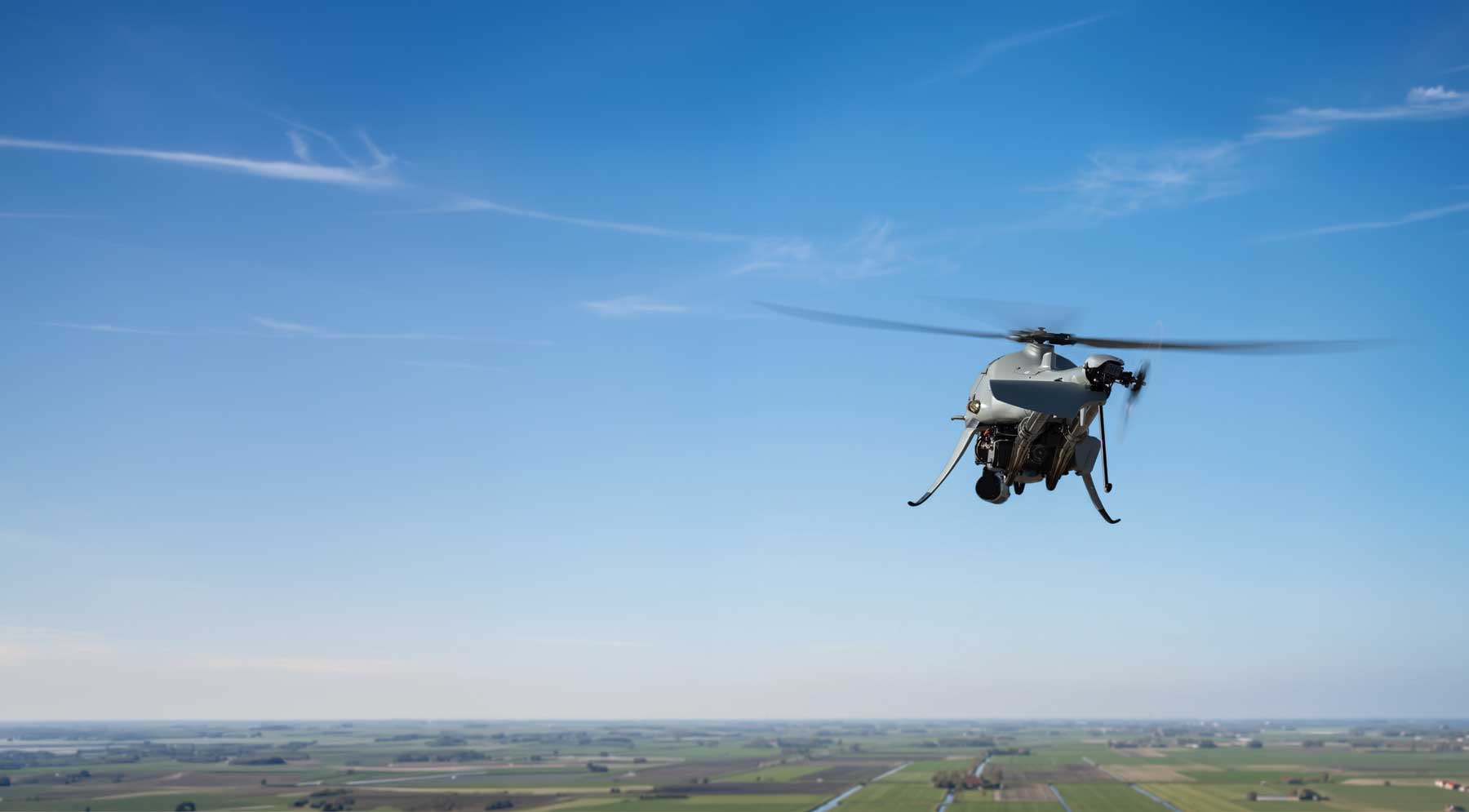
Dutch manufacturer High Eye has completed a 4-hour, 30-minute endurance flight with its Airboxer unmanned helicopter flown in a representative maritime configuration, the company announced on October 27, 2026. The vertical take-off and landing (VTOL) unmanned aerial vehicle (UAV) carried an electro-optical/infrared (EO/IR) payload, an emergency flotation system and two Extended Range Fuel tanks, and landed after 4 hours, 30 minutes and 30 seconds of continuous flight with approximately 0.7 kg of fuel remaining.
After early sales mainly to navies and coast guards in Southeast Asia, the Airboxer now has a NATO customer. High Eye won an open international tender from the Netherlands Ministry of Defence in February 2024 and signed a contract with the Royal Netherlands Navy on May 14, 2024; neither the quantity nor the value of that contract has been disclosed. In December 2025, the company also obtained a Light UAS Operator Certificate (LUC) at Specific Assurance and Integrity Level (SAIL) II from the Malta Civil Aviation Directorate. The figure does not exceed the manufacturer’s published envelope: High Eye’s current specifications list a maximum flight time of more than 4 hours in standard configuration and more than 5 hours with Extended Range Fuel tanks, with payload falling to 3 kg at full fuel. What the flight adds is a duration tied to a named mission fit, including the flotation gear required over water.
High Eye Airboxer Flight Profile and Maritime Payload Configuration
The flight took place in ambient conditions of approximately 22°C at ground level, with winds of around 15 knots. Flown at an endurance cruise speed of approximately 35 knots, the Airboxer covered the equivalent of roughly 290 km of airborne distance. High Eye data published in 2024 put range at 180 km on a single fuel tank at 30 knots with a medium payload; the company’s current specifications list a maximum range of more than 360 km.
The configuration is the point of the test: flotation gear is mandatory for over-water operations and a stabilized EO/IR turret is the core maritime surveillance sensor, both adding weight and drag that a record attempt would omit.
“This flight was not about demonstrating endurance in a stripped-down configuration,” said Joost de Ruiter, CEO of High Eye. “The Airboxer flew with equipment that is directly relevant to maritime operations. For customers, this represents the most important distinction: endurance needs to remain available when the aircraft is carrying the equipment required to perform the mission.”
Several parameters remain undisclosed. High Eye has not identified the EO/IR sensor model or its mass, the aircraft’s take-off weight for the sortie, the date and location of the test, or whether the flight launched from land or from a vessel. The 0.7 kg of fuel remaining at landing also defines this as a maximum-endurance demonstration rather than a planning figure: operational sorties flown with standard fuel reserves will be shorter.
Heavy-Fuel Propulsion and Shipborne Design of the Airboxer UAV
The Airboxer uses a classical helicopter layout with a three-blade main rotor and a two-blade tail rotor. Its 80 cc, two-stroke, air-cooled boxer twin uses dual injection and full authority digital engine control (FADEC) and runs on Jet A-1 heavy fuel, while a 28 V, 700 W onboard generator powers avionics and payloads. Earlier company material cited a maximum take-off weight (MTOW) of 32 kg and an empty weight of 21 kg; High Eye’s current specifications list an MTOW of 34.2 kg and a maximum payload of 7 kg across multiple bays, up from an original 5 kg design target. High Eye states that its rotor systems and two gearboxes reached 1,000 hours of maintenance-free running in simulated testing, supporting a rated 1,000-hour airframe time between overhaul (TBO).
Heavy-fuel operation carries clear naval logic. It keeps gasoline, a volatile handling and fire hazard, out of ship stores and aligns the aircraft with the kerosene-based fuel family used at sea. High Eye has not publicly confirmed qualification on JP-5, the standard naval aviation fuel.
The avionics are rated IP-67 against dust and water inside an IP-56 enclosure, and the company reports that electromagnetic interference testing showed no effect at frequencies from 1 MHz to 18 GHz and field strengths of 200 V/m, a requirement for operating close to naval radars and communications emitters. The platform has also demonstrated automatic take-off and landing from a moving vessel, the capability that determines whether a small rotary-wing UAV can work from patrol vessels without dedicated recovery gear.
That design places the Airboxer between small electric VTOL UAVs, limited in endurance and payload, and heavier heavy-fuel platforms such as the Schiebel Camcopter S-100, which publicly available specifications place at 200 kg MTOW with a payload of up to 50 kg. High Eye markets it for Exclusive Economic Zone (EEZ) and coastal monitoring, search and rescue support, critical maritime infrastructure monitoring and persistent intelligence, surveillance and reconnaissance (ISR) from naval and coast guard vessels.
Analysis: The demonstration targets the central weakness of the sub-50 kg rotary-wing class: endurance figures that shrink once a real sensor and over-water safety equipment are installed. For navies and coast guards, an aircraft that holds an EO/IR sensor aloft for more than four hours from a small deck offers organic ISR to offshore patrol vessels and corvettes that cannot embark a crewed helicopter or a 200 kg-class UAV. This bears directly on seabed infrastructure protection, where NATO launched its Baltic Sentry activity in January 2025 to increase surveillance of undersea cables and pipelines. The caveat is that a single manufacturer-run sortie with undisclosed payload mass is a performance claim, not an operational evaluation; Royal Netherlands Navy experience will be the more credible benchmark.
High Eye says the test is part of a continuing development program covering endurance, communications range, sensor integration and autonomous shipborne operations, and that it is working with customers and technology partners on advanced EO/IR systems, LiDAR, communications, maritime positioning and beyond-line-of-sight (BLOS) connectivity. No timelines have been given. The next indicators to watch are disclosure of the payload mass flown, endurance data from shipborne sorties in higher sea states, and whether the Royal Netherlands Navy moves from its initial contract toward wider fleet integration.