Greece publicly displayed the first elements of its €3 billion Achilles Shield air and missile defense network at the Oxi Day military parade in Thessaloniki on October 28, 2026, showing SPYDER, BARAK MX and David’s Sling hardware alongside Elbit Systems’ Precise and Universal Launching System (PULS) rocket artillery and a broad set of unmanned systems. President Konstantinos Tasoulas and Prime Minister Kyriakos Mitsotakis reviewed the parade on Megalou Alexandrou Avenue, with Defense Minister Nikos Dendias in attendance.
The display came eight weeks after Athens and Jerusalem signed the Achilles Shield agreements in Tel Aviv on August 31, 2026, and three weeks after the sixth US-Greece Strategic Dialogue announced $4 billion in Foreign Military Sales. Both deals feed Dendias’ Agenda 2030 restructuring and about €28 billion in planned defense spending through 2036.
Achilles Shield Air Defense Layers Make Their Public Debut
The most visible new element was a resupply vehicle carrying STUNNER interceptors for David’s Sling, the system that will form the upper tier of Achilles Shield alongside Greece’s existing Patriot batteries. The STUNNER destroys targets by direct hit-to-kill impact rather than with an explosive warhead, using a seeker that combines radar with electro-optical and infrared sensors. Figures presented at the parade credit it with speeds up to Mach 7.5, engagement ranges up to 130 kilometers and intercept altitudes up to 15 kilometers. Greece becomes the second David’s Sling customer after Finland.
The middle tier rests on Israel Aerospace Industries’ BARAK MX, which fires interceptors with ranges of 35, 70 and 150 kilometers from a common architecture whose battle management computer assigns the appropriate round to each threat. Its missiles use active radar guidance activated in the terminal phase and are rated against aircraft, helicopters, drones, cruise missiles and tactical ballistic missiles. Cyprus began fielding the system in 2025, opening a path to shared training and logistics.
Rafael Advanced Defense Systems’ SPYDER covers the short-to-medium range layer. The mobile, all-weather system pairs a 360-degree active electronically scanned array (AESA) radar with DERBY and PYTHON missiles, while electro-optical sensors let it track targets without continuous radar emission. Parade data cited detection at 150 kilometers and interception at up to 80 kilometers; the SPYDER variant Greece is buying has not been disclosed. The contract also covers ELTA Systems multi-mission radars and a Rafael national command-and-control layer. A separate €26 million agreement funds Rafael’s DRONE DOME, which combines signals and imagery intelligence collection with GPS and datalink jamming.
PULS Long-Range Fires and US Army Strykers Ahead of a Transfer to Greece
The PULS launcher represents a $750 million (€650 million) contract Elbit announced on April 6, 2026, reportedly covering 36 launchers. The package includes training rockets, precision-guided rockets across several ranges and loitering munitions, delivered over four years with ten years of follow-on support. With the Predator Hawk missile, the system reaches 300 kilometers, enough to span the Aegean from Greek islands. Most launchers are reportedly destined for the northeastern land border with Türkiye and on Aegean islands. The choice of a non-US launcher carries a constraint: in December 2025, Washington refused to let US-made rockets be fired from Elbit’s EuroPULS launchers, a policy reported at the time as a risk to the Greek deal.
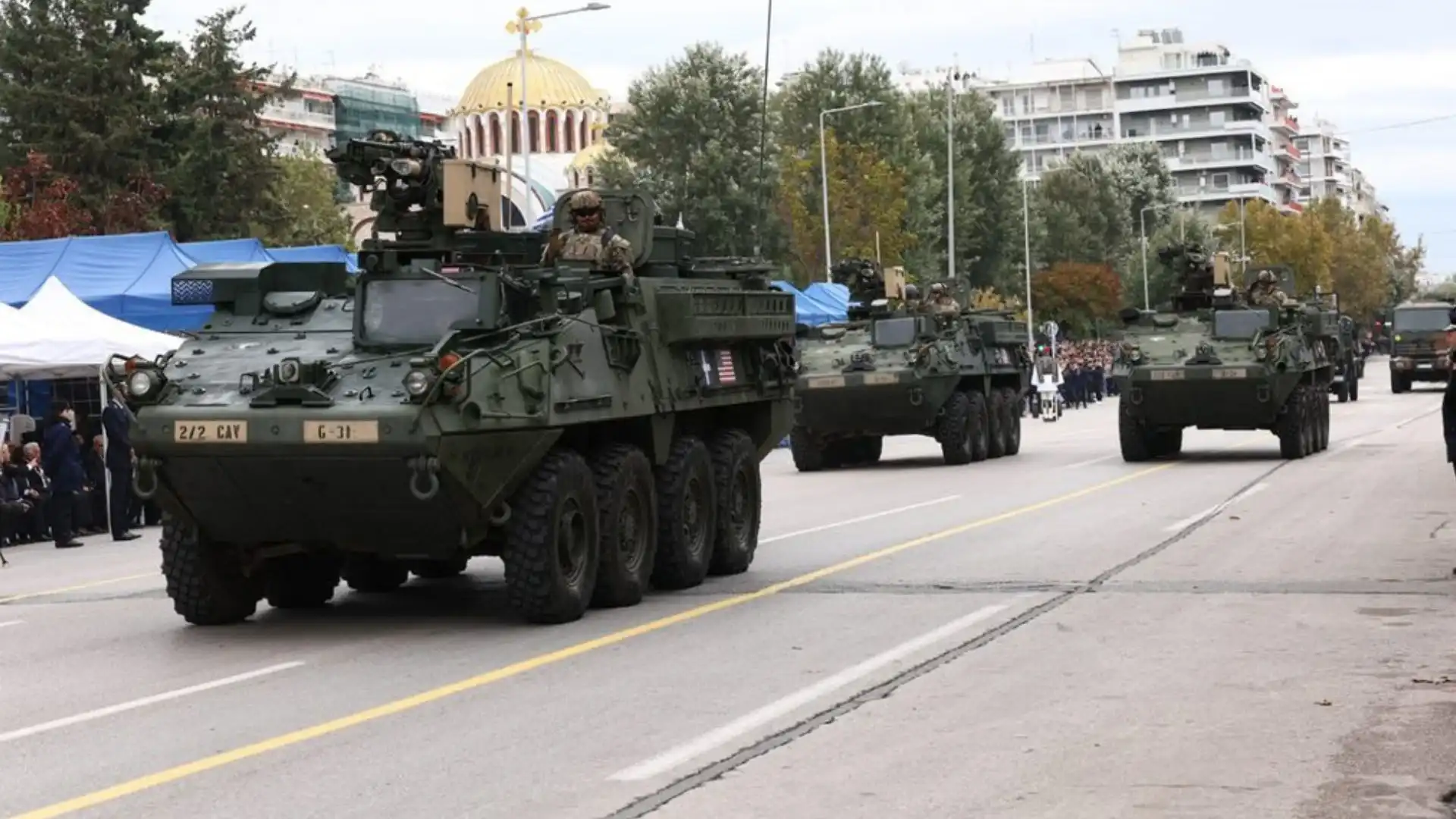
The Strykers in the parade were US Army vehicles from the Germany-based 2nd Cavalry Regiment, operated by American crews, brought by road from Germany for the event and due to return there afterward, so their appearance does not constitute a delivery to the Hellenic Army. The column included the M1126 Infantry Carrier Vehicle, an eight-wheeled platform carrying nine infantry, among them a version whose CROWS-J remote weapon station integrates the FGM-148 Javelin anti-tank missile, and the M1296 Dragoon, armed with a 30 mm cannon in an unmanned turret. The October 7 US-Greek joint statement confirmed that Strykers will be provided to Greece but specified no quantities, variants or delivery dates, and the vehicles on parade do not establish which configurations Athens will receive. The vehicles could replace or supplement aging M113 and Leonidas carriers, although no replacement program has been confirmed.
Greek Unmanned Systems and HYPERION Anchor the Domestic Industrial Push
The Hellenic Navy’s domestically designed PYRPOLITIS unmanned surface vessel (USV), five meters long and capable of 40 knots, is configured for surveillance, anti-surface warfare and one-way attack. It appeared with Saronic’s Corsair, a 7.3-meter autonomous USV the Navy has trialed; Athens has sent Washington a request, reportedly for at least 30. The Greek-built ANEMOGIANNIS attack USV, rated at 75 km/h with a 50-kilogram warhead, and the VICTA special operations craft, capable of 40 knots surfaced and eight knots submerged to 30 meters, completed the naval segment.
The Hellenic Aerospace Industry (HAI) showed its HYPERION counter-drone system, now in advanced testing for ships and land bases, and KENTAVROS, developed with the Hellenic Centre for Defence Innovation and already tested aboard Greek frigates in the Red Sea under the European Union’s Operation ASPIDES. Aerial systems included the V-BAT, with 12 hours of endurance and more than 200 kilometers of reach, and the Schiebel Camcopter S-100 intended for the Navy’s new FDI frigates. A field unit for first-person-view drones and the ARPYIA one-way attack munition signaled attritable mass built in Greece. Greek industry is expected to capture more than 25 percent of the Achilles Shield value, about €750 million.
Analysis: The Thessaloniki line-up shows Greece building its deterrent from three sources: Israeli systems for layered air defense and long-range fires, US platforms for NATO interoperability, and domestic production for attritable unmanned mass. The operational logic is Aegean-specific, pairing 300-kilometer PULS fires from Thrace and the islands with an umbrella against drones, cruise missiles and tactical ballistic missiles. The harder task is integration. Achilles Shield must fuse Israeli sensors and shooters into a Rafael-built national command layer that also connects to Patriot batteries and NATO air defense networks. Israel’s defense ministry said on September 8 that the Greek code base developed under the program will remain under exclusive Greek control, after Greek media reports questioned Athens’ access to the source code.
Dendias has set a 35-month timeline for the full network, pointing to complete capability around mid-2029, with individual layers entering service progressively. PULS deliveries run to roughly 2030. Battery numbers and basing for David’s Sling, BARAK MX and SPYDER, the scale of the Stryker transfer and Washington’s answer on the Corsair request remain undisclosed.