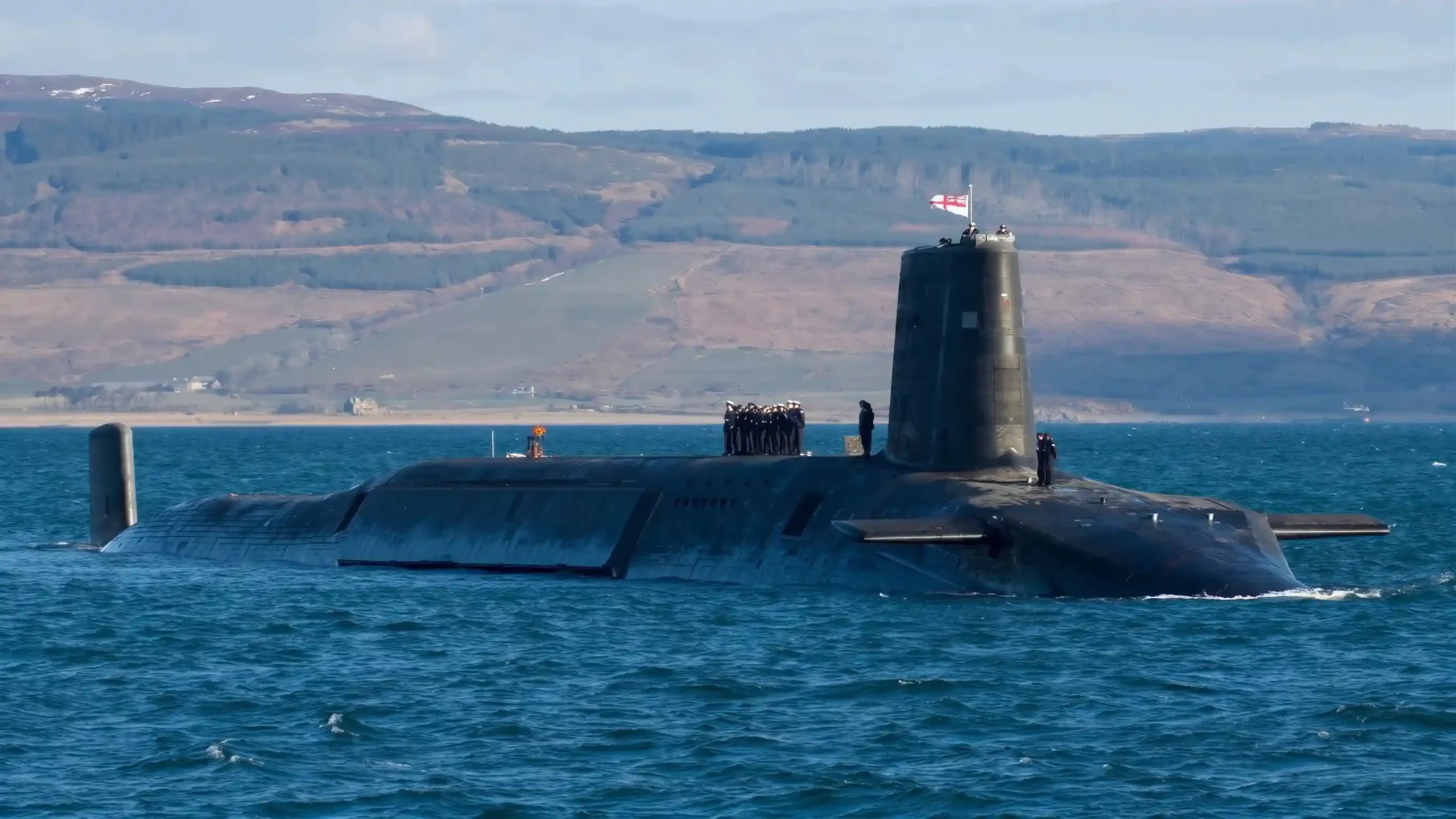
Three of the Royal Navy’s four Vanguard-class nuclear-powered ballistic missile submarines (SSBNs) are at sea at the same time, The Times reported on October 28, 2026. HMS Vanguard, HMS Vigilant and HMS Vengeance are reported to be deployed, while the fourth boat, HMS Victorious, remains in dock at His Majesty’s Naval Base (HMNB) Devonport for deep maintenance. At least one of the three is on deterrent patrol carrying Trident II D5 ballistic missiles.
The deployment lands in a tense week for British defense policy. On October 24, Defence Secretary Wes Streeting warned that Britain has a little over 1,000 days to be ready to fight and win a war alongside its allies, as Russia intensifies its hybrid warfare against NATO. On October 20 and 21, Royal Air Force (RAF) Typhoon FGR4 fighters escorted French Rafale B jets during Exercise Rummy, a simulated nuclear strike flown from Saint-Dizier Air Base and the first British participation in a French airborne nuclear exercise.
Three Royal Navy Nuclear Submarines at Sea: Reading the CASD Rotation
The Royal Navy has not publicly detailed the tasks of the three boats. A navy source described the deployment as “unusual,” while a former senior naval source said the service had operated with two available boats for a long period and stressed that the move was not strategic messaging.
Open-source tracking points to a routine explanation. Under Continuous At-Sea Deterrence (CASD), one SSBN is always on patrol, a posture maintained without interruption since 1969. The boat that sailed to take up the current patrol in April had been at sea for roughly 199 days by late October and is expected home shortly. A second Vanguard-class boat conducted short sea periods in September, called at the Coulport explosives handling jetty and sailed again on October 12. A third left HMNB Clyde at Faslane on October 14.
That sequence fits a patrol handover overlapping with sea trials or work-up by a third submarine. A relieving SSBN normally completes work-up before assuming the patrol, so two boats at sea around a handover is common. Three is rarer. British press reports place the last occurrence more than five years ago, while the independent monitoring group Nukewatch UK recorded three boats at sea together for two days, then for 12 days, in October and November 2022.
Tom Sharpe, a former Royal Navy officer who commanded four warships over a 25-year career, called the movements “just routine operational scheduling” and said rising boat availability would be a positive sign.
Three hulls at sea do not equal three deterrent patrols. Britain stopped publishing missile and warhead loads per boat in 2021; before that change, the declared ceiling was eight operational missiles and 40 warheads per patrolling submarine. No public evidence links the current movements to Exercise Rummy or to nuclear signaling.
Vanguard-Class Availability After a Record 205-Day Patrol
The more consequential story is availability. Vanguard-class readiness has been poor for several years, and CASD has at times depended on two submarines alternating patrols. The result has been extreme patrol lengths: a record 205-day patrol ended in April 2026, and each of the nine patrols before it exceeded five months. Returning a third boat to the rotation creates room for maintenance, training and crew recovery, and could start pulling patrol durations back toward sustainable levels.
The strain reflects the age of the fleet. Commissioned between 1993 and 1999 with a 25-year design life, the four boats will serve well beyond 30 years. Publicly available specifications indicate a submerged displacement of about 15,900 tonnes, a length of 149.9 meters and propulsion from a Rolls-Royce PWR2 pressurized water reactor driving a pump-jet propulsor. Each boat has 16 missile tubes for the Lockheed Martin Trident II D5 submarine-launched ballistic missile, four 533 mm torpedo tubes for Spearfish heavyweight torpedoes, and a crew of roughly 135.
HMS Victorious Deep Maintenance and the Dreadnought-Class Gap
HMS Victorious sits in 9 Dock at Devonport in a Deep Maintenance Period valued at around £560 million, intended to keep her operational into the 2030s. That timeline is critical because the replacement Dreadnought class is not due until the early 2030s, leaving the Vanguard boats to carry CASD through a transition with no spare hull. Any slippage at Devonport compresses the rotation back to two boats. Four Dreadnought boats, Dreadnought, Valiant, Warspite and King George VI, are under construction at BAE Systems in Barrow-in-Furness. At more than 17,000 tonnes and powered by the new PWR3 reactor, they will be the largest submarines ever built for the Royal Navy. The Ministry of Defence (MoD) declines to say when sea trials for the lead boat will begin, stating only that they will support entry into service in the early 2030s.
Analysis: The headline number matters less than what it implies about fleet health. A four-boat SSBN force sized to keep one boat on patrol has little margin; running on two available hulls turned every defect or delay into a direct risk to CASD continuity and pushed crews through patrols approaching seven months. A credible third boat restores that margin as London places its deterrent at the center of its NATO posture. The MoD states that Britain remains the only European ally to commit its nuclear deterrent to the defense of NATO, a commitment that rests on the Vanguard fleet staying available until Dreadnought arrives. Exercise Rummy and the deepening Franco-British nuclear dialogue add political weight, but deterrent credibility is ultimately measured in hull availability.
The next markers are near-term. The patrolling boat’s return will show whether the handover proceeds on schedule and whether the next patrol runs shorter than recent deployments. Further out, completion of HMS Victorious’s maintenance period and the start of Dreadnought sea trials will determine whether the Royal Navy can sustain a three-boat rotation through the transition. Whether government spending plans, under scrutiny since Streeting’s 1,000-day warning, protect that pipeline remains an open question.