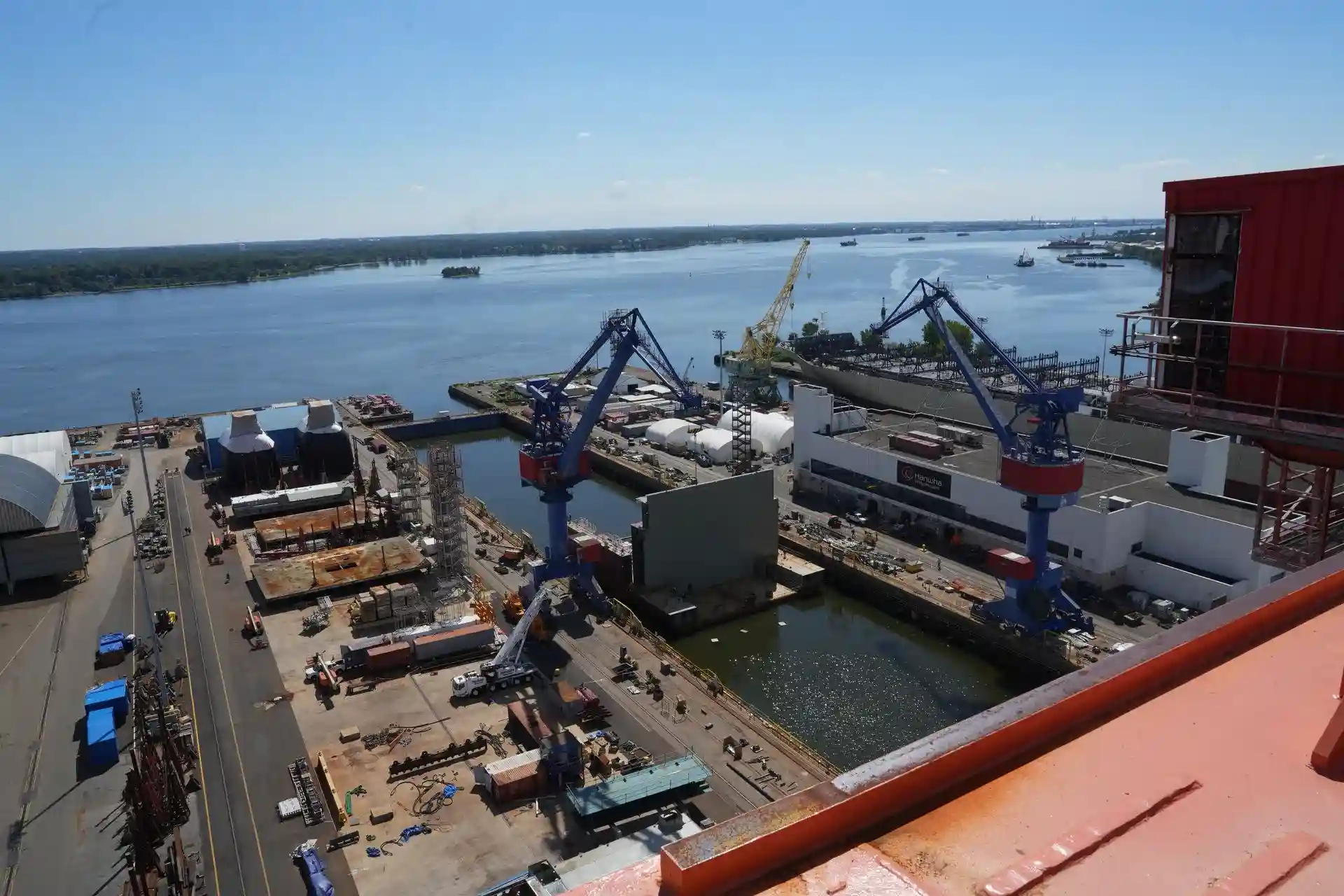
Hanwha Defense USA (HDUSA) announced on October 27, 2026, that it is acquiring a controlling stake in Hanwha Philly Shipyard, placing the Philadelphia yard under the leadership and governance structure of the U.S. defense arm of South Korea’s Hanwha Group. The move consolidates Hanwha’s American government and commercial shipbuilding under one chain of command as the company prepares the yard to build for the U.S. Navy, other federal agencies and commercial customers.
The transaction is an internal restructuring, not a new purchase. Hanwha Systems and Hanwha Ocean bought the yard from Norway’s Aker for $100 million in December 2024, after clearance by the Committee on Foreign Investment in the United States (CFIUS), splitting ownership 60% and 40%. In September 2026, Hanwha Systems announced plans to sell its 60% stake to Hanwha Defense USA Shipbuilding LLC, an HDUSA-led joint venture with Hanwha FutureProof, the group’s North American investment platform. A South Korean regulatory filing values the sale at approximately $237.6 million, closing October 31, 2026. The shift comes as Seoul channels a $150 billion pledge into U.S. shipbuilding under the Make American Shipbuilding Great Again (MASGA) framework.
How the Hanwha Philly Shipyard Ownership Restructuring Works
The deal moves control of the yard from Hanwha Systems, the group’s Korean defense electronics and naval systems affiliate, to a U.S.-incorporated vehicle led by HDUSA, itself a subsidiary of Hanwha Aerospace. HDUSA and Hanwha FutureProof each hold 50% of the joint venture, and Hanwha Ocean retains its 40% stake in the yard.
Leadership follows ownership. Retired Rear Adm. Tom Anderson, HDUSA’s President of U.S. Shipbuilding, will oversee all of the company’s shipbuilding operations in the United States. HDUSA had already set up at the yard earlier in 2026 to drive the dual-use transition.
“As Hanwha Defense USA continues to grow its multi-domain presence across the U.S., bringing the Philly Shipyard under HDUSA will further align our government and commercial shipbuilding efforts,” said HDUSA President and CEO Michael Coulter. “We look forward to continuing to invest in our Philly Shipyard facilities and workforce in preparation for exciting work ahead.”
The change gives a single U.S. defense entity ownership of customer relations with the Navy, the Maritime Administration (MARAD) and the Missile Defense Agency (MDA), instead of routing yard governance through a Seoul-based electronics affiliate.
From Jones Act Builder to Federal Shipyard: The Current Order Book
Founded in 1997 on the site of the former Philadelphia Naval Shipyard, the yard says it has built roughly half of all large oceangoing Jones Act vessels delivered in the United States since 2000. That model nearly collapsed in 2019, when an empty order book cut the workforce from about 1,200 to 80. In April 2020, the yard was selected to build the first two National Security Multi-Mission Vessels (NSMV) under a $630 million contract managed by TOTE Services. The program grew to five training ships; four have been delivered and the fifth is scheduled for 2027.
The NSMV line now underpins the yard’s first defense hardware program. In October 2026, TOTE Services finalized a vessel construction management contract with MARAD and awarded Hanwha Philly Shipyard the shipbuilding subcontract for the MDA’s Missile Range Instrumentation Vessel (MRIV), covering one firm ship with options for two more. The first hull, Golden Defender, is due in 2030. At approximately 525 feet, the MRIV uses the NSMV hull and shares about 70% overall commonality with it, which lets the yard reuse a proven production line and supply chain. The ships will replace Pacific Tracker and Pacific Collector, built in 1965 and 1970, in tracking missile intercept tests over the Pacific.
The Navy relationship remains at the design stage. In March 2026, HDUSA and the yard joined a concept design effort for the Navy’s Next Generation Logistics Ship (NGLS) as a subcontractor, the first Navy contract since the acquisition. Commercial work includes three LNG-powered containerships for Matson and two LNG carriers for Hanwha Shipping.
Hanwha Philly Shipyard Capacity Expansion and the Path to Navy Hulls
Capacity is the binding constraint. Hanwha’s $5 billion plan, announced in August 2025, funds two additional docks and three quays, aiming to lift output from about 1.5 ships per year to as many as 20. Hanwha has spent about $350 million on upgrades since the acquisition and approved another $400 million through 2027, The Wall Street Journal reported. Per Hanwha, the workforce has more than doubled since the acquisition, to nearly 2,500.
Acting Secretary of the Navy Hung Cao toured the yard in September 2026 to discuss capacity and future requirements. The same report said Hanwha aims to move the yard from auxiliary vessels to combat ship construction, including the required certification, by 2028. The yard has never built a naval vessel.
“Over the past two years Hanwha has made significant investments in the Philly Shipyard to contribute to the revitalization of the U.S. shipbuilding industry,” Anderson said. “Now we are positioning the shipyard to transition to dual-use, aligning shipyard operations, workforce, and customer relations in preparation to build for the U.S. Navy, other federal agencies, and commercial customers.”
Analysis: The restructuring matters less for its price than for where it places authority. Federal law bars construction of Navy vessels in foreign shipyards, so Korean production know-how can only reach Navy new construction through U.S.-sited yards governed by U.S. entities. Putting Philadelphia under an American defense subsidiary run by a retired flag officer moves Hanwha closer to the governance model Navy program offices expect from a prime builder. Hanwha has not disclosed any foreign ownership, control or influence (FOCI) mitigation arrangement, and combatant work involving classified combat systems would likely require one. The realistic near-term path runs through auxiliary and sealift hulls that reuse the NSMV and MRIV production line.
The next markers are the planned October 31 closing, confirmation of the final ownership split, delivery of the fifth NSMV in 2027 and decisions on the two MRIV options. The NGLS program’s progression beyond concept design will show whether Hanwha Philly Shipyard can convert design-stage roles into a Navy construction award before Golden Defender delivers in 2030.