The United Kingdom will lead development and delivery of three payloads for uncrewed underwater vehicles (UUVs) under the first signature project of AUKUS Pillar II, the Ministry of Defence (MoD) announced on October 27, 2026. The package comprises a Synthetic Aperture Sonar, a Deployable Anti-Submarine Warfare Sensor and a Deployable Non-Kinetic Effector, due to become available across Australian, British and US UUV fleets from 2027.
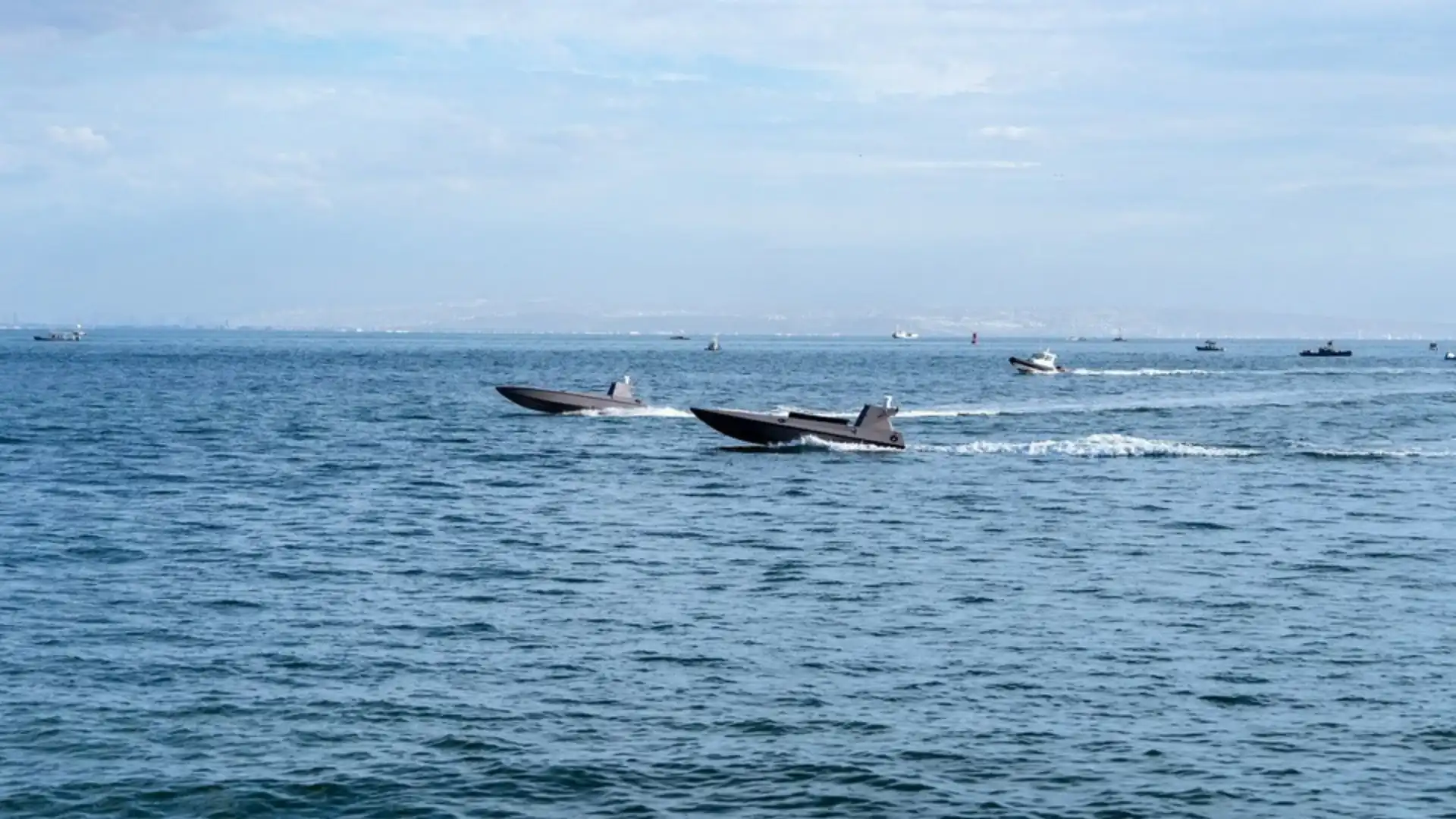
The announcement closed Maritime Big Play Pacific (MBP-P), a trilateral autonomy experiment hosted by Naval Information Warfare Center (NIWC) Pacific, U.S. Pacific Fleet and the U.S. Marine Corps in the Southern California operating area off San Diego from October 5 to 25, 2026. It gives substance to the signature project unveiled at the AUKUS Defence Ministers’ Meeting in Singapore on May 30, 2026, when Australia, the UK and the US committed to jointly develop payloads and enabling systems for UUVs. Pillar II covers advanced capabilities, separate from Australia’s nuclear-powered submarine acquisition under Pillar I.
Three AUKUS UUV Payloads: Sonar, ASW Sensor and Non-Kinetic Effector
The MoD describes the payloads in functional terms: collecting detailed underwater information, deploying sensors to detect and classify underwater threats, and generating underwater effects. Together they are meant to let UUVs watch large ocean areas and protect undersea infrastructure such as cables and pipelines. The MoD has not disclosed prime contractors, contract values, performance figures or the vehicles that will host each payload.
Synthetic Aperture Sonar (SAS) is the most mature of the three technologies. SAS coherently combines successive acoustic returns along the vehicle’s track to synthesize an array far longer than the physical transducer, giving along-track resolution that does not degrade with range as it does on conventional side-scan sonar. Publicly available specifications for current SAS systems on military and commercial autonomous vehicles indicate centimetre-scale imagery at ranges of a few hundred metres per side. That resolution supports mine countermeasures, seabed mapping and change detection along cable and pipeline routes, where a small foreign object must be separated from seabed clutter.
The Deployable Anti-Submarine Warfare (ASW) Sensor points to a UUV that lays sensors rather than tows them. The MoD has not said whether the sensor is passive or active, moored or seabed-mounted, or how long it stays on station. The operational logic is nonetheless clear: a UUV can seed a sensor field at a chokepoint covertly, without a frigate or patrol aircraft signalling the activity. The Deployable Non-Kinetic Effector is the least defined. The MoD says only that it will generate underwater effects; in open-source usage the term generally covers acoustic decoys, jamming and deception, but no technical detail has been released.
Maritime Big Play Pacific Tests UK-Led Anti-Submarine Warfare Strand
MBP-P gathered more than 40 government and industry technologies and tested how crewed and uncrewed systems from the three nations operate together across four strands: anti-submarine warfare, lethality, contested resupply, and subsea and seabed warfare. The UK led the ASW strand, contributing 13 uncrewed surface vessels (USVs), two ASW targets and four underwater gliders from six industry partners.
The event also showcased two of the four winners of the AUKUS Maritime Innovation Challenge, SEA Ltd of Frome and Decision Analysis Services Ltd of Basingstoke. With A2i of Dorchester and US firm MSI Transducers, they share £3 million to develop capabilities for the command, control and cooperation of undersea systems. Royal Navy Captain Keith Taylor framed that as the core problem:
By bringing scientists, industry and warfighters together, and developing the common control solutions that allow diverse autonomous systems to operate and fight as one, we can rapidly build an integrated allied force with greater scale, combat effectiveness and deterrent effect.
XV Excalibur and the Interoperability Case for Shared UUV Payloads
The payload announcement follows a trial that tested the same principle with a weapon. On September 13, 2026, at the British Underwater Test and Evaluation Centre (BUTEC) near the Kyle of Lochalsh in Scotland, the Royal Navy’s XV Excalibur launched an inert, recoverable US Navy Mk 48 heavyweight torpedo, the first torpedo launch from an uncrewed vessel by either nation. Excalibur is a 12-metre extra-large uncrewed underwater vehicle (XLUUV) built by MSubs and in service since May 2025; publicly available data put its displacement at about 19 tonnes. It has no torpedo tubes; the Royal Navy said the vehicle was adapted with a specialist management system to fire and control the weapon.
That trial matters because the receiving fleets are heterogeneous, from the experimental Excalibur to Australia’s Ghost Shark extra-large autonomous underwater vehicle, ordered from Anduril Australia under a A$1.7 billion program of record in September 2025. A payload that moves between such vehicles needs common physical, power and data interfaces, which is the enabling-systems half of the May 30 commitment.
Analysis: The UK’s lead on these payloads ties AUKUS Pillar II directly to the Royal Navy’s Atlantic Bastion programme, launched in December 2025 to deliver on the Strategic Defence Review as a crewed and uncrewed sensor and effector network to find, track and, if needed, act against adversaries across the North Atlantic. Wide-area seabed imaging, deployable ASW sensing and non-kinetic effects are the building blocks that network requires, and the MoD explicitly names the Euro-Atlantic and High North alongside the Indo-Pacific. Pillar II’s first deliverable is therefore as much about Russian undersea activity near allied infrastructure as about deterrence in the Pacific. It also shifts the unit of allied interoperability from the vehicle to the payload: if the interfaces hold, each nation can buy its own UUVs and still share mission modules.
The 2027 availability date is the next marker, but the MoD has not said whether it refers to prototypes, trials units or operational payloads. Contract awards, funding lines within the Defence Investment Plan, which the MoD says sets out £298 billion of UK defence spending over four years, and the first host vehicles remain undisclosed. Further Excalibur torpedo trials are planned to build toward a live firing against a target. Delivery also depends on the AUKUS licence-free trade environment, which ministers agreed in Singapore to expand by narrowing the list of excluded technologies.