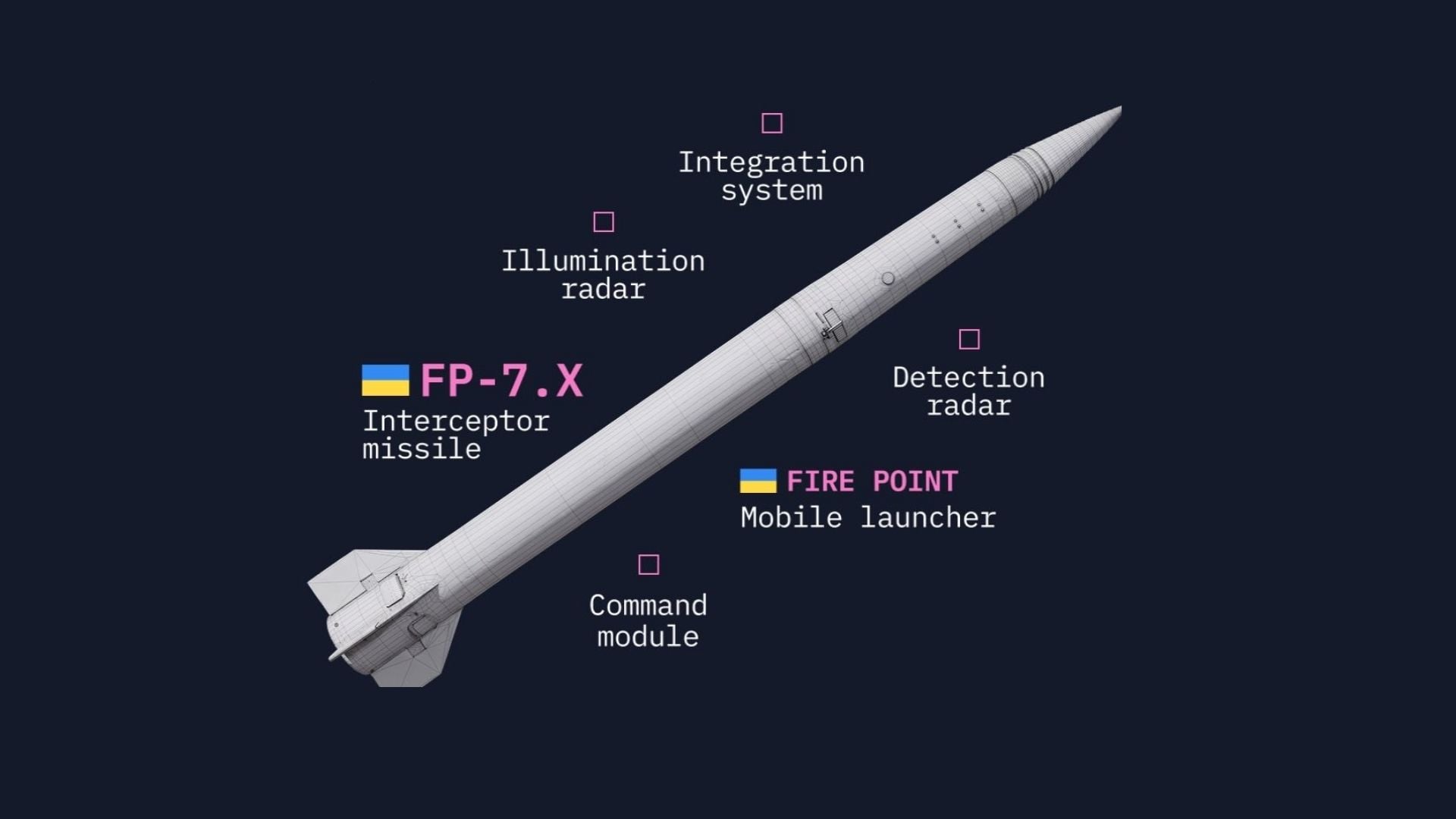
Ukraine has finished its share of Freyja, the multinational anti-ballistic missile defense system built around Fire Point’s FP-7.X interceptor, President Volodymyr Zelenskyy said on October 17, 2026, shifting responsibility for the program’s remaining sensors, seekers and fire-control elements to ten partner nations and their contractors. Fire Point, the Kyiv-based prime contractor, builds the interceptor and its mobile launcher, while firms including Norway’s Kongsberg and Germany’s Diehl Defence develop the components that detect, track and guide it.
“Ukraine has done what it was supposed to do, and that is good news,” Zelenskyy told journalists. “As for what the partners are supposed to do, you know that there are ten participating countries, and they are in the process.” Fire Point confirmed the handover on October 26.
Ukraine’s upper-tier air defense is under mounting strain. Ukrainian Air Force figures cited by Zelenskyy show Russia launching nearly 3,500 jet-powered drones across the country in September, then more than 100 ballistic missiles at Kyiv and its region in roughly two weeks. Civilian casualties for January through September ran 59% above the same period of 2025, according to United Nations data. Against ballistic threats, Kyiv still relies on the MIM-104 Patriot, whose PAC-3 interceptors cost roughly $3.8 million each, can take years to arrive, and have grown scarce: the U.S.-Israel war with Iran is estimated to have consumed about two-thirds of America’s prewar PAC-3 stock.
Freyja Missile Defense Architecture and European Industrial Roles
Fire Point unveiled Freyja in May 2026, and Ukraine and nine European partners, including France, Germany and the United Kingdom, formally launched the coalition in Paris on July 13. Poland joined in September, and Canada has signaled readiness to contribute technology, according to Ukraine’s presidential office.
Under a June agreement with Hensoldt, Fire Point serves as prime contractor and design authority, while the German firm supplies radars such as the TRML-4D, rated by Hensoldt at roughly 1,500 tracked air targets. A preliminary design published in May by Fire Point co-founder and chief designer Denys Shtilerman pairs the FP-7.X with a long-range surveillance radar from Saab, Thales or Hensoldt, a fire-control radar from Weibel or Leonardo, and a command center from Kongsberg, manufacturer of the NASAMS systems already in Ukrainian service.
The architecture is built for NATO interoperability. Freyja would plug into Ukraine’s wider air defense network over Link 16, connect its radars through the ASTERIX surveillance data protocol, and use a two-way datalink to update the interceptor’s trajectory in flight. European partners will provide that datalink and the command center, Reuters reported in June. Most components are designed to be interchangeable, letting each nation field its preferred sensors.
FP-7.X Interceptor Performance, Warhead, and Seeker Integration
The FP-7.X is a faster derivative of Fire Point’s FP-7 ground-launched ballistic missile. Specifications Fire Point released when it unveiled the missile in May put the interceptor at 7.25 meters long with a 0.53-meter body diameter and a flight speed of 1,500 to 2,000 meters per second. Shtilerman said in June the missile can engage ballistic targets below 25 kilometers altitude within an 80-kilometer radius, and Fire Point chief executive Iryna Terekh told Janes in July that speed should grow to 2,200 meters per second, roughly Mach 6.5, as the program matures. None of these figures has yet been validated in an intercept test.
The first production standard will carry a blast-fragmentation warhead, placing it closer to the legacy PAC-2 than the hit-to-kill PAC-3, with intercepts planned at roughly 20 to 25 kilometers altitude, Terekh said in the same interview. That band covers the terminal phase of short-range ballistic missiles such as the Iskander-M. Blast-fragmentation offers less certainty of destroying the warhead than a direct-impact kill, hence the planned hit-to-kill follow-on.
The seeker remains the program’s critical path. Terekh told The War Zone (TWZ) that Fire Point is integrating Diehl Defence’s infrared seeker while developing alternatives with two unnamed partners, and specifications the company posted in late September show a combined infrared and radar seeker configuration. “If we look at everything but the seeker, our production is already ready, even for mass production,” Terekh said. “Even the seeker manufacturers are doing this for the first time in such an integration.”
Cost, Production Targets, and the Race to Initial Testing
Fire Point aims to produce at least 2,000 interceptors per year at under 1 million euros, about $1.2 million, per round, a unit cost Terekh said would come “probably not from the first iterations, but definitely in serial production.” That is roughly one third of a PAC-3; no line at that rate has yet been publicly demonstrated.
Fire Point began integrating European radars and seekers in August, Reuters reported at the time. Shtilerman has said interceptors could be ready by the end of 2026 if European governments move quickly, and Fire Point is targeting battlefield use in July 2027. In Oslo in late October, Zelenskyy, Norwegian Defense Minister Tore Sandvik and Kongsberg chief executive Eirik Lie identified where work “can and must be accelerated to begin testing by the end of this year,” according to Ukraine’s presidential office.
Analysis: The Freyja missile defense program inverts the traditional Western air defense model. Instead of one prime delivering a closed system, a Ukrainian firm supplies a low-cost airframe and propulsion stack while European sensor, seeker and command specialists populate a NATO-standard open architecture. If it works, Europe gains a sovereign lower-tier ballistic missile defense layer and a cost benchmark that could pressure incumbent interceptor pricing. The risk is structural: the system moves only as fast as its slowest subsystem, and Ukraine has delivered the elements easiest to mass-produce. Seeker maturity and fire-control integration against maneuvering targets are exactly where ballistic missile defense programs tend to slip.
The next milestone is a first test campaign before the end of 2026, followed by intercept trials ahead of the July 2027 battlefield target. Key unknowns remain: which seeker will equip the initial production standard, which radars each partner will field, how the coalition will finance serial production, and whether a blast-fragmentation interceptor can achieve acceptable kill probability against Russian ballistic missiles. The year-end test window will show whether European partners can match Ukraine’s pace.