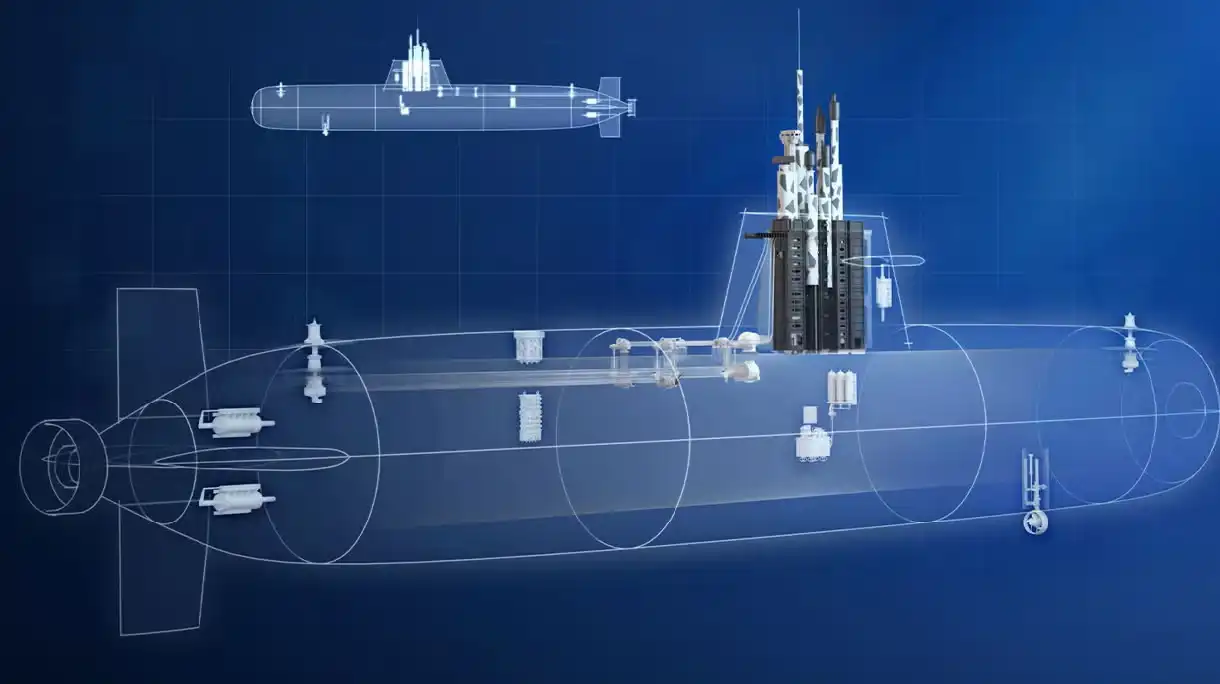
L3Harris Technologies has received two multi-million-dollar contracts from German shipbuilder thyssenkrupp Marine Systems (TKMS) to supply submarine mast-raising equipment and associated electronic control units, the company announced on November 2, 2026. The hardware deploys and retracts the payloads a submarine uses for communications, surveillance and navigation. L3Harris did not disclose contract values, delivery quantities or the hulls covered.
The announcement ties the work to German and Norwegian submarine technology without naming a platform. The only class TKMS is building for both navies is the Type 212CD (Common Design), placed on contract in July 2021 at roughly €5.5 billion for six boats. Germany added four hulls in December 2024 and Norway approved two more on January 30, 2026, lifting the joint order book to 12 submarines, six per navy. Canada then selected TKMS on July 6, 2026, as preferred supplier for up to 12 boats based on the same design.
L3Harris Submarine Mast Raising Equipment and Its Non-Hull-Penetrating Design
The contracts draw on L3Harris’ Italian business, the former Calzoni, founded in Bologna in 1834 and part of the group since 2012. Calzoni introduced non-hull-penetrating mast-raising equipment in the 1960s and, according to company figures, has delivered more than 600 masts to navies worldwide. Its plant at Calderara di Reno handles design, machining, assembly and final testing in-house, and the company also works with the Italian Navy.
A conventional periscope passes through the pressure hull into the control room, which fixes the control room under the sail and creates a penetration that must be sealed and maintained. Mast-raising equipment sits entirely inside the sail, lifting optronic heads, antennas and radar on telescoping stages outside the pressure boundary. Naval architects gain freedom over internal layout, and navies can upgrade sensors without cutting the hull.
L3Harris offers the equipment with hydraulic or electric actuation. The electric version eliminates oil and piping, removing the risk of oil pollution. The company lists communication masts for HF, multi-function and satellite antennas, radar masts, sensor masts for optronics and electronic support measures (ESM) antennas, and the Universal Modular Mast (UMM).
The UMM also equips new-construction US Navy submarines: in April 2026, Naval Sea Systems Command (NAVSEA) awarded L3Harris a contract for UMM production and engineering support worth $20.2 million at award and up to $147.5 million with options, with 78 percent of the work performed in Bologna. L3Harris says the equipment combines high-grade materials with minimal maintenance to raise vessel availability and cut lifecycle costs. It has not said which actuation type TKMS ordered or how many masts each boat will carry.
Type 212CD Sensor Integration and the German-Norwegian Supply Chain
Publicly available specifications put the 212CD at about 73 meters long, against 56 meters for the Type 212A, with a diamond-shaped outer hull to reduce sonar signature and fuel-cell air-independent propulsion. Boats are being built at TKMS yards in Kiel and Wismar.
The class optronic fit is already on contract. In January 2022, Hensoldt received an order worth more than €50 million to equip each boat with an OMS 150 multispectral search mast, an OMS 300 low-signature attack mast and an i360°OS panoramic surveillance system, a fully digital suite replacing the direct-view periscope. L3Harris has not stated which masts its hoists will carry, so whether the TKMS awards cover the optronic masts, the communications and radar masts, or both remains unconfirmed.
The second element of the award, the electronic control units, commands raise and lower sequencing and links the hoists to the boat’s onboard systems. L3Harris has not identified the interface, but that integration work ties the supplier into the class configuration baseline, and a common configuration matters here: German and Norwegian 212CD boats are to be based together in southern Norway and supported from a shared maintenance facility, so identical mast hardware simplifies spares, training and depot work for both navies.
The award places a US-owned company, producing in Italy, inside an industrial team led by TKMS and kta naval systems, a consortium of Kongsberg, TKMS and Atlas Elektronik responsible for the combat system.
“L3Harris is proud to play a major role in shaping the future of European submarine capability,” said Nino DiCosmo, President, Maritime, Space & Mission Systems at L3Harris.
Analysis: The award matters less for its undisclosed value than for its position. With 12 boats ordered by Germany and Norway and up to 12 more planned for Canada, the 212CD is becoming the reference conventional submarine for NATO’s northern and Arctic flanks, and subsystem suppliers selected now stand to ride a production run into the late 2030s. L3Harris’ Bologna footprint lets a US prime compete as a European-sourced vendor as European buyers weigh supply chain sovereignty more heavily.
Open questions remain: contract values, shipset numbers, actuation type, and whether the awards cover all 12 German and Norwegian hulls or an initial tranche. Norway expects its first boat in 2029. Canada aims to finalize its TKMS contract by the end of 2027, with a first Canadian delivery targeted for 2033, the next test of whether L3Harris carries its mast content into a trilateral fleet.