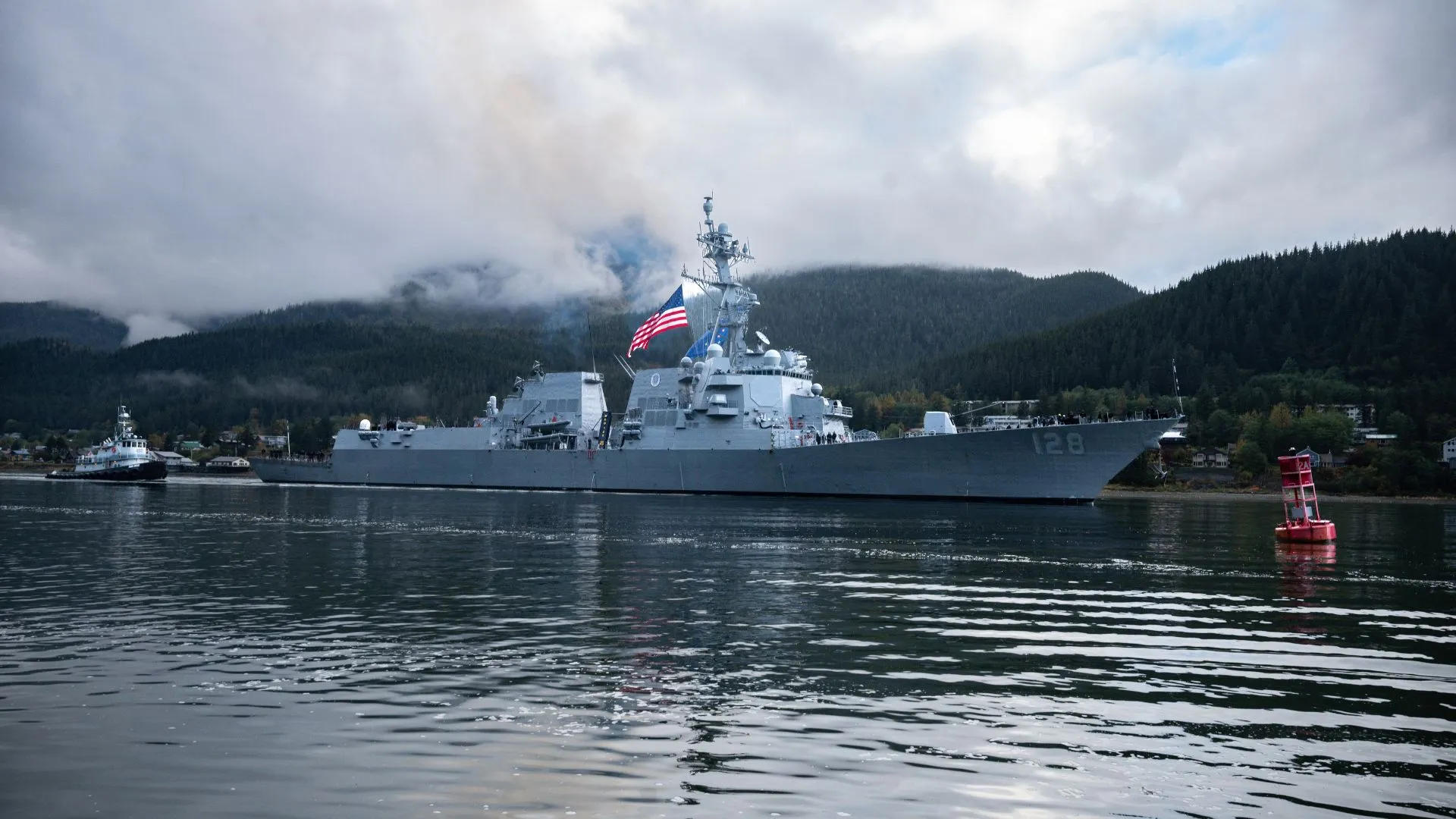
GE Aerospace has received orders for eight LM2500 marine gas turbines to propel the U.S. Navy’s next two Flight III Arleigh Burke-class guided-missile destroyers, the future USS Ray Mabus (DDG 147) and USS Robert R. Ingram (DDG 149), the company announced on November 2, 2026. Each hull will receive four engines, keeping the LM2500 as the sole propulsion prime mover across a class that has formed the backbone of the surface fleet for more than three decades.
The award follows a December 10, 2025, order for eight LM2500s for the future USS Intrepid (DDG 145) and USS Robert Kerrey (DDG 146). According to GE Aerospace, 75 Arleigh Burke-class destroyers were in active service as of April 2026, all driven by LM2500 engines, and the company projects demand for the program out to 2056. The two newest hulls are split between the Navy’s two destroyer yards: Ray Mabus is assigned to Huntington Ingalls Industries’ Ingalls Shipbuilding in Pascagoula, Mississippi, while General Dynamics Bath Iron Works in Bath, Maine, received the construction contract for Robert R. Ingram on May 6, 2026. GE did not disclose the value of the orders or a delivery schedule.
Inside the LM2500 Gas Turbine Powering Flight III Destroyers
The DDG-51 class uses the LM2500-30 variant in a combined gas turbine and gas turbine (COGAG) arrangement, with two engines driving each of the ship’s two shafts through reduction gears to controllable reversible-pitch propellers. Navy fact sheets list total propulsion output at 100,000 shaft horsepower and top speed in excess of 30 knots. Publicly available specifications indicate each LM2500-30 is rated at approximately 26,250 horsepower, up from the roughly 21,500 shp rating of the engine’s earlier Spruance-class configuration.
The LM2500 is an aeroderivative design. Open-source references trace its gas generator to the core of GE’s TF39 and CF6 high-bypass turbofans, paired with a free power turbine that delivers torque to the gearbox. That lineage yields a high power-to-weight ratio and rapid start-up. The COGAG layout lets a destroyer transit on one or two turbines for fuel economy and bring all four online for sprint speed, a flexibility that matters for carrier strike group escort and for repositioning ballistic missile defense pickets.
Because the LM2500 has propelled every hull since USS Arleigh Burke (DDG 51) was commissioned on July 4, 1991, the Navy operates a common engineering plant across Flight I, II, IIA and III ships. That commonality means shared spares, standardized maintenance and a single training pipeline for gas turbine technicians. GE states that hardware improvements proven in industrial and commercial applications are carried into the naval variants, and the company claims 99 percent reliability across more than 55 years of naval service since the first LM2500 went to sea in 1969. The engine family has since expanded to include the LM2500+ and LM2500+G4.
Flight III Power Demands and the AN/SPY-6 Radar
Flight III, which began with DDG 125 and DDG 126 and continues from DDG 128 onward, leaves the propulsion plant unchanged but overhauls electrical generation. The configuration replaces the three 3 MW Rolls-Royce AG9140 ship service gas turbine generators of Flight IIA with three AG9160 sets rated at 4 MW each, raising installed electrical capacity to 12 MW and moving to a 4,160-volt distribution architecture.
The driver for those changes is the Raytheon AN/SPY-6(V)1 Air and Missile Defense Radar, an active electronically scanned array built from 37 Radar Modular Assemblies per array face. It replaces the legacy AN/SPY-1D passive array and is integrated with the Aegis Baseline 10 combat system, enabling simultaneous anti-air warfare and ballistic missile defense. Its added sensitivity against smaller, faster targets makes Flight III ships central nodes in carrier strike group air and missile defense.
The separation between propulsion and ship service power carries operational consequences. The DDG-51 uses a mechanical drive rather than an integrated electric plant, so the roughly 100,000 shp generated by the four LM2500s cannot be redirected to sensors or to future high-power systems such as directed-energy weapons. Combined with the thin weight and space margins widely attributed to Flight III, that caps the electrical load the class can absorb over its service life.
Production Capacity and the Arleigh Burke Industrial Base
“These orders reflect the strength of our long-standing partnership with the U.S. Navy and the confidence they place in the LM2500 platform,” said Asha Belarski, vice president and general manager of GE Aerospace’s Marine Engines and Systems business. “We’re investing in the people and capacity behind this engine, so the Arleigh Burke class continues to have the reliable power that has defined its performance for decades.”
The U.S. Navy has taken delivery of more than 700 LM2500 gas turbines for frigates, destroyers and other surface combatants, and thousands of units are in service with navies worldwide. GE did not specify the scale of its capacity investment or the delivery lead time. The orders also skip the future USS Kyle Carpenter (DDG 148); the release does not address that hull’s propulsion order.
Analysis: The order is routine on its face, but it shows how tightly the Navy’s principal surface combatant is bound to a single propulsion supply chain. With engines now ordered for DDG 145 through DDG 147 and DDG 149 within roughly eleven months, GE’s position is secure for as long as DDG-51 construction continues, and its 2056 demand horizon points to decades of sustainment work on the in-service fleet beyond new builds. Propulsion is not the binding constraint on the program. Shipyard throughput, workforce and the Flight III hull’s limited growth margin are, so engine supply will track construction schedules rather than drive them.
The next milestones are construction starts for DDG 147 at Pascagoula and DDG 149 at Bath, along with any disclosure of LM2500 delivery dates and the propulsion order for DDG 148. Future DDG-51 procurement quantities in upcoming Navy budget requests will determine how far the LM2500 production line extends before the service commits to a successor large surface combatant.