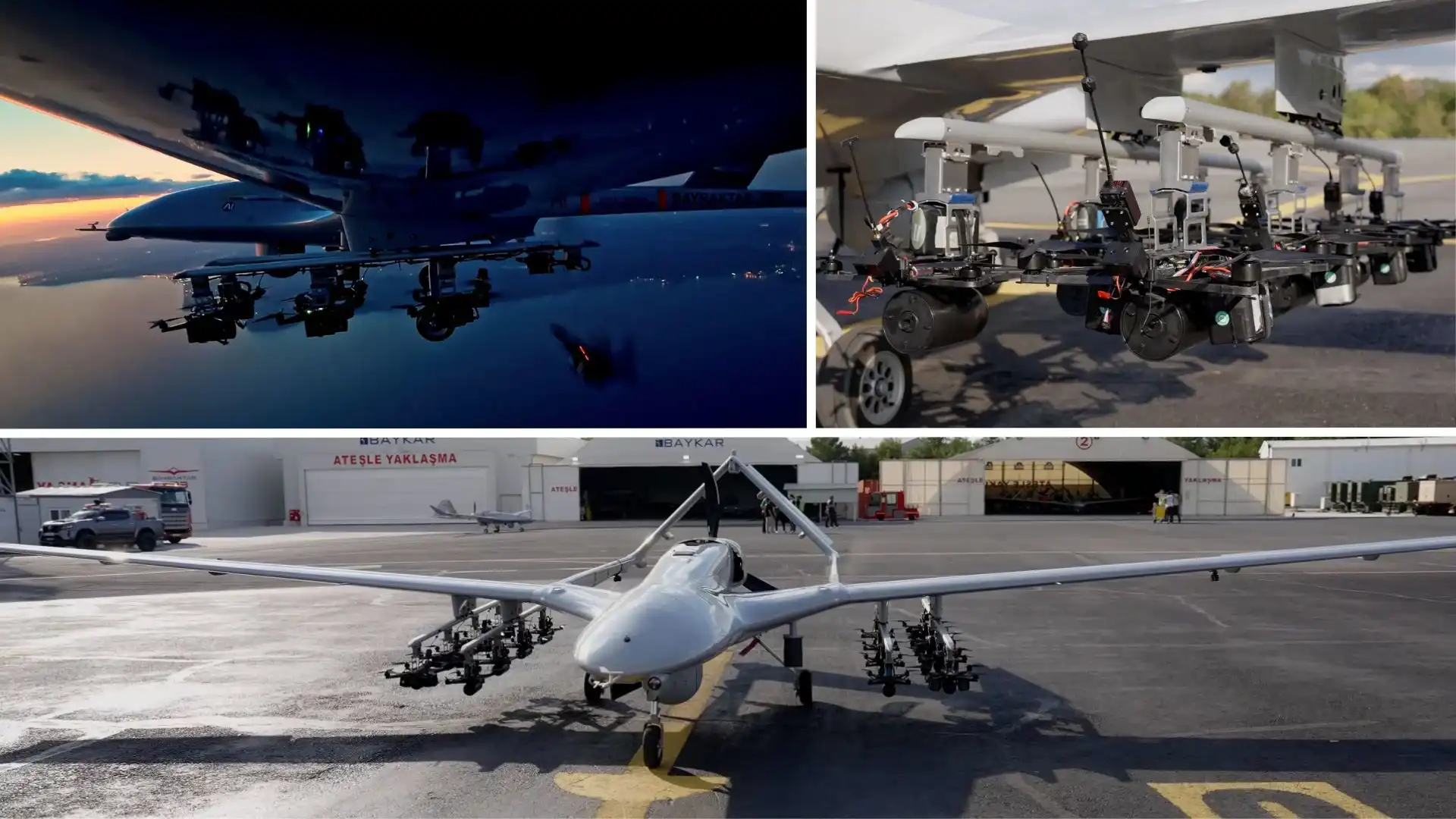
Baykar’s Bayraktar TB2 unmanned combat aerial vehicle (UCAV) released two Skydagger first-person-view (FPV) kamikaze drones during a test flight and struck designated targets, the Turkish manufacturer announced on November 4, 2026. The aircraft took off from the Keşan Flight Training and Test Center in Edirne province carrying 16 Skydagger FPV drones before transiting to the test area.
The trial extends an air-launch concept first shown in November 2025, when a Skydagger 7 FPV drone was dropped from the Bayraktar KALKAN vertical takeoff and landing (VTOL) unmanned aerial vehicle (UAV). Moving the concept onto the TB2, Baykar’s most widely exported platform, matters because of reach: the company reports TB2 export agreements with 36 countries. FPV munitions have become a dominant short-range strike tool in the Russia-Ukraine war, but their effective radius remains capped by battery endurance and the radio horizon of ground-based pilots.
Inside the Bayraktar TB2 FPV Release Test at Keşan
According to Baykar, the two released drones were flown to their targets through a datalink connection relayed by the TB2, with operators controlling them independently of the ground. In this configuration the UCAV serves as carrier and communications node at once: it carries the munitions forward, then sustains control links that a ground team could not hold at that distance or behind terrain masking.
Baykar did not disclose which Skydagger variant was used, the release altitude, the standoff distance, the target type, or the warhead fitted. Imagery released with the announcement shows the munitions carried in clusters on racks under both wings. Skydagger markets 7-inch, 10-inch and 15-inch FPV models; the company says its largest, the Skydagger 15 Plus, carries 10 kg of munitions, while the Skydagger Mini carries a 0.5 kg anti-personnel warhead. A load of 16 airframes points toward the lighter end of the family, though Baykar has not confirmed this.
Baykar lists the TB2 with a 700 kg maximum takeoff weight, a 150 kg payload, a 100 hp-class internal combustion engine, and endurance of more than 18 hours, with a flight record of 27 hours. Pairing that persistence with a 16-round FPV load turns a long intelligence, surveillance and reconnaissance (ISR) orbit into a distributed strike capability, with sensor and shooter on the same sortie and munitions far cheaper than the guided smart munitions the TB2 normally carries.
Skydagger Mass Production Feeds Baykar’s Export Pipeline
Skydagger, a Baykar-backed manufacturer that began producing FPV kamikaze drones in 2024, has scaled quickly. In January 2026, Baykar general manager Haluk Bayraktar said the Skydagger line had reached an annual capacity of 120,000 drones, with motors, flight controllers, batteries, video links and warheads produced domestically. Skydagger general manager Mehmet Öztekin said at the time that the company had shipped some 30,000 drones to 14 countries within a year and a half. The Kosovo Security Force took delivery of thousands of Skydagger FPV kamikaze drones in October 2025, three months ahead of schedule, alongside its existing TB2 fleet.
The parent company supplies the commercial weight behind the concept. Baykar reports exports of $2.2 billion in 2025, about 90% of its revenue, and agreements with 39 countries in total: 36 for the TB2 and 16 for the AKINCI UCAV.
Analysis: The test reflects a broader shift from scarce precision munitions toward cheap, mass-produced effectors launched from reusable carriers. For TB2 operators, many of which lack deep-strike assets, a qualified FPV launch package would extend the reach of disposable munitions without new airframes, and Baykar can sell carrier and payload as a single package. The limitation is survivability: the TB2 is a slow, medium-altitude platform, so the mothership role fits permissive or degraded air-defense environments far better than airspace covered by layered integrated air defense systems.
Baykar has not said whether the capability is cleared for operational use or offered for export, or when it will move to the TB3, AKINCI and KIZILELMA, all of which Skydagger has publicly named as future launch platforms. Open questions include the terminal guidance mode, the maximum relay range, and whether later trials will employ all 16 drones in coordinated swarm attacks.