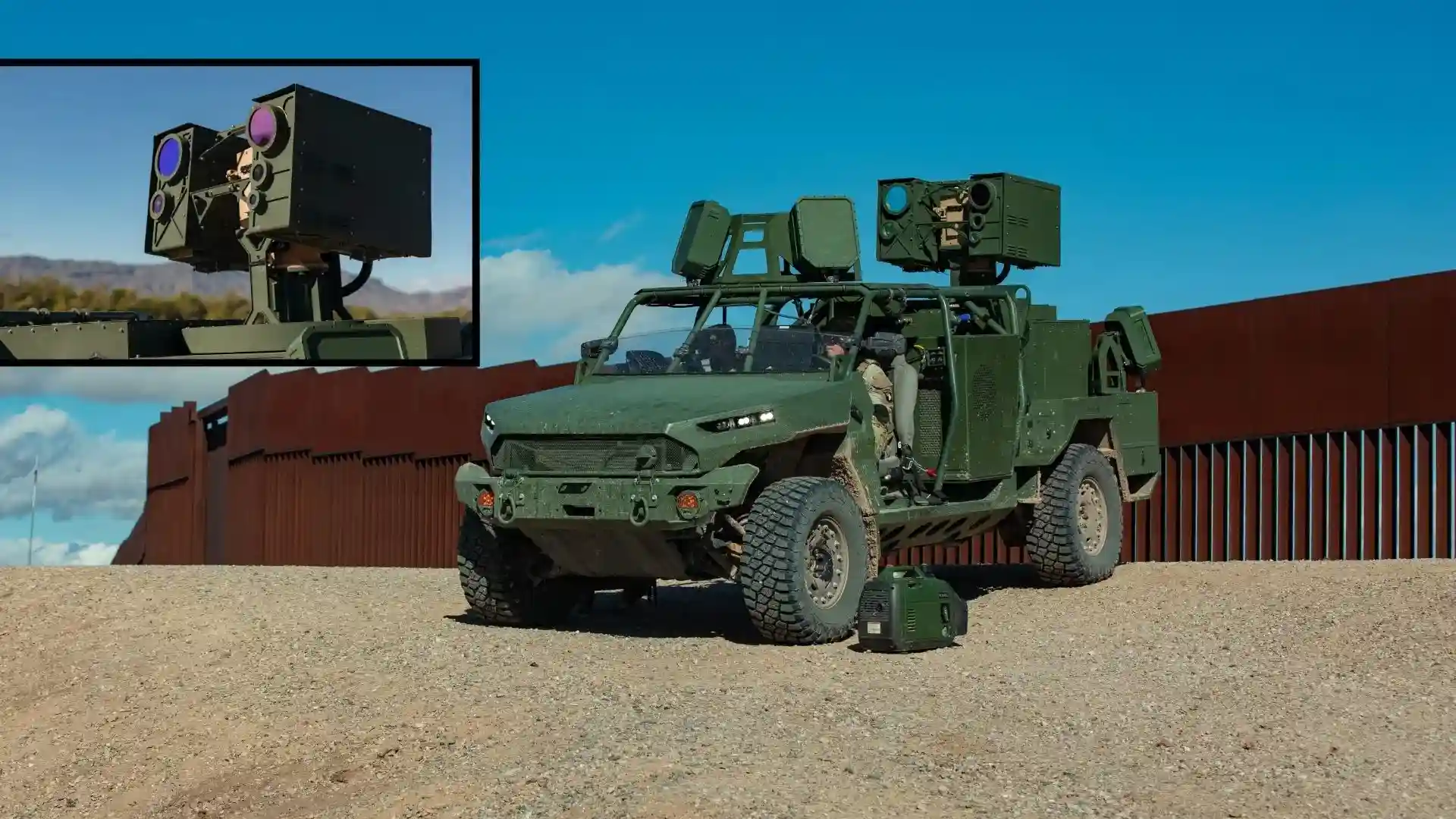
U.S. Army soldiers from the 2nd Battalion, 327th Infantry Regiment, 101st Airborne Division, trained on the Army Multi-Purpose High Energy Laser (AMP-HEL) near Fort Hancock, Texas, on November 2, 2026, operating the 20-kilowatt counter-drone weapon from an Infantry Squad Vehicle (ISV) along the U.S.-Mexico border, according to imagery released by the Department of War on November 3.
The soldiers are assigned to Joint Task Force-Southern Border (JTF-SB), which operates under U.S. Northern Command (USNORTHCOM) as part of Operation Ardent Vanguard. The training follows the system’s first operational use against cartel-linked drones in late August, and the military now describes AMP-HEL as in use for counter-unmanned aircraft system (C-UAS) operations on the border. The Department of War has not disclosed how many laser-armed vehicles the task force fields or how often they are employed.
AMP-HEL Laser on the Infantry Squad Vehicle: Program and Specifications
AMP-HEL is a prototyping effort managed by the Army Rapid Capabilities and Critical Technologies Office (RCCTO). In 2023, the office awarded BlueHalo a $45.7 million base Other Transaction Authority agreement, with $30.2 million in options, to integrate a 20-kilowatt-class laser on the ISV to protect division and brigade combat teams. BlueHalo was later acquired by AeroVironment (AV), which builds the weapon around its LOCUST Laser Weapon System.
AV delivered the first increment, two LOCUST systems integrated on General Motors Defense ISVs, in September 2025, after government acceptance testing at Yuma Proving Ground, Arizona, and new equipment training at Fort Sill, Oklahoma. A second increment of two Joint Light Tactical Vehicles (JLTV) with the same laser, radar and command-and-control systems was scheduled to follow, and the Army has since received additional mobile laser systems.
LOCUST pairs the laser with precision optics, beam control and AI-enabled tracking software to detect, identify and engage targets. The manufacturer says it defeats Class 1 and Class 2 unmanned aircraft. A LOCUST-based Palletized High Energy Laser (P-HEL) previously deployed overseas as the Army’s first operational high-energy laser counter-small UAS capability.
Publicly available specifications indicate the ISV is derived from the Chevrolet Colorado ZR2 commercial chassis, carries a nine-soldier squad, and can be sling-loaded by a UH-60 Black Hawk or airdropped. The mount gives light infantry an organic, non-kinetic counter-drone option that moves with the unit rather than depending on fixed air defense sites. Each shot draws on electrical power rather than a finite stock of interceptors, which favors the defender against inexpensive commercial quadcopters. AV has not released engagement range, dwell time per kill or sustained magazine depth for the ISV configuration; those parameters remain unknown.
Border Engagement Record and FAA Airspace Clearance Since August
JTF-SB first used AMP-HEL against cartel-linked drones on the nights of August 25 and 26, 2026, downing three aircraft that USNORTHCOM said supported activities posing a physical threat to U.S. military and U.S. Customs and Border Protection (CBP) personnel. The command did not specify the engagement site, though later media reports placed it in Texas’s Rio Grande Valley. By September 4, USNORTHCOM put the laser tally at 11 drones.
“Cartel networks are increasingly employing unmanned aircraft systems to facilitate illicit human-smuggling,” said Maj. Gen. Curtis Taylor, commander of JTF-SB, in August.
Across a 30-day period ending in late September, JTF-SB logged 378 drone detections, 75 turnbacks, 15 takedowns and one captured drone, Taylor said during a counter-drone exercise on the southern border, Breaking Defense reported. He added that a high-energy laser downed two more cartel-linked drones on September 24. Officials said most were commercial quadcopters flying reconnaissance in support of human smuggling. Hard kills remain a small share of encounters.
Firing a laser near busy civil airspace required coordination with the Federal Aviation Administration (FAA). After an unannounced airspace closure around El Paso International Airport in February caused confusion among local, state and federal officials, the military and the FAA completed a safety assessment of border laser use in April. The FAA concluded the systems do not increase risk to the flying public. USNORTHCOM says it supports the Department of Homeland Security and CBP within “narrowly defined authorities.”
Analysis: The southern border has become the Army’s first sustained operational test bed for a vehicle-mounted laser in domestic airspace. Crews are generating engagement data against real small drones in desert clutter, under FAA deconfliction rules, with a light airborne formation rather than a dedicated air defense unit. That data will inform how high-energy lasers move from prototypes into fielded division-level capability. The caveat is threat realism: commercial quadcopters on reconnaissance flights are not the massed, faster or hardened drones seen in Ukraine, so border results do not predict performance in high-intensity combat.
Key unknowns remain the number of AMP-HEL systems assigned to JTF-SB, whether the JLTV variant is also deployed there, and how border data will shape the Enduring-High Energy Laser (E-HEL) program, under which the Army awarded AeroVironment a $464.8 million production agreement on September 2 for the 30-kilowatt LOCUST X3. The next indicators will be updated USNORTHCOM engagement figures and directed energy funding lines in the fiscal 2028 budget request.