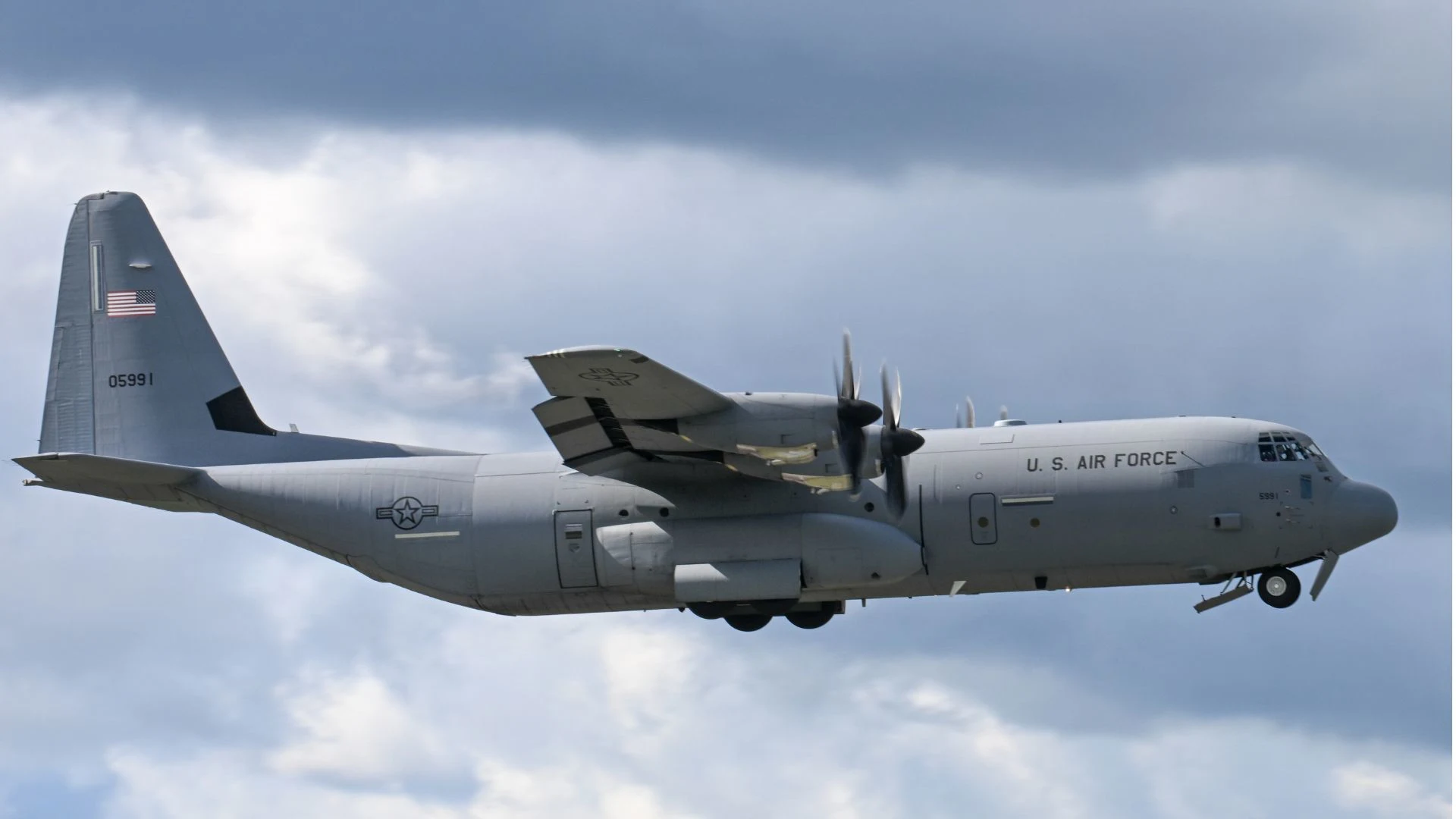
The US Air Force has awarded Georgia Tech Applied Research Corp. of Atlanta a $9,896,783 cost-plus-fixed-fee task order to develop the electronic warfare Mission Data Test Station for the AN/ALQ-251 radio frequency countermeasures (RFCM) system fitted to Royal Australian Air Force (RAAF) C-130J airlifters, according to a Pentagon contract announcement dated November 4, 2026. The sole-source award covers development, documentation, delivery and initial maintenance of the station, with work split between Atlanta and Robins Air Force Base, Georgia, and completion expected by November 4, 2028. The Air Force Life Cycle Management Center (AFLCMC) at Robins is the contracting activity under order FA8523-27-F-B003.
The full $9,896,783 comes from Foreign Military Sales (FMS) funds obligated at award, making Australia the paying customer. The order builds on Canberra’s 2025 selection of the Northrop Grumman AN/ALQ-251 for its Super Hercules fleet and follows a $175.65 million sole-source contract to Northrop Grumman for a modified ALQ-251 configuration tailored to the RAAF C-130J-30 program, with work running to March 27, 2029. Australia committed in July 2023 to 20 new C-130J-30 aircraft under Project AIR 7404 Phase 1, valued at AUD 9.8 billion, to replace and expand the 12 C-130J-30s that No. 37 Squadron has operated from RAAF Base Richmond since 1999. Australian Defence plans deliveries from 2028.
ALQ-251 Mission Data Test Station: Scope of the Georgia Tech Award
An RFCM suite is only as effective as the threat data loaded into it. Mission data defines the emitter parameters the system must detect, identify and geolocate, and the jamming techniques it applies against each radar. Those libraries have to be built, exercised against representative signals and validated before release to aircrews, then updated as adversary radars change waveforms or operating modes. A mission data test station is the laboratory environment that supports that reprogramming cycle.
The contract notice does not state whether the station will remain in the United States or be delivered to an Australian facility, how many test assets it includes, or which threat sets it will host. Those details remain unconfirmed.
Georgia Tech Applied Research Corp. contracts on behalf of the Georgia Tech Research Institute (GTRI), a University Affiliated Research Center that has supported the AFLCMC Electronic Warfare and Avionics program office at Robins for more than 30 years. Its Warner Robins field office lists C-130 tactical airlift sustainment and Air Force Special Operations Command (AFSOC) mission programming among the organizations it supports. That background is consistent with a sole-source award, although the notice does not publish the justification.
How the AN/ALQ-251 Protects the RAAF C-130J-30 Fleet
The AN/ALQ-251 is a digital RFCM system combining radar warning, threat identification, precision geolocation and active countermeasures within a modular, open systems architecture. Northrop Grumman states the system can detect complex emitters including millimeter-wave frequencies, a band increasingly used by fire-control and missile seeker radars. The company has not publicly released frequency coverage, effective radiated power or the number of threats the system can engage simultaneously.
The system’s US program of record is the US Special Operations Command (USSOCOM) RFCM upgrade for the AC-130J Ghostrider gunship and the MC-130J Commando II. Sierra Nevada Corporation received a $700 million integration contract in July 2020, succeeding the BAE Systems RFCM effort awarded in 2016, and completed the first AC-130J installation in early 2022 to support developmental and operational testing. Commonality with that program gives the RAAF access to an established production line, shared logistics and a proven integration baseline on the C-130J airframe.
The 2022 FMS notification for up to 24 Australian aircraft paired 32 ALQ-251 sets with a layered defensive aids suite: the AN/AAQ-24(V)N Large Aircraft Infrared Countermeasures (LAIRCM) system, AN/AAR-47 missile warning, AN/ALR-56 radar warning receivers and AN/ALE-47 countermeasures dispensers. Infrared countermeasures address shoulder-fired missiles around airfields; the ALQ-251 covers the radar-guided surface-to-air and air-to-air threats an airlifter faces at longer range.
Analysis: The test station is the least visible element of Australia’s ALQ-251 acquisition, yet it determines how quickly the system can respond to new threats. Hardware commonality with USSOCOM reduces integration and sustainment risk; mission data is where national requirements diverge. Because the RAAF configuration is a modified variant, its mission data and test tooling likely cannot be lifted directly from the special operations baseline. A dedicated station indicates Canberra wants a validated reprogramming path for threat libraries matched to Indo-Pacific emitters before its new Hercules fleet enters service.
The station is due by November 4, 2028, broadly in step with the first AIR 7404 deliveries planned from 2028. Open questions include how many ALQ-251 sets Australia will ultimately field now that Canberra has ordered 20 aircraft rather than the 24 covered by the 2022 notification, whether the legacy C-130J-30s will receive the system before retirement, and where the station will be operated. Progress on Northrop Grumman’s modified configuration, due by March 2029, will set the pace for both.