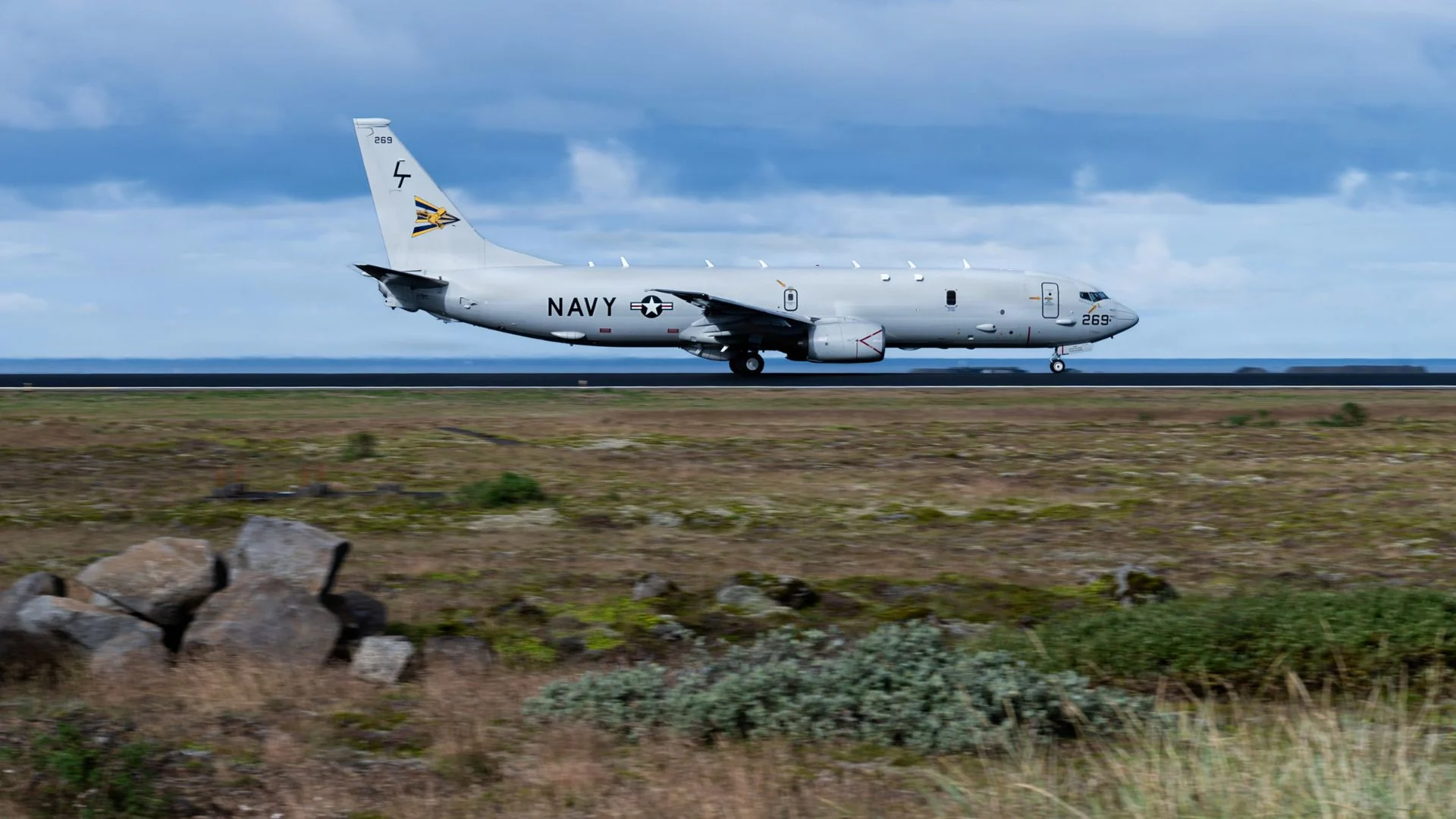
The U.S. Navy has awarded Boeing a $119,654,234 cost-plus-fixed-fee modification to procure nine more P-8A Poseidon retrofit A-kits with Increment 3 Block 2 (I3B2) Engineering Change Proposal 6 (ECP 6) capabilities, seven for Navy aircraft and two for the Royal Australian Air Force (RAAF), according to the Pentagon’s November 4, 2026, contract announcement. The modification, P00001 to order N0001926F1095, also funds the installation of four retrofit A-kits and their government-furnished B-kits on Navy P-8As.
The award exercises options on an order issued in June 2026 under Boeing’s P-8A basic ordering agreement, N0001926G1002. That initial order covered nine A-kits, six for the Navy and three for Australia, three Navy installations, and non-recurring engineering to address diminishing manufacturing sources tied to I3B2. With this modification, the order now totals 18 A-kits, 13 for the Navy and five for the RAAF, plus seven Navy installations. It follows the Navy’s declaration of Initial Operational Capability (IOC) for I3B2 on April 24, 2026, after initial operational testing by Air Test and Evaluation Squadron One (VX-1) at Naval Air Station Patuxent River, Maryland.
What the P-8A Increment 3 Block 2 Retrofit Kits Deliver
A-kits are the permanent provisions Boeing builds into the airframe: per the Navy, I3B2 adds new airframe racks, a new radome, antennas, sensors, and wiring. B-kits are the mission equipment itself, which the Navy procures separately and furnishes to the installer. That split lets the service control the classified avionics supply chain while Boeing handles the structural and integration work.
The mission package centers on a new combat systems suite with improved computer processing and a higher security architecture, a wideband satellite communications system, an anti-submarine warfare (ASW) signals intelligence capability, a track management system, and additional communications and acoustic systems. Program documentation describes ECP 6 as the combat system architecture upgrade carrying higher-than-Secret processing, Minotaur track management, and wideband SATCOM, while a follow-on ECP 7 adds enhanced multistatic active coherent (MAC) sonobuoy processing.
Each element has a direct operational payoff. Higher-than-Secret processing lets crews fuse classified cueing on board rather than waiting on ground analysis. Minotaur merges radar, acoustic, and electronic tracks into a single picture, and wideband SATCOM pushes that picture to carrier strike groups and maritime operations centers in near real time. I3B2 completes the spiral that began with Increment 1, which reconstituted P-3C Orion capabilities, and continued through Increment 3 ECP 5, which brought Link 16 net-enabled weapon messaging and the Harpoon Block II+ missile. The Navy now treats I3B2 as the baseline for future rapid capability insertion efforts.
Jacksonville Workload and RAAF Cooperative Funding Behind the Order
Boeing will perform 79.6% of the work in Jacksonville, Florida, 10.9% in St. Louis, Missouri, and 9.5% in Mesa, Arizona, with completion expected in May 2030. Jacksonville hosts Boeing’s maintenance, repair, and overhaul hangar at Cecil Airport, where the first fleet P-8A was inducted for I3B2 modification on March 27, 2024, and returned to the Navy in June 2025.
The obligation combines $110,156,192 in fiscal 2027 Navy aircraft procurement funds with $9,498,042 in RAAF cooperative partner funds, roughly 7.9% of the total. The award was not competitively procured. Naval Air Systems Command (NAVAIR) nonetheless issued a sources-sought notice in July 2026 for I3B2 kit installation, citing an estimated turnaround exceeding six to eight months per aircraft and asking vendors whether they could store and integrate classified government property, including COMSEC equipment.
Australia is the first international P-8A customer to receive Increment 3 modifications, according to Boeing. Its first aircraft entered modification in Jacksonville in October 2025, and Boeing plans to upgrade the first two RAAF P-8As there, while Boeing Defence Australia modifies the remaining aircraft at its facility near RAAF Base Edinburgh. This modification buys RAAF kits but no RAAF installations, consistent with that in-country path. The announcement does not disclose unit cost per kit or per installation.
Analysis: The constraint on I3B2 is throughput, not money. Seven Navy installations funded through May 2030, at a turnaround the Navy itself estimates exceeds six months per aircraft, means the service will fly a mixed-configuration P-8A fleet for years after IOC. The July sources-sought notice suggests NAVAIR is testing whether a second installation line could compress that timeline. Australian co-funding, meanwhile, keeps the two fleets on a common software and sensor baseline, which preserves shared tactics, sonobuoy processing, and logistics for combined ASW operations in the Indo-Pacific.
Next milestones include further option exercises on this order, any installation contract emerging from the sources-sought effort, and the pace of RAAF inductions at Edinburgh. The Navy has not publicly stated how many fleet aircraft have completed I3B2 modification to date.