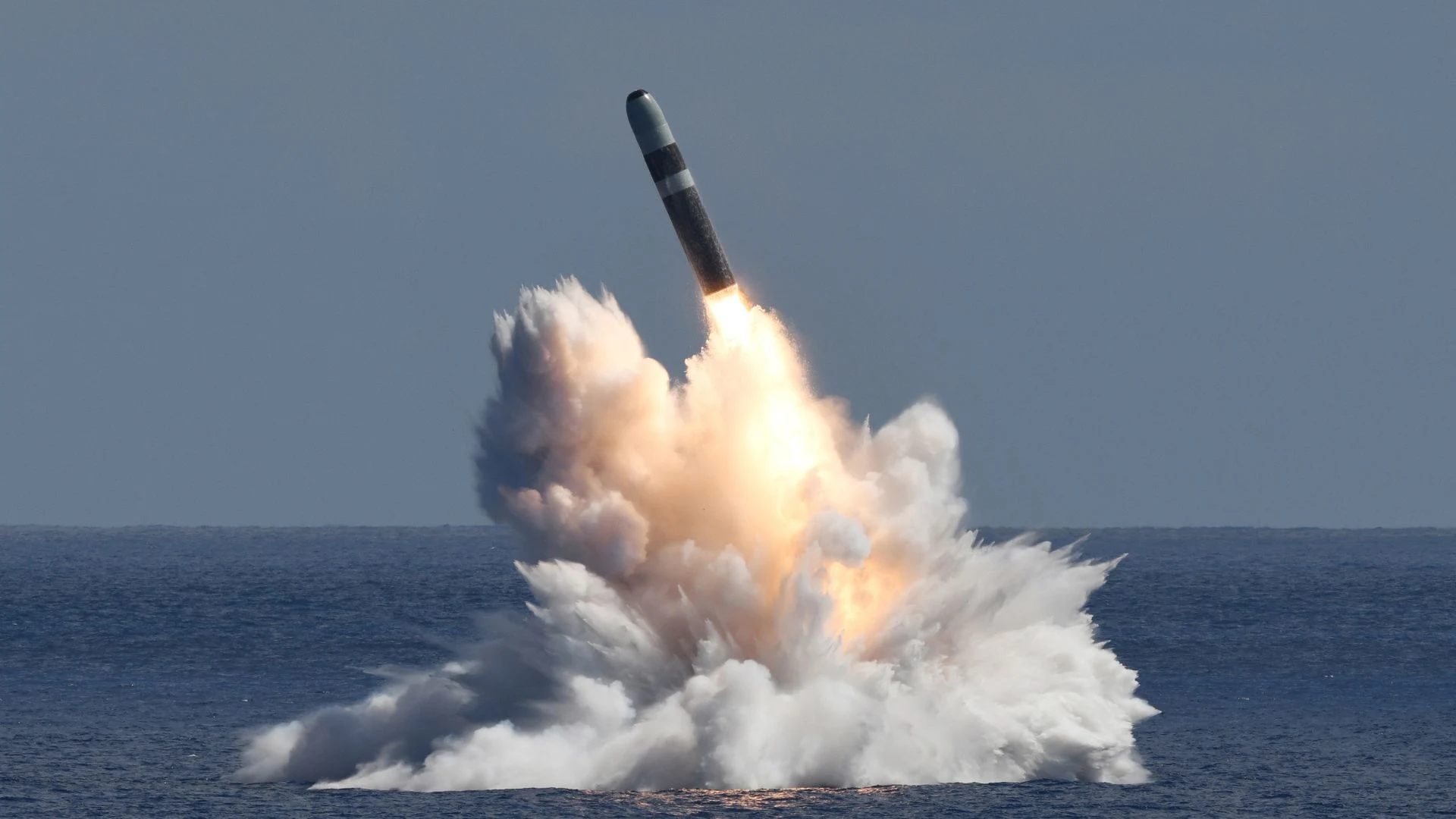
The US Navy has awarded Lockheed Martin Rotary and Mission Systems of Mitchel Field, New York, a $122,449,494 sole-source contract to support the Trident II D5 Strategic Weapon System navigation subsystem, including development work under Shipboard Integration Increment 8. The cost-plus-incentive-fee and cost-plus-fixed-fee award (N0003027C3015), announced by the Pentagon on November 4, 2026, also supports a Foreign Military Sale to the United Kingdom and runs through October 31, 2030.
The contract lands as both Trident operators prepare to change submarines. The Navy is replacing its 14 Ohio-class ballistic missile submarines (SSBNs) with a planned 12 Columbia-class boats, while the Royal Navy will retire its four Vanguard-class SSBNs in favor of the Dreadnought class. Both new designs share the Common Missile Compartment and will deploy first with the life-extended Trident II D5LE. Previous Strategic Systems Programs (SSP) notices tied Shipboard Integration Increment 8 directly to Columbia and Dreadnought navigation hardware and software, and Lockheed Martin received a $1.17 billion award covering Trident fleet support, Increment 8 and navigation subsystem development in October 2024.
Trident II Navigation Subsystem Contract: Funding and Work Share
The $122.4 million figure includes optional line items, and the notice does not disclose the value of the base award or the options. Only $29,190,585, roughly 24% of the ceiling, will be obligated at award, drawn from three fiscal 2027 Navy appropriations: $3,967,324 in operations and maintenance, $12,257,072 in other procurement, and $12,966,189 in shipbuilding and conversion. The operations and maintenance funds expire at the end of the current fiscal year, on September 30, 2027.
That appropriation mix maps onto the scope. Operations and maintenance money typically sustains in-service equipment, here the navigation suites aboard Ohio-class boats still on patrol. Other procurement funds hardware buys, while shipbuilding and conversion dollars are tied to new-construction hulls, consistent with navigation equipment destined for Columbia-class submarines.
Lockheed Martin will perform 77% of the work at Mitchel Field, 20% in Huntington Beach, California, 2% in Manassas, Virginia, and the remaining 1% at various other locations. The Portfolio Acquisition Executive Strategic Systems Programs in Washington, D.C., is the contracting activity. It justified the sole-source award under 10 U.S. Code 3204(a)(1) and (a)(4), the provisions covering a single responsible source and acquisitions dictated by an international agreement or by a foreign government that reimburses the cost.
How SSBN Navigation Underpins Trident II D5 Launch Accuracy
A ballistic missile is only as accurate as its knowledge of where it starts. Publicly available specifications indicate the SSBN navigation subsystem supplies continuous own-ship position, velocity and heading data to the fire control system, which uses it to initialize each missile’s Mk 6 astro-inertial guidance before launch. Any error in launch-point data carries through to the reentry bodies. Earlier SSP contracts with the same Lockheed Martin unit described inertial navigation system and gyro modification and repair for both navies, along with a refresh of the Electrostatically Supported Gyro Navigator.
The missile it serves remains the backbone of both deterrents. According to the Navy’s public fact file, the three-stage, solid-fuel Trident II D5 is 44 feet long, weighs about 130,000 pounds, and has a range greater than 4,000 nautical miles with multiple independently targetable reentry vehicles.
Navigation work also has to bridge two missile generations. SSP plans to field Columbia hulls 1 through 8 with the D5LE, then introduce the D5 Life Extension 2 (D5LE2) on hull 9 in fiscal 2039 and backfit the earlier boats during maintenance periods through 2049. Because Columbia is designed to serve until 2084, the subsystem developed now must support a weapon system that will be upgraded around it for decades. SSP brought its Strategic Weapons Systems Ashore test facility online in November 2025 to validate such alterations before they reach the fleet.
Analysis: The award shows how tightly the US and UK deterrents are bound at the subsystem level. One prime, with 77% of the work at a single site, underpins navigation for four submarine classes across two navies, which is why SSP can invoke both the sole-source and international-agreement exemptions. That commonality shares costs and keeps configurations aligned under the Polaris Sales Agreement framework, but it also concentrates risk: a technical or industrial slip at Mitchel Field would hit the Columbia and Dreadnought timelines at the same time. The modest obligation at award points to incremental, year-by-year funding.
The October 31, 2030, completion date coincides with the Navy’s goal of sending the lead Columbia-class boat, District of Columbia (SSBN-826), on its first deterrent patrol in 2030. Open questions include the value of the options, the UK funding share, and how this award relates to the October 2024 Increment 8 contract, which carried a 2031 completion date. The fiscal 2028 budget request will show whether funding keeps pace with the navigation schedule.