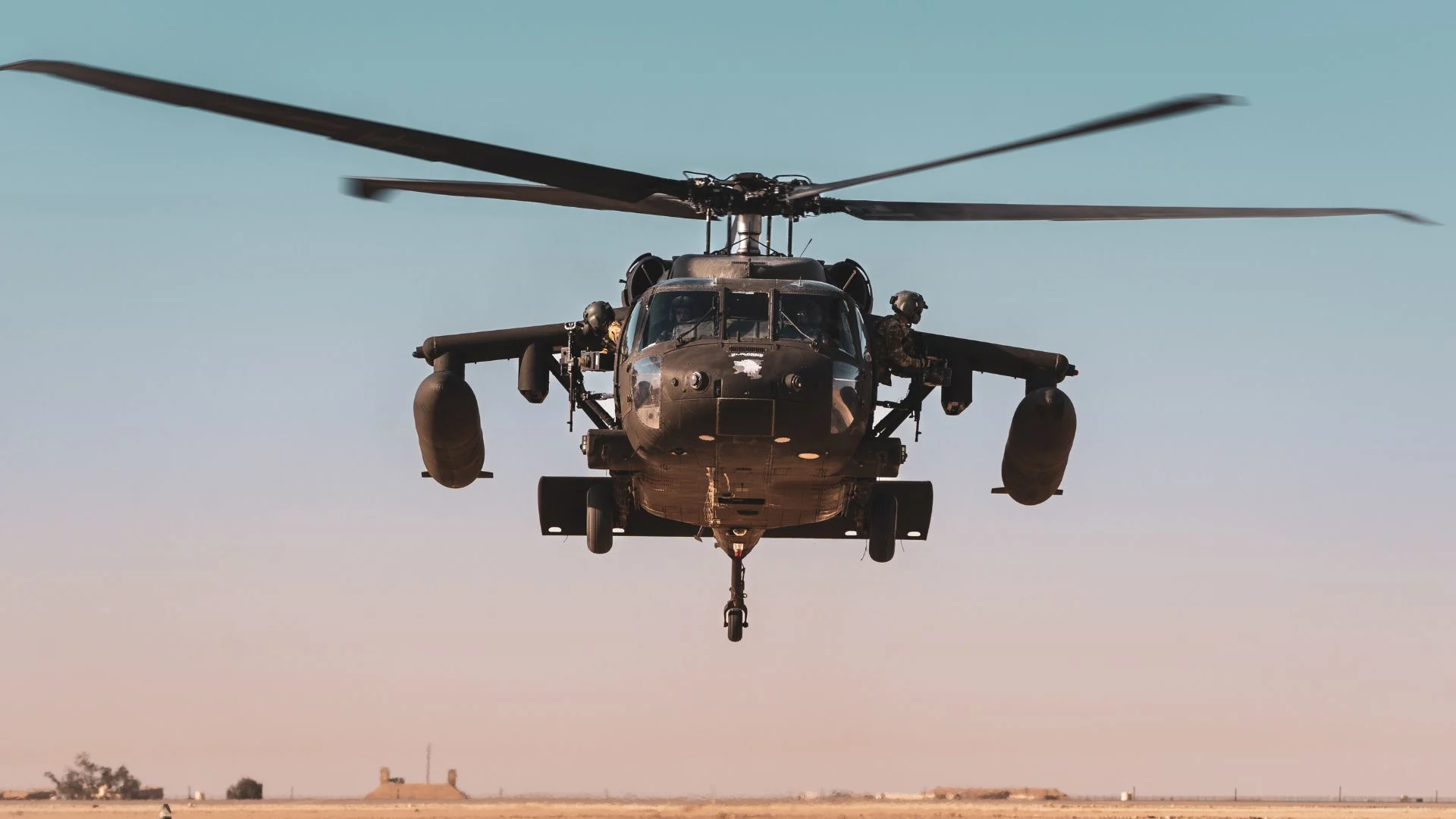
On November 6, 2026, the US State Department approved a possible Foreign Military Sale (FMS) to Mexico of 11 UH-60M Black Hawk helicopters, 27 General Electric T700-GE-701D engines and a full mission and support package, at an estimated $1.075 billion. Sikorsky, a Lockheed Martin company based in Stratford, Connecticut, is named principal contractor under Transmittal 26-104, which now goes before Congress.
The package would expand an existing UH-60M fleet flown by the Mexican Air Force (Fuerza Aérea Mexicana, FAM) and the Mexican Navy (Secretaría de Marina, SEMAR), which lists 10 of the type. The FAM’s main batch stems from an April 2014 FMS case for 18 helicopters valued at $680 million, and its UH-60Ms equip Air Squadrons 107 and 108, based in Culiacán, Sinaloa, and Monterrey, Nuevo León. The approval arrives as Washington and President Claudia Sheinbaum’s government deepen intelligence sharing and joint training against cartels, and the State Department ties it directly to counter-drug airlift.
Mexico Black Hawk Package: Engines, Navigation, and Secure Communications
The quantities point to a sustainment buy layered on top of the airframes. Twenty-seven T700-GE-701D engines equal 22 installed units plus five spares, a deeper reserve than in the 2014 case, where 40 engines covered 36 installed and four spares. The same 27-unit count applies to the EAGLE-M+429 Embedded Global Positioning System/Inertial Navigation System (EGI), consistent with the UH-60M’s dual-EGI architecture plus spares, and to the AN/ARC-231A RT-1987 VHF/UHF/line-of-sight satellite communications radio.
Publicly available specifications indicate each 701D produces 1,994 shp for 10 minutes and 1,716 shp at maximum continuous rating, feeding an Improved Durability Gearbox and wide-chord composite rotor blades. The UH-60M is rated at a 22,000-lb maximum gross weight, a 9,000-lb external hook load and 11 troops, cruises at about 151 kt and offers roughly 276 nm of internal-fuel range without reserve. The internal auxiliary fuel tank systems in the package extend that radius for long transits between garrisons and remote landing zones, reducing dependence on forward fuel caches.
Navigation gear is built for national and civil airspace as much as tactical work: an AN/ARN-147(V) VOR/instrument landing system receiver, AN/ARN-149(V) automatic direction finder, AN/ARN-153 tactical air navigation (TACAN) set, RACC-209 radar altimeter, AN/ARC-220 HF radio, RDR-7000 color weather radar and Traffic Alert and Collision Avoidance System I. An APX-128 identification friend or foe (IFF) transponder, KIV-79 cryptographic appliqué computers and the AN/PYQ-10 Simple Key Loader complete a US-standard identification and keying chain, while a country-unique instrument panel and cockpit multi-function display adapt the glass cockpit to Mexican requirements.
How the UH-60M Mission Kit Supports Counter-Drug Air Assault
The mission equipment defines these aircraft as armed assault and recovery platforms. Ballistic armor protection systems and M-134 7.62 mm rotary machine guns pair with a fast rope insertion and extraction system, an airframe-mounted rescue hoist with dedicated equipment sets and AN/AVS-6 night vision goggles. That combination supports night insertion of ground teams into improvised landing zones, followed by casualty or personnel recovery where the helicopter cannot set down, as well as the hurricane and flood relief flown under the Defense Secretariat’s Plan DN-III-E and the Navy’s Plan Marina.
The L3Harris WESCAM MX-10D electro-optical/infrared turret adds a laser designator, illuminator, pointer and rangefinder, plus a cabin viewer that lets a team leader in the back follow the sensor feed during the approach. The package lists no laser-guided munitions, so the designator would serve to mark targets for ground units or other aircraft. Engine inlet barrier filters address dust and debris ingestion on unprepared landing zones, and an upturned exhaust system is intended to reduce the infrared signature seen from the ground.
The list carries no aircraft survivability equipment: no missile warning system, radar warning receiver or countermeasures dispenser. That suggests Mexico is sizing protection against ground fire from small arms, heavy machine guns and rocket-propelled grenades rather than man-portable air defense systems, or sourcing such equipment through a separate channel. The notification also does not name the receiving service, leaving open whether the aircraft go to the FAM, SEMAR or the National Guard, which now sits under the Secretariat of National Defense (SEDENA).
Analysis: The figure that stands out is cost per tail. Across 11 airframes, the $1.075 billion estimate works out to about $97.7 million per helicopter, against roughly $37.8 million in the 2014 case, a jump that reflects sensor, armor and spares content as well as inflation. Notification values are ceilings, not contract prices: Sikorsky’s 2014 award for the FAM’s 18 green airframes totaled $203.6 million. The larger signal is consolidation. The release does not say which types the UH-60M would displace, but each Black Hawk added reduces reliance on Russian-built Mi-17s, whose support chain carries secondary sanctions exposure under the Countering America’s Adversaries Through Sanctions Act, and binds Mexico more tightly to US logistics, training and cryptographic support.
Congress now has 30 days to review the notification under the Arms Export Control Act. Absent objection, the two governments can negotiate a Letter of Offer and Acceptance, after which a Sikorsky production contract would set delivery dates, which the notification does not specify. Open questions include the end-user service, whether the 11 aircraft absorb the seven-helicopter FAM requirement reported in Mexican budget planning in February 2026, and any offset terms, which the US government says it is not aware of. Fifteen US government or contractor personnel would deploy to Mexico for fielding and training.