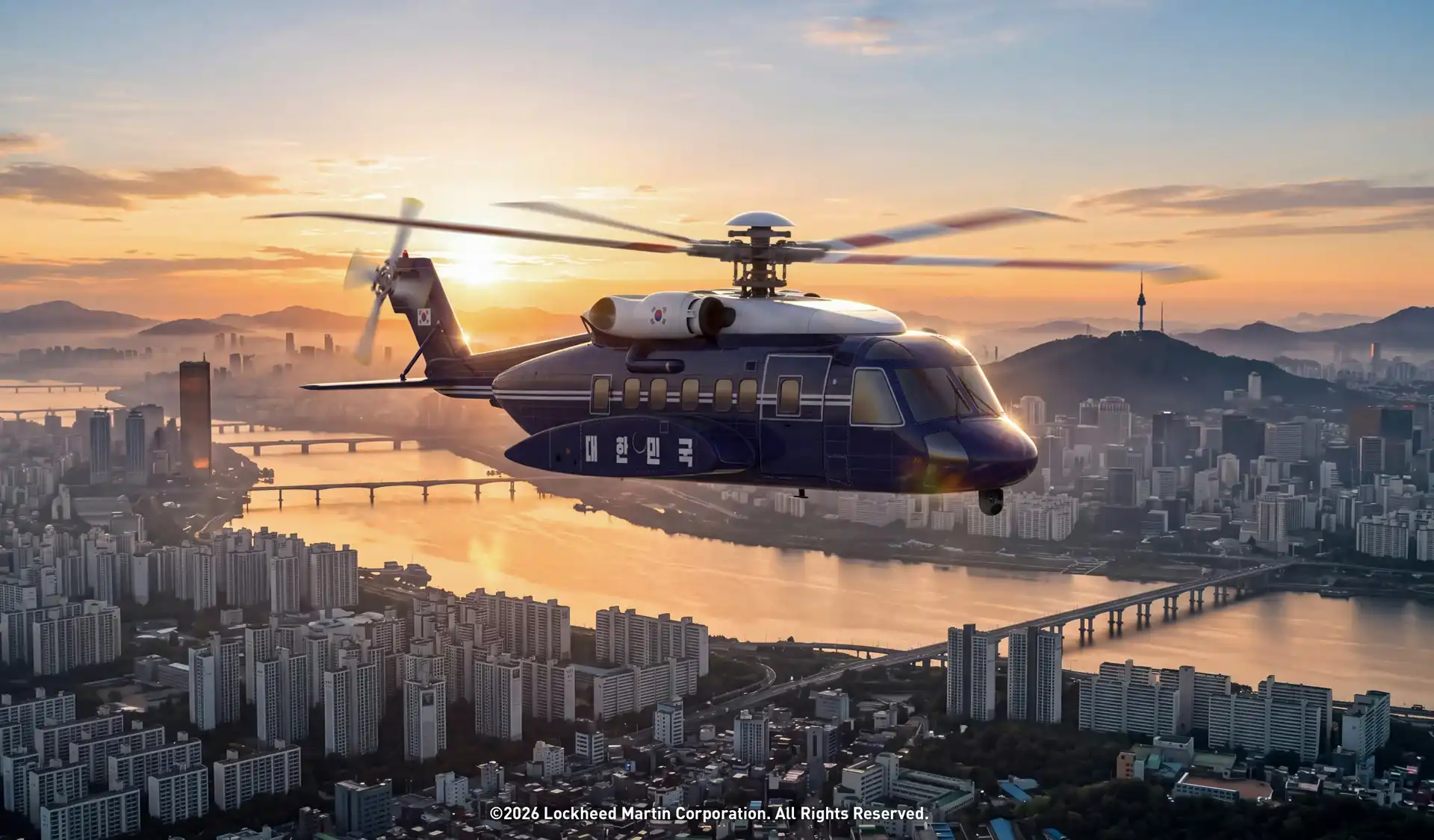
Sikorsky, a Lockheed Martin company, has been selected to deliver the S-92A+, the newest production standard of its S-92 twin-engine helicopter, to the Republic of Korea Air Force (ROKAF) for its Presidential Helicopter II program, the company announced on November 6, 2026. Four aircraft are planned under the effort, which South Korea’s Defense Acquisition Program Administration (DAPA) manages as the Command Helicopter-II project to replace the VH-92 fleet that has carried the South Korean president since 2007.
DAPA’s Defense Acquisition Program Promotion Committee approved Command Helicopter-II on April 30, 2025, with a budget of 870 billion won (about $570 million) spread from 2025 through 2031. The requirement centers on enhanced survivability and command and control for domestic VIP airlift. The three incumbent VH-92s, delivered in 2007, already carry a radar warning receiver, infrared countermeasures, and missile warning and decoy systems, setting the baseline the new fleet must exceed.
How the S-92A+ Upgrades the South Korea Presidential Helicopter Fleet
The core of the S-92A+ standard is the Phase IV main gearbox, which replaces the legacy unit in the same installation space. Its auxiliary lubrication system, which uses additional oil lines to recirculate gearbox oil if the primary system fails, allows the aircraft to complete a flight after a loss of primary oil pressure rather than landing immediately. That addresses the oil-loss failure mode exposed by the fatal 2009 Cougar Flight 491 accident off Newfoundland, which shaped S-92 airworthiness requirements for more than a decade. Sikorsky rates the gearbox for a minimum life of more than 6,000 flight hours.
Power comes from two General Electric CT7-8A6 turboshafts with increased shaft horsepower that holds output in hot and high-altitude conditions. Sikorsky has not published the exact rating. Combined with airframe strengthening, the added power raises maximum gross weight to 27,700 pounds (12,565 kilograms), an increase of 1,200 pounds (544 kilograms) available as payload or fuel, along with higher external sling-load capacity. For a presidential platform, that margin matters most as integration headroom: secure communications, self-protection equipment and cabin fittings can be added without trading away range or passenger load.
Sikorsky had anticipated Federal Aviation Administration (FAA) certification of the Phase IV gearbox in 2025, and the target has since moved to 2026. The November 6 announcement does not confirm whether that certification has been granted. The wider S-92 fleet has logged more than 2.6 million flight hours with an average lifetime availability rate above 90%, across more than 300 aircraft delivered to 28 countries. The airframe is also the basis of the U.S. Marine Corps VH-92A Patriot presidential helicopter.
How the S-92A+ Prevailed in South Korea’s Command Helicopter-II Competition
Four types entered the early stages of the competition: the S-92A+, the Leonardo AW101, the Airbus H225M and the Bell 525. According to South Korean press reports, the Bell 525 was set aside because it had not achieved certification and lacked the required operational maturity, while the AW101 failed to meet lifecycle cost requirements. By June 2026, the S-92A+ was reportedly the only candidate left in contract negotiations, with a test evaluation under way.
Incumbency weighed heavily. The ROKAF already runs S-92 maintenance procedures, spares inventories and training pipelines, and the Korea Coast Guard flies the type for search and rescue. Korea Aviation Engineering & Maintenance Service (KAEMS), a subsidiary of Korea Aerospace Industries (KAI), will perform in-country mission equipment completion. The contract also covers additional special mission equipment and sustainment, including critical spare parts and field service representatives.
Production will draw on Sikorsky’s Stratford, Connecticut, plant for dynamic components and its Owego, New York, line for assembly, with capacity for up to 12 S-92A+ aircraft per year. Lockheed Martin country executive Wonik Lee tied the selection to the “ROK-U.S. alliance, national defense and defense industry cooperation.”
Analysis: Seoul has chosen continuity over a clean-sheet capability leap. Retaining the S-92 family keeps the existing support ecosystem intact and reduces certification and maturity risk from a mission that tolerates none, while the Phase IV gearbox closes the platform’s best-known safety gap. Assigning mission equipment completion to KAEMS also keeps the most sensitive layer of the aircraft, its command and control and survivability systems, under Korean industrial control. The main programmatic exposure is schedule: the S-92A+ standard depends on FAA certification of a gearbox still completing its qualification path.
Lockheed Martin and DAPA have not disclosed the contract value. The next milestones are the final contract terms, the confirmed aircraft count and delivery schedule, and disclosure of the mission system fit KAEMS will integrate. With Command Helicopter-II funding running through 2031, the first S-92A+ deliveries will set the retirement timeline for the ROKAF’s VH-92 fleet, which by then will have flown the presidential mission for more than two decades.