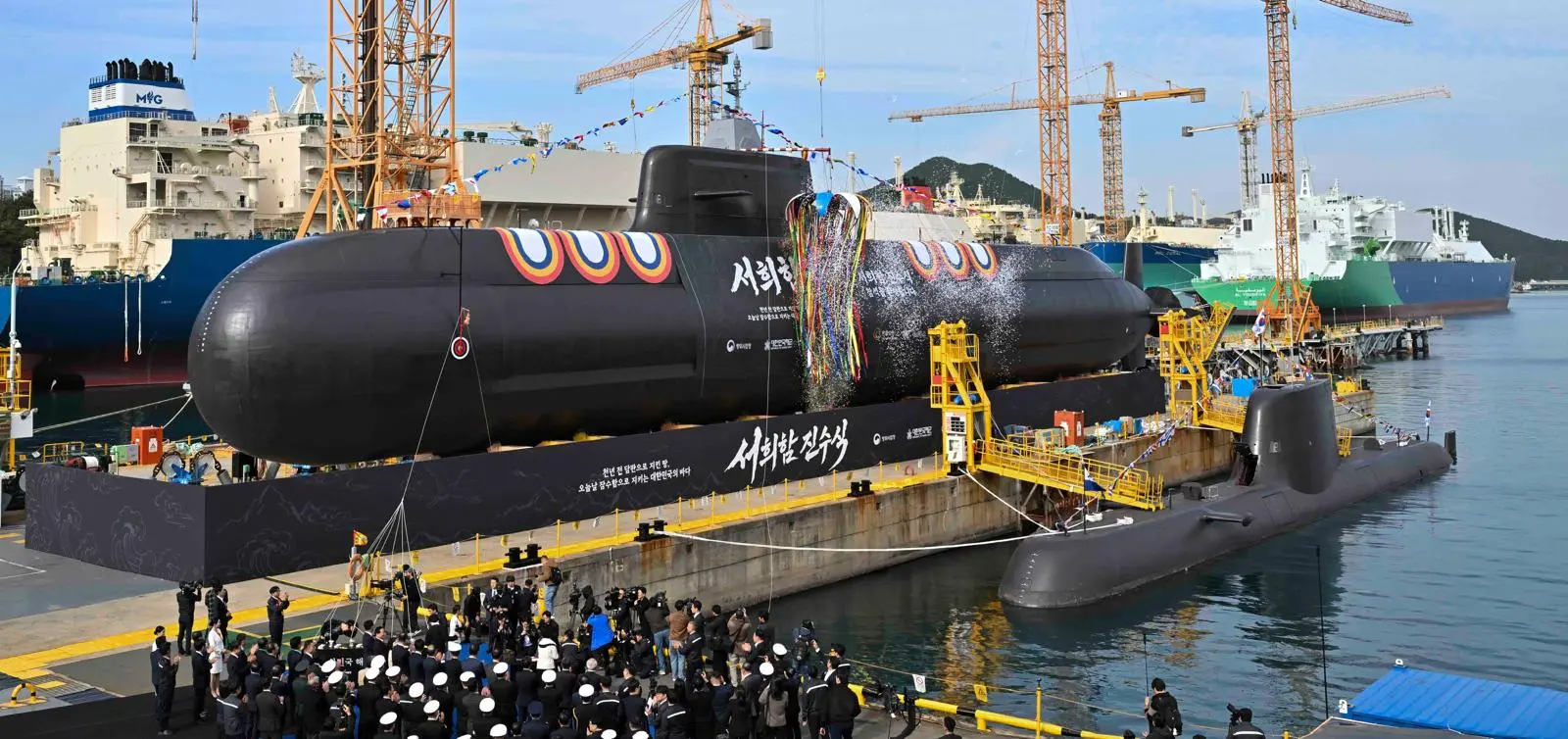
The Republic of Korea (ROK) Navy and the Defense Acquisition Program Administration (DAPA) launched ROKS Seo Hui (SS-088), the second KSS-III Batch-II diesel-electric submarine, at Hanwha Ocean’s Okpo shipyard in Geoje on November 3, 2026. The 3,600-ton-class boat carries 70 types of domestically developed equipment, including a Korean lithium battery system, and is scheduled for delivery to the Navy in 2028, according to a joint Navy and DAPA press release.
Seo Hui follows lead boat ROKS Jang Yeong-sil (SS-087), launched on October 22, 2025, and extends a program that began with three 3,000-ton-class Batch-I boats: ROKS Dosan Ahn Chang-ho (SS-083), Ahn Mu (SS-085) and Shin Chae-ho (SS-086). The launch comes four months after Canada selected ThyssenKrupp Marine Systems (TKMS) and its Type 212CD over a Hanwha Ocean offer derived from the Batch-II design for the Canadian Patrol Submarine Project. Each new Korean hull now serves both as a fleet asset and as a reference for export customers.
ROKS Seo Hui Design: Larger Hull, Lithium Batteries, Lower Signature
ROKS Seo Hui displaces approximately 3,600 tons and measures approximately 89 meters in length, roughly 600 tons heavier than the Batch-I boats. The Navy says the added volume provides capacity for a broader range of weapons and onboard equipment. Publicly available specifications indicate that Batch-II hulls carry ten Korean Vertical Launch System (K-VLS) cells behind the sail, up from six on Batch-I, sized for submarine-launched ballistic missiles and land-attack cruise missiles. The Navy and DAPA did not detail the vertical launch configuration at the ceremony.
The most consequential change sits in the energy section. Seo Hui is fitted with a domestically developed lithium battery system that, according to the Navy, extends both submerged endurance and the time the boat can sustain maximum speed. For a conventional submarine, sprint duration determines whether a commander can close a target or break contact without returning to snorkel depth. DAPA said the system’s safety was validated through multiple built-in safety features, testing at a dedicated land-based facility and formal safety assessments, addressing the thermal runaway risk inherent to lithium-ion chemistry. Capacity and endurance figures have not been released.
Upgrades to the combat management system and sonar suite improve the boat’s ability to identify multiple targets at long range and engage them precisely, per the Navy. Specific system designations were not disclosed. Advanced noise-reduction measures lower onboard noise and vibration to reduce the acoustic signature.
Survivability Redundancy and 70 Domestic Systems on KSS-III Batch-II
Two survivability features address single points of failure. An auxiliary propulsion system preserves maneuverability if the main propulsion plant fails, and a hull-penetrating periscope allows direct visual observation if the electro-optical sensors are degraded. Both trade internal volume for redundancy, a choice the larger Batch-II hull makes easier to absorb.
Compared with the Dosan Ahn Chang-ho class, 12 additional equipment types, including the lithium battery system, have been developed domestically, bringing the total aboard Seo Hui to 70. The Navy expects this to secure reliable and timely follow-on logistics support. Lee Sang-woo, head of DAPA’s Nuclear-Powered Submarine Program Group, said the boat should contribute to “establishing an advanced defense-industrial base and supporting submarine exports.”
The build followed a construction contract awarded in 2021, steel cutting later that year and keel laying in 2024. The boat is named after Seo Hui, a Goryeo Dynasty statesman recognized for military and diplomatic achievements during national crises. National Assembly Speaker Cho Jung-sik attended as guest of honor among roughly 200 guests.
Analysis: Seo Hui matters less as a hull than as evidence of a maturing supply chain. Every localized system removes a foreign export license that a buyer would otherwise need to clear and a dependency that could disrupt wartime sustainment. Canada’s decision, reportedly tipped by NATO interoperability considerations, showed that technical maturity alone does not win European-aligned customers; deeper domestic content strengthens Hanwha’s position with buyers outside that bloc, with Saudi Arabia among the prospects the company is reported to be pursuing. The quieting, energy storage and combat system integration matured on Batch-II also form the industrial base Seoul would need for its nuclear-powered submarine ambitions.
Seo Hui now moves to outfitting, harbor acceptance and sea trials ahead of its 2028 delivery, followed by an operational work-up before entering service. The third Batch-II boat, which publicly available program schedules place for delivery in 2031, has not been named. Battery endurance figures and the final weapons fit remain the key unknowns.