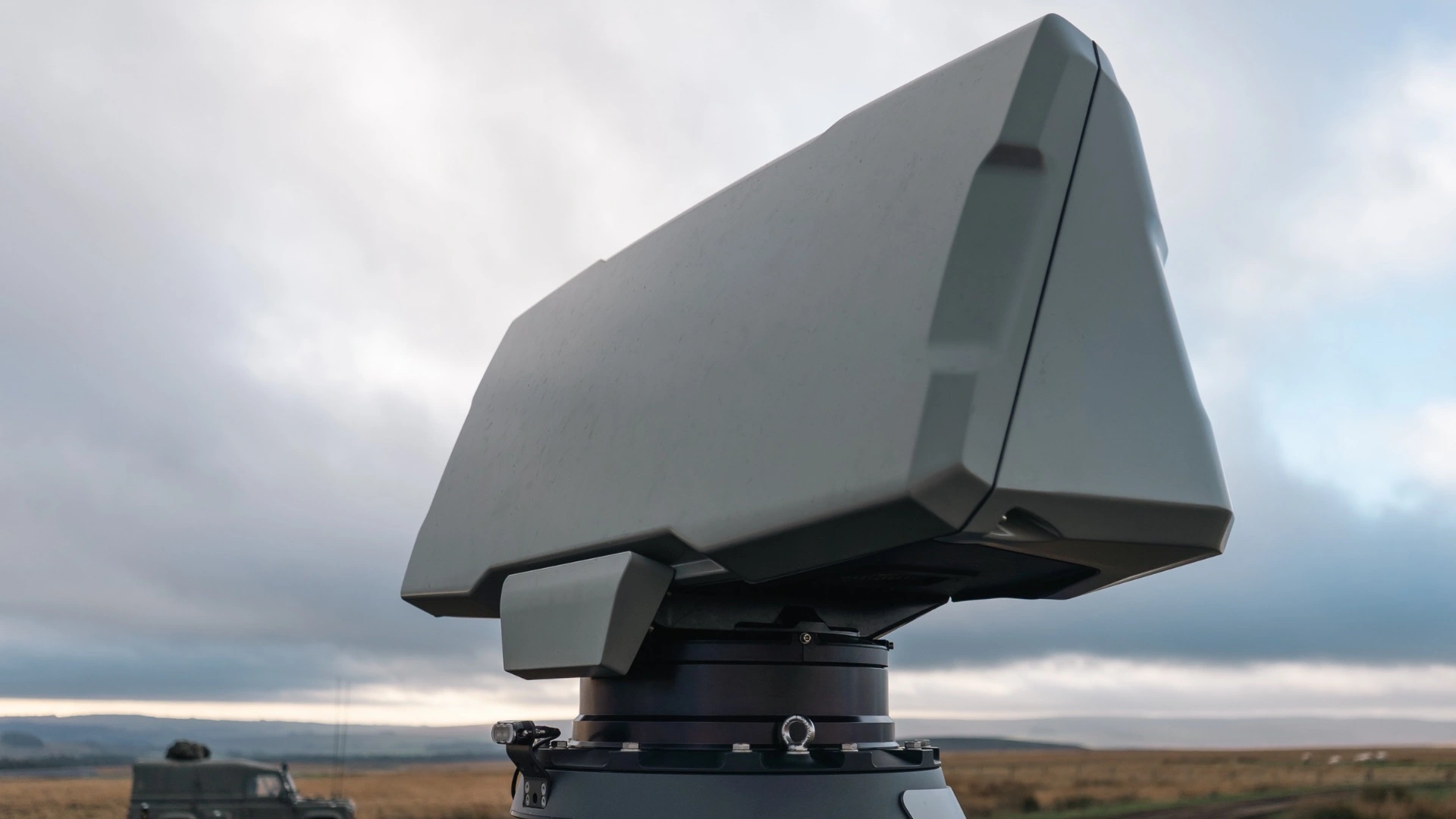
Saab has signed a EUR 450 million contract with the Ministry of Defence of Ukraine to supply Giraffe 1X radar systems to the Ukrainian Armed Forces, the Swedish company announced on November 28, 2026. Deliveries are scheduled during 2027. Saab did not disclose the number of systems, the scope of support included, or how the purchase is financed.
The contract lands as Ukraine’s air defense network continues to absorb massed Russian strikes that combine one-way attack drones, cruise missiles, and ballistic missiles. Short-range sensors able to see small, low-flying targets form the layer that cues Ukraine’s mobile fire groups, gun systems, and short-range interceptors. Giraffe-family radars are already in Ukrainian service: in June 2026, Ukraine’s Ministry of Defence listed the PS-90, PS-100, Giraffe 1X, Giraffe AMB, and Giraffe Mk IV among the Swedish sensors supporting its air defense. This time, the customer of record is Kyiv itself, unlike the Giraffe 1X batch the UK Ministry of Defence ordered in April 2026 with money from the NATO Security Assistance and Training Ukraine (NSATU) Trust Fund.
Giraffe 1X Radar: Compact X-Band AESA for Short-Range Air Defense
Saab describes Giraffe 1X as a high-performing 3D radar, delivered to Ukraine in the Compact Radar Module (CRM) configuration. According to the company, the system provides 360-degree air surveillance and detects, tracks, and classifies aircraft, missiles, rocket, artillery and mortar (RAM) threats, and drones, with updates every second, even in cluttered environments.
Publicly available specifications indicate an X-band Active Electronically Scanned Array (AESA) built with gallium nitride (GaN) circuits, with an instrumented range of up to 75 km for the land version. Total system weight is under 150 kg, of which 100 kg is topside, allowing transport on a pickup-sized vehicle, a towed trailer, or a helicopter. Saab claims the radar can detect a UAV lighter than a milk carton at 4 km, and that its RAM sense-and-warn function runs alongside air surveillance without degrading it.
The CRM, unveiled in June 2024, packages the radar as an all-in-one unit whose antenna folds into the housing at the push of a button. For Ukrainian crews, that matters as much as raw performance. Emitting ground radars are priority targets for Russian reconnaissance drones and loitering munitions, and a sensor that stows and relocates quickly survives longer. The one-second refresh rate is equally relevant against drones that fly low and change course, where slower-rotating search radars lose track continuity.
Compared with the older PS-90 Giraffe 75, also in Ukrainian service, Giraffe 1X is a compact 3D AESA design whose tracks include altitude data for the weapons it cues. It sits below the medium-range, C-band Giraffe AMB in Saab’s portfolio, covering the short-range layer of ground-based air defense. Giraffe 1X does not engage targets itself; it hands tracks to weapons through command and control systems and tactical data links.
How the Ukraine Contract Compares With Earlier Giraffe 1X Orders
By value, the Ukrainian award dwarfs previous Giraffe 1X contracts. The UK ordered 11 radars with support for SEK 264 million in May 2023, then placed a further order worth about GBP 24 million in April 2026. Sweden’s Defence Materiel Administration (FMV) signed a framework agreement in 2025 with a first call-off worth about SEK 650 million, also in the CRM configuration. The U.S. Army booked an order of about USD 46 million in the third quarter of 2025 for security cooperation partners, and a USD 24 million modification to that contract covers 10 radars for Lithuania, Latvia, and Estonia. Denmark joined the customer base in June 2026.
Saab has not said whether the EUR 450 million covers only radars or also command and control equipment, carrier vehicles, training, spares, and long-term sustainment. That gap makes any unit count derived from earlier prices speculative. Saab released the information under the EU Market Abuse Regulation, a signal that the company considers the order material to its financial position.
Delivering within 2027 will test production capacity. Saab builds Giraffe 1X in Sweden and at its Fareham site in the UK, while U.S. Army contract work for the 10 Baltic radars is performed at Saab Inc. in East Syracuse, New York. The company has not specified which facility will supply Ukraine.
Analysis: Ukraine’s air defense problem is now as much about sensor density as interceptor supply. Guns, electronic warfare, and interceptor drones are the most economical answers to massed Shahed-type drones, and all of them depend on precise, low-altitude cueing at short range. A purchase of this size points to Kyiv building a dense national network of compact 3D sensors rather than buying radars for point defense of individual sites. For NATO, the result will be a large operational dataset on how a short-range AESA performs against saturation drone raids, relevant to every European force fielding the same radar.
Deliveries are due to run through 2027. Key unknowns remain the number of systems, the funding source, the scope of support, and how the radars will be integrated into Ukraine’s existing air defense command and control architecture. The contract also deepens a Saab and Ukraine relationship that already includes a SEK 24.6 billion contract for 16 Gripen E fighters, signed in June 2026.