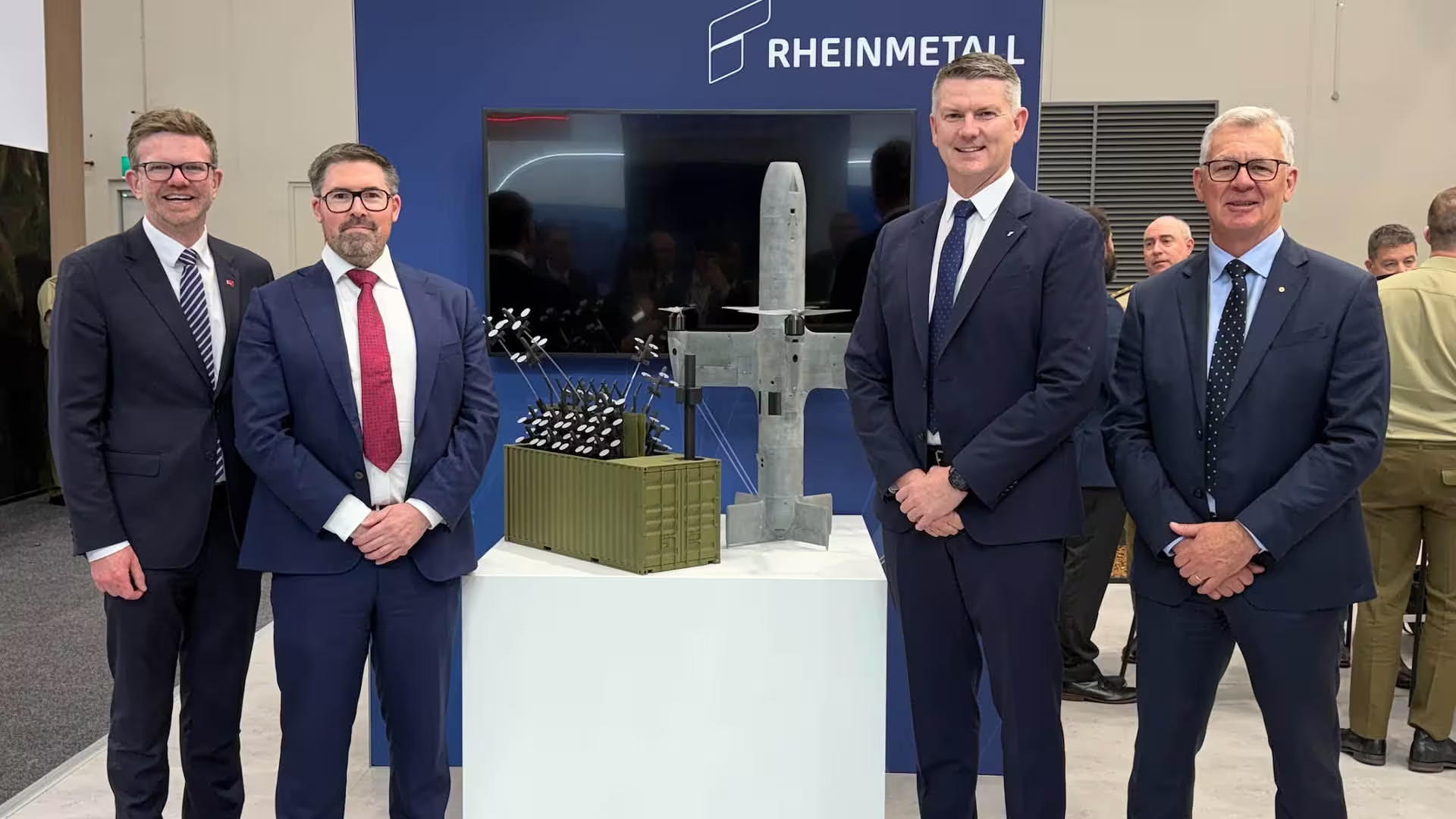
Rheinmetall Defence Australia and Adelaide-based Praetorian Aeronautics have built a working prototype of AERIE, a containerized counter-uncrewed aircraft system (C-UAS) launcher that packs more than 20 interceptors into a standard 20-foot ISO shipping container, Rheinmetall announced on October 7, 2026. The demonstrator pairs Praetorian’s Arrow interceptor with the company’s Hadrian command-and-control (C2) software and is scheduled to move to full operator demonstrations in the fourth quarter of 2026.
AERIE, short for Autonomous-Engagement-Rapid-Interceptor-Effector, went from concept to prototype within 12 months under an Australian research and development partnership, according to Rheinmetall. It arrives as Canberra scales up counter-drone spending. On April 21, 2026, the government committed up to A$7 billion to counter-drone capability over the next decade under the 2026 Integrated Investment Program, more than doubling planned funding. Australian Defence Force (ADF) counter-drone acquisition runs through Project LAND 156. Neither company has announced a customer, contract value, or program designation for AERIE.
Rheinmetall AERIE Architecture: 20-Foot Container, Arrow Interceptor, Hadrian C2
Rheinmetall describes AERIE as an interceptor-agnostic, self-sustained, deployable launcher. The container is the defining design choice. A standard 20-foot ISO container measures roughly 6.06 meters long, 2.44 meters wide, and 2.59 meters high; Rheinmetall has not published AERIE-specific dimensions or weight. That footprint lets the system move by truck, rail, or ship and be handled with ordinary port and depot equipment, with no dedicated launcher vehicle. For a force protecting airfields, ports, and fuel infrastructure across a continent, that logistics compatibility is a capability in itself. Rheinmetall says AERIE can be rapidly deployed and reloaded, but it has not disclosed reload time, crew size, power generation, or onboard sensors.
Arrow is described as an autonomous, high-speed, low-cost interceptor that kinetically defeats multiple types of uncrewed threats beyond visual range. Its propulsion, top speed, engagement range, warhead mass, and unit cost have not been published. One test milestone is on record: Praetorian and Adelaide munitions firm Zero Dawn completed ground-based blast testing of a Zero Dawn warhead integrated into Arrow ahead of a memorandum of understanding announced by the South Australian government on September 7, 2026. The two companies intend to export the capability to Ukraine in 2027.
Hadrian is an AI-enhanced system for managing autonomous effectors across the air, land, and maritime domains. Earlier Praetorian materials describe it as an open-architecture C2 that uses sensor fusion to find, classify, and track drone threats, then allocates interceptors under an “Any Sensor, Best Effector” framework, with decentralized control designed for communications-degraded environments. That allocation logic is where a magazine of 20-plus rounds will be judged. At one interceptor per target, a single load covers about 20 threats; under shoot-look-shoot doctrine against a raid of one-way attack drones, that number falls. Praetorian says Hadrian lets a single operator command a swarm of interceptors through one authorization step; how that human control applies to AERIE engagements has not been specified.
Where AERIE Sits in Australia’s A$7 Billion Counter-Drone Plan
AERIE enters a crowded sovereign field. Through the Advanced Strategic Capabilities Accelerator’s (ASCA) Mission Syracuse, Canberra has awarded A$21.3 million to AIM Defence for its Fractl high-energy laser, A$10.4 million to SYPAQ Systems for the Corvo Strike interceptor drone, and A$5.7 million to Electro Optic Systems for the R400 Slinger, bringing the total to A$37.4 million. Corvo Strike targets larger battlefield drones such as the Shahed, the same threat band an Arrow-armed AERIE would address. Rheinmetall has not said whether Commonwealth funding supported AERIE.
The differentiation is architectural. An interceptor-agnostic launcher could in principle host other rounds, although no integration beyond Arrow has been announced. AERIE also fills a gap in Rheinmetall’s air defense portfolio, which centers on gun-based systems such as the Skyranger 30 and Skynex. Guns deliver cheap rounds at short range; surface-to-air missiles reach farther at a per-shot cost that rarely matches a mass-produced one-way attack drone. Low-cost interceptor drones occupy the band between. Rheinmetall has not said whether AERIE would network with Skyranger to layer guns and interceptors.
Industrial capacity is the other half of the pitch. Rheinmetall Defence Australia builds Boxer combat reconnaissance vehicles under LAND 400 Phase 2 at its Redbank, Queensland, facility. Managing Director Nathan Poyner said the partnership had delivered “a working concept of advanced C-UAS using Australian ingenuity with global air defence engineering and manufacturing know-how.” Praetorian founder and chief executive Brett Hill said it joins Praetorian’s AI-enhanced C2 and interceptor with Rheinmetall’s engineering and manufacturing base. Praetorian employs about 50 people and has raised A$15 million, according to the South Australian government.
Analysis: AERIE’s case with the ADF will turn on two numbers neither company has released: cost per engagement and probability of kill per shot. The container answers the deployment problem, and Rheinmetall’s production base answers the scaling question that limits most Australian counter-drone startups. The harder test is integration. Defence has committed to plugging its Mission Syracuse effectors into the C2 architecture delivered under LAND 156, and any ADF pathway for AERIE would likely face the same requirement. Hadrian would need to work inside that common air picture rather than as a standalone stack, and Praetorian’s open-architecture claim has yet to be demonstrated against LAND 156. For a force fusing lasers, guns, jammers, and interceptors into one layered defense, a C2 layer that cannot plug into the common air picture is a procurement risk, however capable it is.
The fourth-quarter operator demonstrations are the next milestone, though Rheinmetall has not named the participating operator or test range. Published data on Arrow’s speed, range, and per-round cost, along with AERIE’s reload cycle and sensor pairing, will show whether the system competes for LAND 156 funding, export orders, or both. The planned 2027 export of Zero Dawn-armed Arrow interceptors to Ukraine would test the effector in the most demanding counter-drone environment active today.