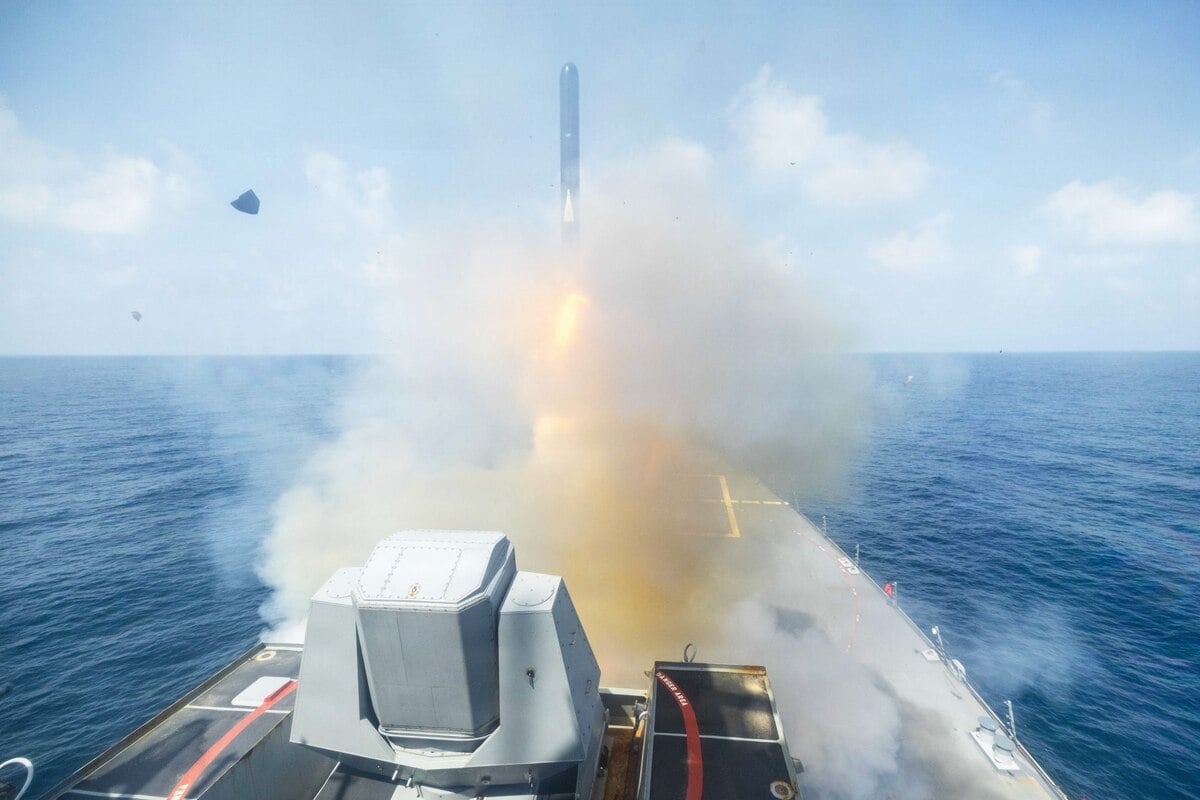
The USS Abraham Lincoln (CVN 72) Carrier Strike Group launched 450 Tomahawk Land Attack Missiles, flew 3,693 combat sorties and sank 64 Iranian warships during Operation Epic Fury and the follow-on blockade of Iran, according to figures Secretary of War Pete Hegseth gave the crew at sea on October 7, 2026. The Nimitz-class carrier is due to moor at Naval Air Station North Island in San Diego on October 8, ending a 321-day deployment.
Lincoln left San Diego on November 21, 2025, for a planned Indo-Pacific deployment and was redirected to the Middle East in January. The flagship of Carrier Strike Group 3 (CSG-3) was in the Arabian Sea when the United States and Israel opened Epic Fury on February 28, 2026. The group fought 40 consecutive days of combat until the two-week ceasefire announced April 7, then shifted to enforcing the U.S. blockade of Iranian ports that began April 13. USS George Washington (CVN 73) reached the U.S. Central Command (CENTCOM) theater on August 19 to take over the mission.
Lincoln Strike Group Tomahawk Expenditure Versus Mk 41 Cell Capacity
The carrier itself fired none of the Tomahawks. They came from the Arleigh Burke-class guided-missile destroyers of Destroyer Squadron (DESRON) 21: USS Spruance (DDG 111) and USS Frank E. Petersen Jr. (DDG 121), both shown in official imagery firing Tomahawks on the campaign’s opening day, and USS Michael Murphy (DDG 112). Each Flight IIA hull carries 96 Mk 41 Vertical Launching System (VLS) cells, 288 in total, and those cells also hold the Standard Missile-2 (SM-2), SM-6 and Evolved Sea Sparrow Missile (ESSM) interceptors that defend the carrier.
The 450 total therefore exceeds the group’s combined launcher capacity by 162 missiles, even if every cell had carried a Tomahawk. That points to repeated reload cycles in port, launches from other platforms assigned to the group such as submarines, or both. The Department of War has not broken the figure down by ship or said where the escorts rearmed. Mk 41 cells are not routinely reloaded at sea; the Navy first demonstrated its Transferrable Reload At-sea Method (TRAM) aboard the cruiser USS Chosin (CG 65) in October 2024 and has not said whether it was used in Epic Fury.
Publicly available specifications indicate the Block IV and Block V Tomahawk pairs a 1,000-pound-class warhead with a Williams F107 turbofan, flying subsonic and low to ranges manufacturer RTX puts at about 1,000 miles. That reach let the destroyers hold targets deep inside Iran from the Arabian Sea before Iranian air defenses were suppressed.
Sea Control Results: 64 Iranian Warships Sunk and 77 Drones Downed
Hegseth also credited the group with shooting down 77 one-way attack drones, destroying 21 anti-ship cruise missiles and defending against four fast-attack craft and explosive-laden wooden sailing vessels. He did not say whether the cruise missiles were intercepted in flight or destroyed before launch. The department has not published a hull-by-hull list of the 64 sinkings or split them between Carrier Air Wing 9 (CVW-9) and the escorts.
Disclosures from the opening weeks indicate what the total covers. On March 4, Hegseth announced the sinking of the Islamic Revolutionary Guard Corps Navy (IRGCN) corvette Shahid Soleimani, lead ship of a class of four 600-ton missile catamarans armed with six anti-ship missiles, vertically launched surface-to-air missiles and close-in weapons. CENTCOM commander Adm. Brad Cooper said on March 11 that all four had been destroyed, a day after CENTCOM reported 16 Iranian minelayers destroyed. Analysts assessed that smaller IRGCN missile and fast-attack craft made up most first-week losses, alongside as many as four of the regular navy’s seven frigates. How many of those hulls fall within Lincoln’s 64 has not been disclosed.
Nor has the department said how the 77 drone kills divided between the escorts’ interceptors and the air wing’s fighters, a figure that bears directly on magazine depth. Iran claimed in early March that it had hit Lincoln and forced it off station; CENTCOM rebutted the claim on March 6 with imagery of continued flight operations.
CVW-9 Ordnance Delivery and the Shift to Blockade Enforcement
CVW-9 delivered 1.37 million pounds of ordnance, roughly 621 metric tons, across the 3,693 combat sorties, which Hegseth said were flown without a single aircraft mishap. The wing combined F/A-18E/F Super Hornets, Marine Fighter Attack Squadron (VMFA) 314 F-35C Lightning IIs, EA-18G Growlers and E-2D Advanced Hawkeyes. The totals are not split between the strike phase and the blockade, though analysts reported that Tomahawk use declined once air superiority was established, shifting the strike load to carrier aircraft and cheaper short-range munitions.
From April 13, the mission shifted from strikes ashore to controlling traffic around the Strait of Hormuz, a task that rewards persistent surface surveillance and close-in defense against small boats. Sustaining that posture kept Lincoln at sea for 264 consecutive days without a port call, a record according to the Department of War.
Analysis: The ledger shows the group’s heaviest offensive output came from its escorts’ magazines, which is where the cost lands. At the $3.6 million unit price in Navy budget documents, 450 Tomahawks represent about $1.62 billion and more than four times the 110 missiles the Navy is due to receive in fiscal 2026, against a stockpile the Center for Strategic and International Studies (CSIS) estimates in the low 3,000s. RTX’s February 2026 framework agreement targets more than 1,000 Tomahawks a year. Until that rate is reached, Gulf expenditure draws down the inventory planners count on for a Western Pacific contingency, a theater that George Washington, the Navy’s only carrier homeported overseas, had to leave to relieve Lincoln.
Lincoln’s return closes CSG-3’s part in the campaign; the blockade it helped launch has no announced end date. Still undisclosed: the per-ship breakdown of the 450 launches, the interceptor count behind the 77 drone kills, where DESRON 21 rearmed and whether TRAM saw operational use. Those answers will shape the Navy’s next munitions budget and the case for making VLS reload at sea a fleet capability.