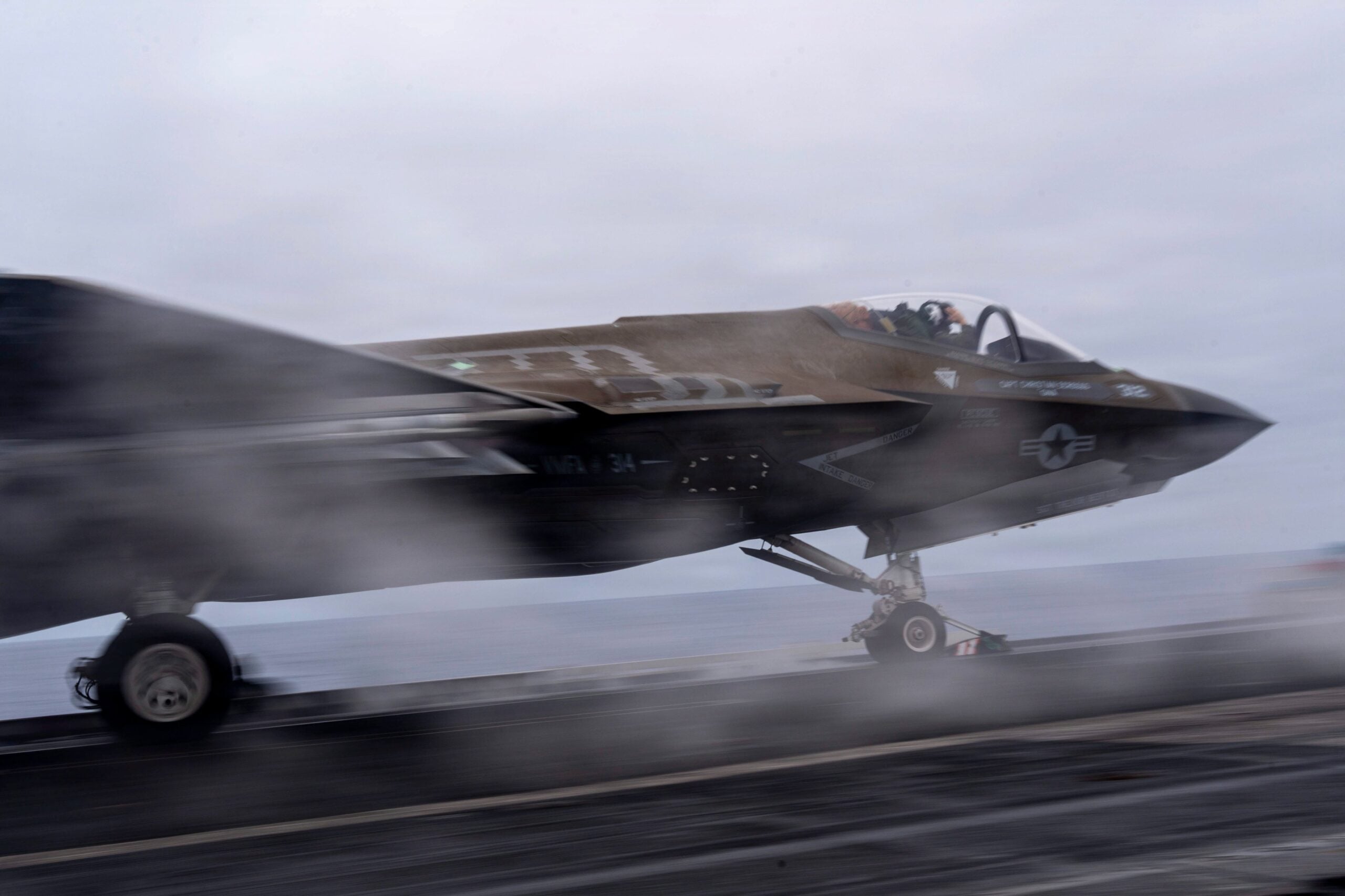
U.S. Pacific Fleet and U.S. Pacific Command released imagery on October 7, 2026, of the aircraft carrier USS Abraham Lincoln (CVN 72) conducting flight operations in the Pacific, including an F-35C Lightning II catapult launch and an E-2D Advanced Hawkeye moving under a flight deck director’s signals. The Nimitz-class carrier is expected to moor at Naval Air Station North Island in San Diego around midday on October 8, ending a deployment of roughly 10 months. The Department of War confirmed the homecoming date on October 7, when Secretary of War Pete Hegseth boarded the carrier at sea.
Lincoln left San Diego on November 21, 2025, for a planned seven-month Indo-Pacific deployment. The Pentagon redirected the Carrier Strike Group 3 flagship to the Middle East in January 2026, and the carrier was in the Arabian Sea when Operation Epic Fury, the joint U.S.-Israeli campaign against Iran, opened on February 28. USS George Washington (CVN 73) relieved Lincoln in August. The October 8 arrival closes out 321 days deployed, five short of the 326-day mark USS Gerald R. Ford (CVN 78) set in May, and the second-longest carrier deployment since the Vietnam War.
How USS Abraham Lincoln Sustained 13,000 Flights Across 10 Months
Navy figures put Carrier Air Wing 9 (CVW-9) at more than 13,000 flights and 28,500 flight hours over the deployment, backed by 72 replenishments-at-sea. During a 220-day Western Pacific deployment in 2022, the same carrier and air wing logged 10,250 sorties and 21,307 flight hours. Nuclear propulsion gives Lincoln effectively unlimited steaming range; the replenishment count shows where the dependency sits, in JP-5 aviation fuel, ordnance and stores for the air wing.
Hegseth gave the strike group’s combat totals during his October 7 visit. Over roughly six months of Epic Fury operations, he said, the group conducted 3,693 combat sorties without a single aircraft mishap, delivered 1.37 million pounds of ordnance, launched 450 Tomahawk Land Attack Missiles, shot down 77 one-way attack drones, destroyed 21 anti-ship cruise missiles and sank 64 Iranian warships. According to the Department of War, the campaign opened with 40 straight days of combat operations from February 28, followed by Lincoln’s participation in a blockade of Iran in and around the Strait of Hormuz that is still ongoing.
CVW-9 deployed nine squadrons and more than 70 aircraft: three F/A-18E/F Super Hornet squadrons, an EA-18G Growler squadron, an E-2D squadron, a CMV-22B Osprey logistics squadron, two MH-60R/S Seahawk squadrons and Marine Fighter Attack Squadron (VMFA) 314 flying the F-35C. Navy imagery showed VMFA-314 jets supporting Epic Fury from Lincoln’s deck in early March. Publicly available specifications for the F-35C, the carrier variant of the Joint Strike Fighter, indicate a 43-foot wingspan against 35 feet for the F-35A, roughly 19,750 pounds of internal fuel and a combat radius above 600 nautical miles on a single Pratt & Whitney F135-PW-400 engine. That radius, with weapons carried internally, lets a carrier in the Arabian Sea hold targets at depth while staying outside the densest layer of coastal anti-ship threats.
The E-2D is the strike group’s airborne sensor and battle-management node. Published specifications credit its AN/APY-9 ultra-high-frequency radar with 360-degree coverage, and the aircraft shares tracks with escorts through Cooperative Engagement Capability. Iran’s Islamic Revolutionary Guard Corps claimed ballistic missile, drone and cruise missile strikes on Lincoln in March. The carrier stayed on station and kept flying, which puts layered early warning at the center of the deployment’s survivability record.
Crew Endurance After a Record 264 Days Without a Port Call
Lincoln spent 264 consecutive days at sea without a port call before a liberty stop in Thailand in early September, a record according to the Department of War, surpassing the 206 days USS Dwight D. Eisenhower (CVN 69) logged in 2020. During a logistics stop in Guam on September 19 and 20, 13 Fleet and Family Support counselors embarked to run return-and-reunion training. After parting with its escort, USS Frank E. Petersen Jr. (DDG 121), near Hawaii in late September, the carrier has held off California since October 3 to fly off CVW-9 squadrons and transfer ammunition to USNS Washington Chambers (T-AKE 11). Helicopter Maritime Strike Squadron (HSM) 71 was back at North Island on October 2, and Electronic Attack Squadron (VAQ) 133 has returned to Naval Air Station Whidbey Island, Washington.
The cruise drew scrutiny in Washington. In August, families described supply shortages and difficult living conditions aboard. Acting Navy Secretary Hung Cao disputed the coverage while acknowledging that a small number of mental health cases were treated, menus were adjusted when fresh provisions were unavailable and calls home were restricted under elevated threat levels. In a letter to Sen. Kirsten Gillibrand, Cao stated that at least eight personnel across the strike group attempted suicide during the deployment. Secretary of War Pete Hegseth has said the reports misrepresented conditions. Aboard Lincoln on October 7, he presented the crew with the Presidential Unit Citation for its role in Epic Fury and asked sailors to pass his and the president’s gratitude to their families at the homecoming.
Against that backdrop, the released imagery carries a deliberate message. The Pacific Command post describes the flight operations as maintaining “aviation proficiency and carrier strike group readiness” on a cruise that ran about 50 percent past its planned length. Hegseth made the same point aboard, contrasting his landing on an empty flight deck, with the air wing already flown off, against night recoveries on a full deck under combat conditions, where the crew, he said, “didn’t miss a beat.”
What Comes Next: Carrier Deployment Strain and a Likely Move to Bremerton
Analysis: Lincoln’s return relocates the strain on the carrier force rather than relieving it. Ford logged 326 days, Lincoln 321, and USS George H.W. Bush (CVN 77) spent 188 consecutive days at sea before a port call in Phuket on October 4, leaving George Washington as the only carrier supporting operations against Iran. USS Theodore Roosevelt (CVN 71) left San Diego on September 27 with Carrier Air Wing 11, its families told to plan on eight months. Each extended cruise adds wear to hulls, catapults and arresting gear and pushes maintenance later, so the bill for Epic Fury will surface in 2027 and 2028 Pacific carrier availability.
Chief of Naval Operations Adm. Daryl Caudle said in June that Lincoln would probably shift homeport to Naval Base Kitsap-Bremerton, Washington, where Puget Sound Naval Shipyard operates the only West Coast dry dock able to take a Nimitz-class carrier. The Navy has not announced the move’s timing, the scope of the follow-on maintenance period or a unit-level breakdown of the strike group totals Hegseth cited.