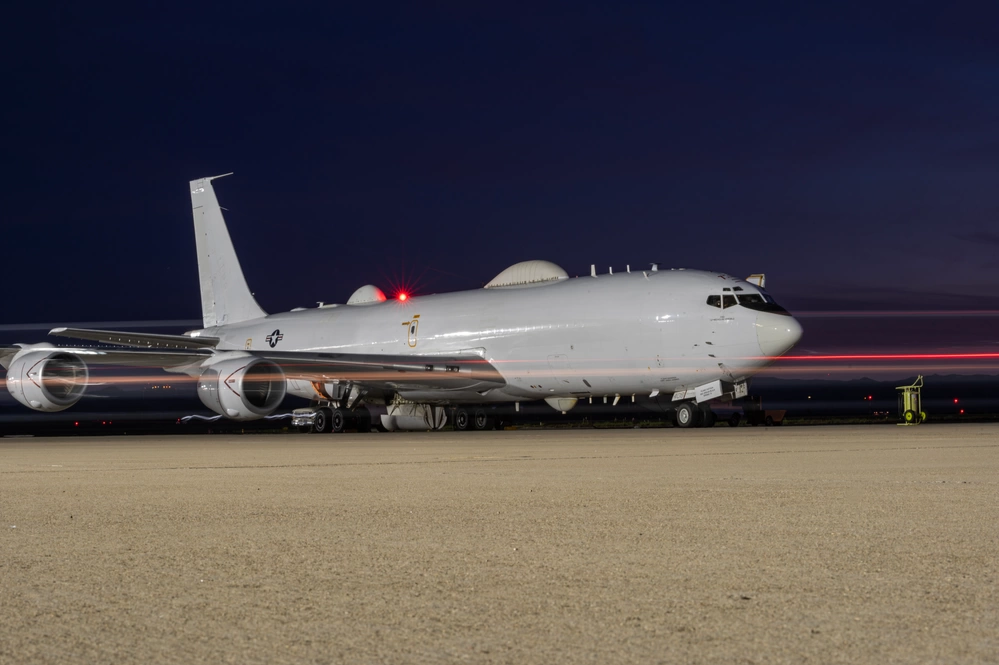
Air Force missileers completed a Simulated Electronic Launch-Minuteman (SELM) test at Malmstrom Air Force Base, Montana, from September 15 to 17, 2026, to verify the airborne secondary launch capability of the LGM-30G Minuteman III intercontinental ballistic missile (ICBM) without firing a missile. Airborne Launch Control System (ALCS) operators from the 625th Strategic Operations Squadron (625th STOS) ran the test aboard a Navy E-6B Mercury flown by Fleet Air Reconnaissance Squadron Four (VQ-4), Strategic Communications Wing One.
The event was the second SELM of 2026, after a June 3 iteration at Minot Air Force Base, North Dakota. It comes as the Air Force works to finish restructuring the LGM-35A Sentinel program and regain Milestone B approval by year end, while spending more than $2 billion a year, per congressional testimony, to keep Minuteman III on alert. Each year of Sentinel delay extends the service life of a missile first fielded in 1970, and of the backup command paths that serve it.
How the SELM Tests Minuteman III Secondary Launch Capability
Conducted twice a year, a SELM exercises selected Minuteman III missiles in their deployed environment, from day-to-day alert posture through issuance of the first-stage ignition signal. A Glory Trip launch from Vandenberg Space Force Base, California, measures flight performance; a SELM evaluates the system interactions that precede ignition, which a live shot cannot isolate.
The Malmstrom event targeted the secondary launch path. ALCS operators sent test commands from the E-6B to launch facilities isolated in their own mini-squadron, separating test articles from the operational alert force. Capt. Noah Woods, 625th STOS ALCS test engineer, said engineers worked alongside the flight crew and ground teams, tracking system responses at every step. Maj. Quinn Sokolnicki, 625th STOS test flight commander and ALCS operator, said months of planning precede each SELM and give operators actual repetitions commanding test-configured launch facilities.
The 341st Missile Wing at Malmstrom operates 150 Minuteman III launch facilities and 15 missile alert facilities across roughly 13,800 square miles of north-central Montana, the largest of the three ICBM complexes. Each wing fields three missile squadrons, and each SELM concentrates on one. Woods said the airborne priority was positioning the aircraft to hold clean command links across the wing’s dispersed launch control centers and launch facilities.
How the E-6B Mercury Carries the Airborne Launch Control System
The ALCS keeps Minuteman III missiles commandable if ground-based launch control centers are damaged or unable to respond. The 625th STOS, based at Offutt Air Force Base, Nebraska, is the only Department of the Air Force unit that operates it. ALCS commands reach the missiles along a different path than orders from underground launch control centers, which lets a SELM test components unique to the airborne node. The crews fly as part of the Operation Looking Glass airborne command post, a mission the E-6B took over from the Air Force EC-135C on October 1, 1998.
Publicly available specifications indicate the E-6B is a Boeing 707-320 derivative powered by four CFM International CFM56-2A-2 turbofans, with aerial refueling to extend time on station. The Navy operates 16 aircraft through VQ-3 and VQ-4 at Tinker Air Force Base, Oklahoma. The Mercury also carries the Take Charge and Move Out (TACAMO) very low frequency suite that relays orders to ballistic missile submarines, placing two legs of the nuclear triad on one airframe.
Malmstrom’s airfield supports only helicopter operations, so the E-6B staged out of Great Falls International Airport. VQ-4 crews managed the flight profile and endurance while the 625th STOS team executed the test script over the missile complex, with the 341st Missile Wing and Vandenberg’s 576th Flight Test Squadron in support. The 625th STOS last used the ALCS for a live shot on November 5, 2025, launching an unarmed Minuteman III from Vandenberg during Glory Trip 254.
Sustaining Minuteman III Through the Sentinel ICBM Transition
Woods said the SELM data verifies secondary launch performance and supports a credible ICBM deterrent through the transition to Sentinel. The Air Force continues to replace aging parts and update hardware, and planners are preparing a phased transition that takes legacy nodes offline in sequence as Sentinel comes on line, with the stated aim of preserving continuous alert.
That handover remains years away. Sentinel lost its Milestone B approval after a 2024 Nunn-McCurdy breach, when the Pentagon’s Cost Assessment and Program Evaluation office estimated a modified program at $141 billion, against a 2020 baseline of $77.7 billion. Air Force leaders said in September 2026 that the restructure and a new Milestone B remain on track for year end, with a first flight test in 2027 and initial capability in the early 2030s. The Government Accountability Office placed that first flight in March 2028 in a February 2026 assessment.
Sentinel will also use new-build silos rather than converted Minuteman III launch facilities, with a prototype under construction in Promontory, Utah, since early 2026. That keeps the legacy force on alert during construction, but it means old and new launch infrastructure, and their command paths, will operate in parallel.
Analysis: The SELM series gains weight as Sentinel slips. The ALCS is the survivability hedge for the land-based leg: an adversary weighing a counterforce strike cannot assume that destroying launch control centers neutralizes the missiles beneath them. That hedge rests on an aging E-6B fleet the Navy is replacing with the C-130J-30-based E-130J, configured for TACAMO only. The Air Force has reclaimed the Looking Glass mission and is defining requirements under a Looking Glass-Next effort, but has not publicly selected the aircraft that will carry the ALCS or its successor. The missile and its airborne launch node are now being recapitalized on separate timelines.
The next markers are Sentinel’s Milestone B decision, expected by the end of 2026, and its first flight test, which the Air Force places in 2027. The Air Force has not announced the date or wing for the next SELM. The open question is whether a successor airborne launch platform will be fielded before the E-6B retires.