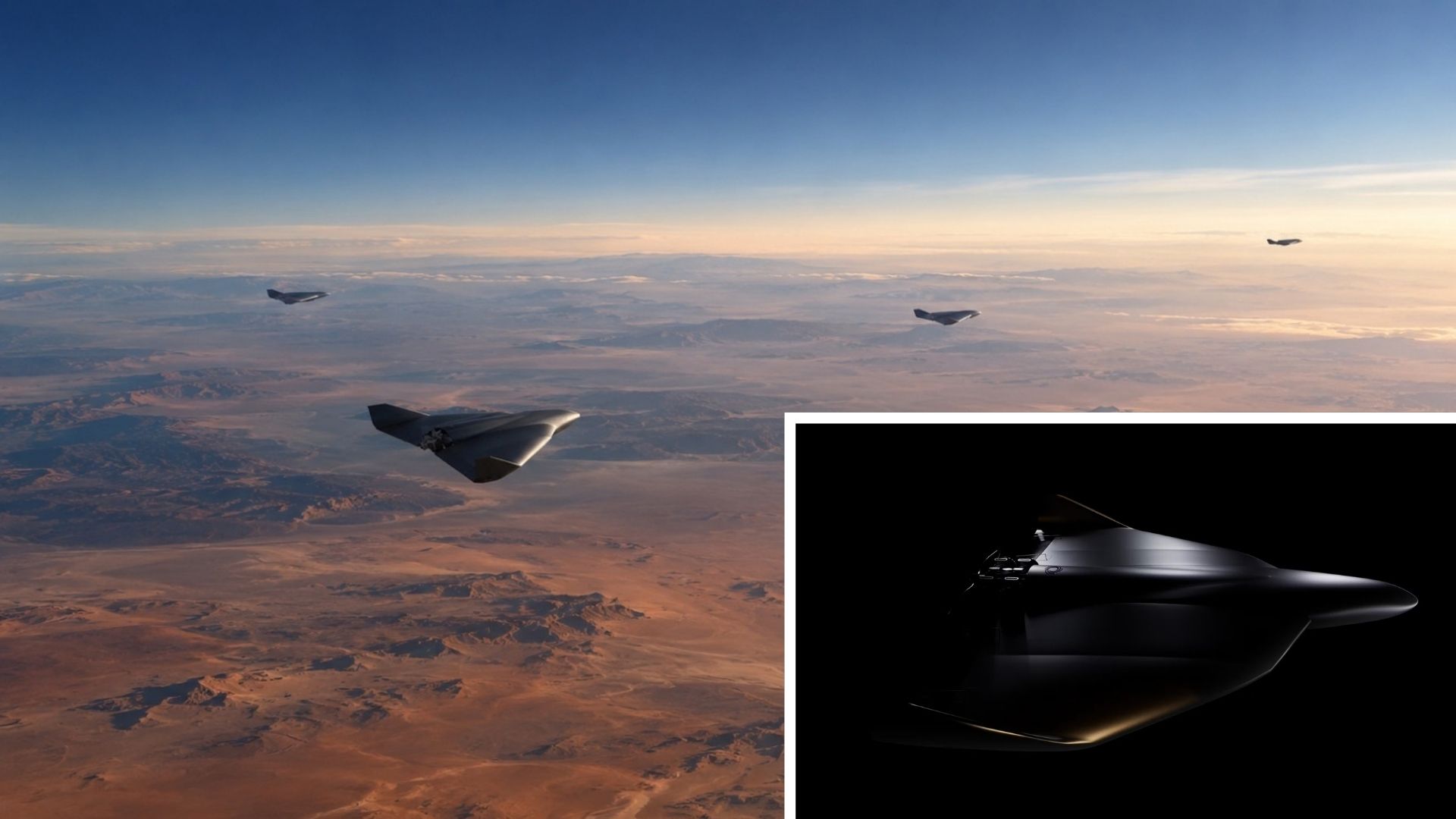
French defense startup Harmattan AI unveiled IRIFI on October 6, 2026, an attritable one-way strike system designed to hit targets at ranges of up to 2,000 km (1,240 mi). The company says IRIFI launches from a mobile canisterized launcher, navigates without relying on global navigation satellite systems (GNSS) and uses visual terminal guidance to reach meter-level precision, taking the firm into deep strike for the first time.
The reveal comes nine months after Dassault Aviation led a $200 million Series B round that valued the Paris-based company at $1.4 billion on January 12, 2026. Founded in April 2024, Harmattan AI built its order book on small systems, including 5,000 Delco combat drones ordered by France’s Direction générale de l’armement (DGA) on May 28, 2026. IRIFI targets a different requirement: on February 12, 2026, the six nations of the European Long-range Strike Approach (ELSA), France among them, signed a letter of intent to accelerate procurement of low-cost one-way effectors with ranges above 500 km.
Harmattan AI IRIFI Specifications: Range, Navigation, and Terminal Guidance
Harmattan AI’s published data on IRIFI covers three items: a maximum range of up to 2,000 km, an undisclosed payload and a combustion engine. The company has not released cruise speed, flight altitude, airframe dimensions, launch weight, warhead mass or unit cost, nor whether the powerplant is a piston or turbine design. The number of canisters per launcher is also undisclosed.
The navigation architecture carries most of the claimed capability. IRIFI pairs multi-source onboard navigation that does not depend on GNSS with onboard sensing and processing, so the mission continues when datalinks are jammed or spoofed and satellite positioning is degraded or denied. Harmattan says the effector is designed to fly below radar detection, which implies a low-altitude profile, though no altitude figures have been released. In the target area, visual terminal guidance steers the munition toward the human-designated aimpoint. The meter-level accuracy claim has not been independently verified, and no circular error probable (CEP) figure has been published.
That design responds directly to the electromagnetic environment in Ukraine, where jamming and spoofing have degraded GNSS-dependent munitions on both sides. The mobile canisterized launcher serves a parallel survivability goal: dispersed, road-mobile launch points complicate the adversary’s counter-launch targeting.
How Kalahari C2 Keeps Human Authority Over IRIFI Strikes
Harmattan frames IRIFI around a two-layer authorization process. Designated targets, launch positions and mission parameters are approved at command level, followed by a final launch authorization at the point of release. Target selection remains human-confirmed. Once launched, IRIFI executes the mission with no human control, within the boundaries set before release.
All deployed launchers run under Kalahari, the company’s command and control (C2) software, which supports mission planning and launch execution. According to Harmattan, a single commander can launch dozens of autonomous strikes, supported by an AI system that processes large volumes of satellite imagery. The company has not identified the imagery sources feeding that process.
The operator ratio is the operational argument: current one-way attack drone campaigns depend on large crews for planning and route programming. Removing the human from flight also has limits. Speed is undisclosed, but any subsonic combustion-engine effector flying 2,000 km spends hours in transit, and Harmattan has announced no in-flight retargeting or abort function. That points IRIFI toward fixed targets such as depots, industrial sites, airfields, command posts and logistics hubs, the target set Harmattan itself cites, rather than mobile launchers or relocatable air defenses.
IRIFI vs Shahed, Storm Shadow, and MBDA’s One Way Effector
Harmattan AI chief executive and co-founder Mouad M’Ghari positions IRIFI between two existing classes. He described the Iranian-designed Shahed as cheap and easy to mass-produce but imprecise and easy to shoot down, and cruise missiles such as Tomahawk and Storm Shadow as highly survivable but expensive and built in limited numbers. “AI-powered autonomy now makes it possible to combine the best of both worlds,” he said.
Publicly available specifications indicate the Shahed-136, built in Russia as the Geran-2, carries a warhead of roughly 40 to 50 kg over ranges estimated between 1,800 and 2,500 km, using satellite-aided inertial navigation. Storm Shadow/SCALP-EG pairs a 450 kg-class penetrating warhead with an imaging infrared seeker over a publicly stated range beyond 250 km, while Tomahawk Block IV is credited with about 1,600 km. IRIFI’s stated reach matches the Shahed and exceeds Tomahawk, but without a payload figure its effect against hardened targets cannot be assessed.
The closest national comparison is MBDA’s One Way Effector, placed under DGA contract in early 2026. Per MBDA, the jet-powered effector flies beyond 500 km at up to 400 km/h with a 40 kg warhead and GNSS-aided inertial guidance, with first deliveries planned for mid-2027 and production scalable from about 100 units per year to more than 1,000 per month. On paper, IRIFI offers roughly four times the range and GNSS-independent navigation. MBDA, however, has a contract, a published warhead and a delivery date; Harmattan has disclosed none of the three.
Analysis: IRIFI’s range is not the differentiator, since Shahed-class drones already fly that far. The bet is on where precision comes from. Harmattan places it in onboard processing and software rather than in costly seekers, signature reduction and heavy warheads, the cost structure Europe needs to generate deep-strike mass without drawing on US stocks. French Army chief of staff General Pierre Schill argued in January 2025 that future deep strike would mix cheap saturation effectors with precise, powerful penetrators. If IRIFI’s GNSS-free accuracy holds up in testing, it would blur that division and give ELSA’s low-cost tier a second French candidate alongside MBDA.
Harmattan has not announced a launch customer, test campaign, production rate or unit price for IRIFI, nor whether the system has been offered to the DGA or other ELSA governments. The next milestones are a documented flight demonstration in a GNSS-denied environment, disclosure of the payload class and a first government order, all measured against MBDA’s mid-2027 delivery benchmark.