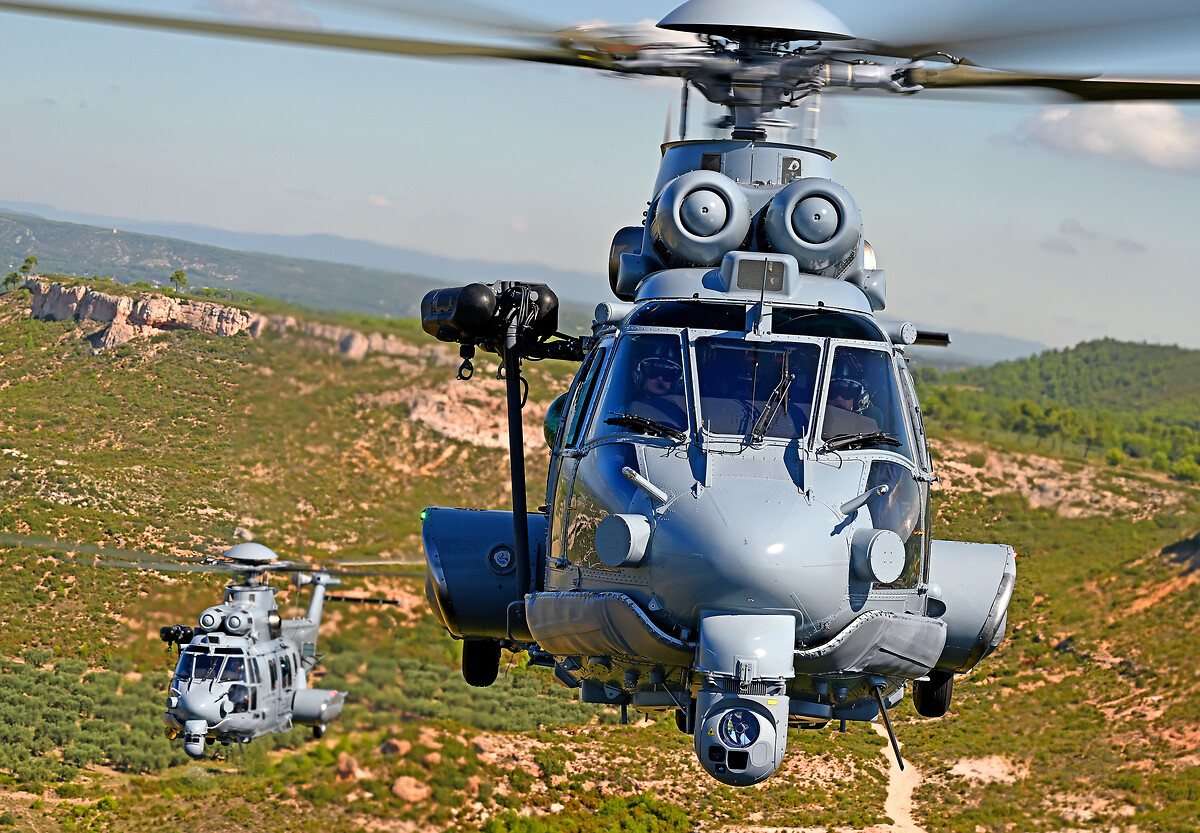
Romania has signed a contract for 12 Airbus H225M multirole military helicopters, Airbus Helicopters announced on October 7, 2026, in a deal concluded with France’s Directorate General for Armament (DGA) and financed through the European Union’s Security Action for Europe (SAFE) loan instrument. The aircraft will begin replacing the Romanian Air Force’s license-built IAR-330 Puma fleet in conventional and special operations roles.
The announcement formalizes a procurement that Romania’s Ministry of National Defence launched on July 17, 2026, when its General Directorate for Armaments signed a purchase order worth approximately €757 million against a total approved SAFE project value of €852 million. The helicopters draw on Romania’s €16.68 billion SAFE allocation, the second largest in the EU after Poland’s, and follow a separate SAFE-funded order in June 2026 for seven H160 and five H145 helicopters for the Ministry of Internal Affairs.
H225M Helicopters Contract: SAFE Financing, Delivery, and IAR Brașov Role
Romania did not contract Airbus directly. The DGA acts as contracting authority and lead nation in what Bucharest describes as a joint acquisition with France, while Romania remains the customer, end user, and borrower. The arrangement reflects the SAFE regulation, which allowed purely national purchases only for contracts signed by May 30, 2026, and requires later procurements to involve at least two participating countries. SAFE-supported contracts are also exempt from value added tax, and the loans carry maturities of up to 45 years with a 10-year grace period.
According to the ministry, the first helicopter is due 38 months after signature, around September 2029, with the remaining aircraft delivered in stages through 2030. The ministry has not published a breakdown of the €757 million between airframes, mission equipment, training, and initial support, nor explained the roughly €95 million gap to the approved project value.
Industrial work centers on IAR Brașov, Romania’s sole helicopter manufacturer, which has license-built the Puma since 1975, holds a 40% stake in the Airbus Helicopters Romania joint venture, and will take part in the initial batch, per the ministry. Romanian government officials have said a final assembly line for the H225M will be installed at the IAR site in Ghimbav, with the first locally produced aircraft expected from 2030. Airbus has conditioned full industrial cooperation on a total order of 42 helicopters, meaning the 12-unit contract must be followed by roughly 30 more. Romanian defense officials said in July that those follow-on orders are planned to be committed by 2030.
H225M vs IAR-330 Puma: Range, Power, and Survivability Gains
The H225M, formerly designated EC725 Caracal, is the top-end model of Airbus’ military Super Puma and Cougar family, an 11-tonne-class helicopter descended from the same SA 330 Puma design Romania has produced for five decades. Two Safran Makila 2A1 turboshafts each deliver 1,567 kW of takeoff power, or 1,784 kW in a 30-second one-engine-inoperative rating, driving a five-blade main rotor. Airbus lists a maximum speed of 324 km/h, a maximum cruise speed of 262 km/h, and a range of 920 km on standard fuel, or 1,253 km with auxiliary tanks. Air-to-air or hover in-flight refueling extends endurance beyond 10 hours.
The cabin carries 28 equipped troops or 11 stretchers with four medical attendants, and the sling hook lifts 4,750 kg. Romanian ministry data for the IAR-330 Puma SOCAT list two Turmo IV engines of 1,400 hp each, a maximum takeoff weight of 7,400 kg, a maximum speed of 263 km/h, and a range of 550 km, while publicly available specifications for the Puma family indicate 16 to 20 troops. One H225M therefore moves a full platoon with about 67% more unrefueled range, cutting the sorties and forward refueling points a special operations insertion or casualty evacuation requires.
Survivability features include crashworthy self-sealing fuel tanks, armored crew seats, optional cabin armor, a radar warning receiver, missile approach and laser warning, chaff and flare dispensers, and infrared exhaust suppressors. A four-axis dual-duplex autopilot with automatic hover and night vision goggle compatibility supports low-level night and shipborne operations. Weapons can be integrated through Airbus’ modular HForce system, but Romania has not disclosed its mission equipment or armament fit. The H225M also shares the Super Puma lineage with the two H215M naval helicopters Romania ordered in 2023 for anti-surface warfare with MBDA’s Marte ER missile, easing aircrew and maintainer conversion.
Analysis: The order modernizes only a fraction of a Puma fleet that local reporting puts at roughly 50 aircraft, but it resolves a longer industrial impasse. Airbus opened a dedicated factory at Ghimbav in 2016 to build the H215 for Romania, and its final assembly line never became operational for lack of a large enough national order. SAFE financing, VAT relief, and a French lead-nation wrapper have now unlocked a contract, and Romania joins France, Hungary, and the Netherlands as NATO operators of the type. The decisive variable is the 42-aircraft threshold: without the follow-on 30, Ghimbav remains a support site and most of the Puma fleet stays in service on NATO’s Black Sea flank.
Romania can request its first regular SAFE disbursement in October 2026, and the loan availability period closes on December 31, 2030, the same year initial H225M deliveries are due to conclude. Still unannounced are the Romanian aircraft’s mission configuration, IAR Brașov’s exact work share on the first 12, and the budget source for the follow-on 30.