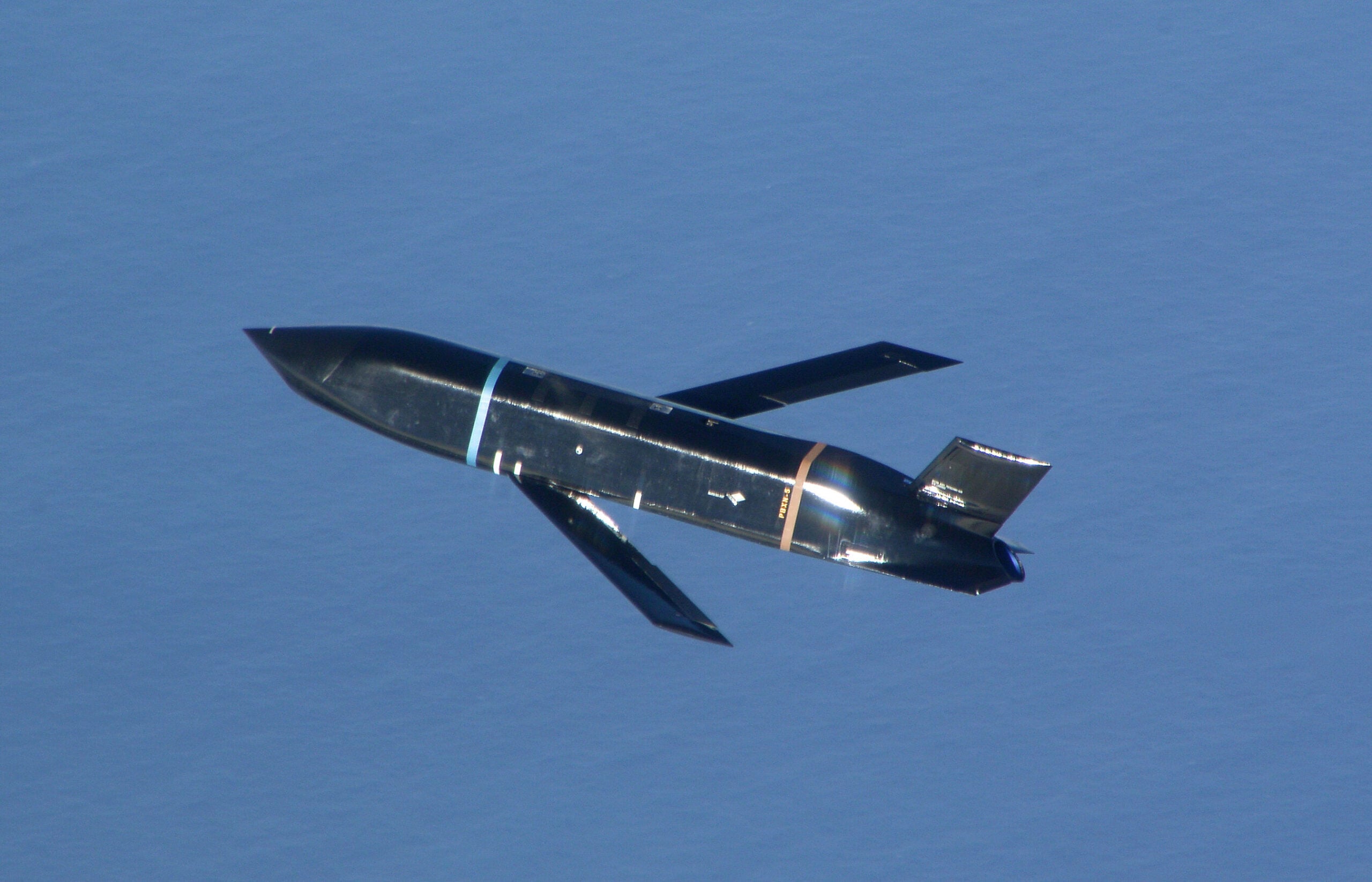
Naval Air Systems Command (NAVAIR) plans to award Lockheed Martin a sole-source delivery order to integrate the AGM-158C Long Range Anti-Ship Missile (LRASM) on the U.S. Air Force’s B-52 Stratofortress bomber, according to a presolicitation notice published October 7, 2026. The cost-plus-fixed-fee order would cover missile software updates, associated testing, test asset repair, and failure review boards.
The notice revives an effort that previously stalled. About $10 million was allocated in fiscal 2019 to study LRASM integration on the B-52, but by 2023 the Navy’s precision strike weapons program office said no B-52 integration work was being coordinated through it. The renewed push comes as the Pentagon expands LRASM production and extends B-1B and B-2 service lives, three months after the first publicly acknowledged LRASM launch from a B-2. Completing the B-52 work would put the missile on all three of the Air Force’s legacy bomber types.
What the LRASM B-52 Integration Order Covers and Why NAVAIR Leads
NAVAIR intends to place the order against Basic Ordering Agreement N00019-23-G-0002 with Lockheed Martin Missiles and Fire Control (LMMFC). The notice invokes the only-one-responsible-source exception under 10 U.S.C. 2304(c)(1) and Federal Acquisition Regulation (FAR) Subpart 6.302-1, describing Lockheed Martin as the “sole designer, developer, manufacturer, and integrator” of LRASM.
Other firms may submit capability statements until October 22, 2026, though the government retains sole discretion over whether to compete the work. The notice discloses no dollar value, period of performance, or place of performance.
The Navy’s lead on an Air Force bomber reflects how the missile family is managed. The Navy funds development of the maritime LRASM, the Air Force funds the land-attack Joint Air-to-Surface Standoff Missile (JASSM), and the Air Force buys both under a shared Lockheed Martin production contract.
The scope leans toward software and test rather than airframe modification. LRASM is built on the AGM-158B JASSM-ER, a missile the B-52 already carries. The bomber can load up to 20 JASSM-class weapons: 12 on two underwing pylons and eight on the internal Conventional Rotary Launcher (CRL), which first released a JASSM at Edwards Air Force Base, California, in August 2016. The notice does not state whether the order covers pylon carriage, internal carriage, or both.
AGM-158C Design, Sensors, and Range: What the Stratofortress Inherits
LRASM grew out of a Defense Advanced Research Projects Agency (DARPA) and Office of Naval Research effort to close an anti-surface warfare gap the Navy identified in 2008. The missile is a roughly 2,400-pound (1,089-kilogram) high-subsonic, low-observable weapon that retains the JASSM-ER’s 1,000-pound WDU-42/B penetrating blast-fragmentation warhead. Publicly available specifications indicate a length of about 14 feet (4.3 meters) and the JASSM-ER’s Williams International F107 turbofan.
The defining change is the sensor package. A BAE Systems passive radio frequency (RF) sensor performs wide-area detection of emitting ships, an imaging infrared (IIR) seeker handles terminal targeting, and a ViaSat L-band weapon data link allows in-flight updates. Anti-jam GPS and inertial navigation carry the missile to an initial point before onboard sensors take over, letting LRASM select a specific ship within a defended group with limited dependence on external cueing.
Lockheed Martin cites a range greater than 200 nautical miles (370 kilometers) for the in-service AGM-158C-1; open-source estimates run higher. The AGM-158C-3, also called LRASM-ER, adds JASSM-ER-class range, a beyond-line-of-sight weapon data link, new software, and survivability upgrades, after the Navy dropped a planned land-attack capability. Navy budget documents identify fiscal 2026 as the final C-1 procurement year. The notice does not say which variant the B-52 work addresses.
For the B-52, the payoff is standoff. The bomber cannot survive inside a modern naval air defense umbrella, so a low-observable missile that conducts its own terminal search lets it strike ships from outside that envelope. The mission is not new to the airframe: 30 B-52Gs were modified to launch the AGM-84 Harpoon by 1985, with squadrons at Loring Air Force Base, Maine, and Andersen Air Force Base, Guam.
B-52 Payload Capacity and the Expanding Bomber LRASM Fleet
LRASM reached early operational capability on the B-1B Lancer in 2018 and on the Navy’s F/A-18E/F Super Hornet in 2019, with integration work extending to the P-8A Poseidon and F-35. On June 27, 2026, a B-2 Spirit fired an LRASM at the decommissioned amphibious transport dock ex-USS Juneau during Exercise Valiant Shield 2026 north of the Mariana Islands, the first publicly acknowledged LRASM employment from the stealth bomber.
The Air Force operates 76 B-52H bombers and plans to keep them viable through 2050 as the B-52J. The Rolls-Royce F130 Commercial Engine Replacement Program (CERP) received Milestone B approval on June 1, 2026, and the AN/APQ-188 Radar Modernization Program received Milestone C approval on August 21, 2026.
Missile supply sets the ceiling. The Air Force’s fiscal 2027 budget request seeks 156 LRASMs and 821 JASSMs, and a July 10, 2026, Air Force notice outlined plans to buy up to 11,200 missiles across JASSM Lots 27 to 33 and LRASM Lots 13 to 19 over five to seven years.
Analysis: The order matters less for any single sortie than for aggregate maritime strike capacity. The B-52 is the most numerous bomber in the inventory, and if cleared for both internal and pylon carriage, one aircraft could carry up to 20 LRASMs, a magazine no fighter can match. Pairing a non-stealthy launch platform with a low-observable, self-targeting missile repeats the logic of the B-52’s JASSM role: survivability resides in the weapon. That shifts the binding constraints to inventory and targeting. LRASM buys remain a fraction of JASSM quantities, and a B-52 armed with anti-ship missiles still depends on offboard intelligence, surveillance, and reconnaissance to cue it against moving ships across Pacific distances.
The notice goes inactive November 6, 2026. The order’s value, schedule, LRASM variant, funding service, and whether the work targets the B-52H or the future B-52J remain undisclosed. The next public markers will be a Pentagon contract announcement and any flight tests tied to B-52 software certification.