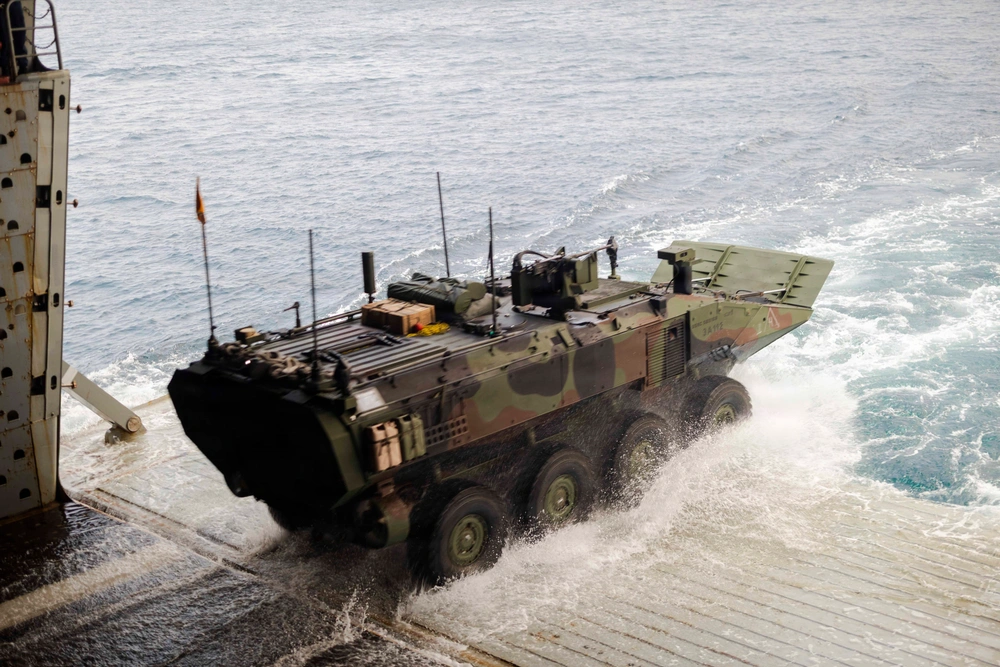
The Congressional Research Service (CRS) has asked lawmakers to examine how vulnerable the US Marine Corps’ Amphibious Combat Vehicle (ACV) is to armed drones, anti-tank guided missiles (ATGMs), and loitering munitions. The In Focus report, published October 6, 2026, arrived one week after the service placed the final production order for the eight-wheeled vehicle.
That order, a $230 million contract modification awarded to BAE Systems on September 30, 2026, funds 32 ACV-R recovery vehicles, the fourth and last variant, with work scheduled to conclude in November 2028. The Navy’s FY2027 request carries $237 million for ACV platform upgrades and no new vehicles, a pre-planned end to procurement after the program received more than $1 billion in FY2026 for final production contracts. Any survivability fix the report points toward will now arrive as a retrofit.
Amphibious Combat Vehicle Fleet Settles at 608 Units Across Four Variants
The ACV replaces the tracked Assault Amphibious Vehicle (AAV), fielded since the early 1970s, as the Marine infantry battalion’s primary means of tactical mobility at sea and ashore. BAE Systems, teamed with Iveco Defence Vehicles, entered low-rate initial production in June 2018 with an order for 30 vehicles. Initial operational capability followed in November 2020, and the full-rate production decision in December 2020 after a COVID-19 delay.
The original objective of 1,122 vehicles was cut under Force Design modernization. According to quantities the Marine Corps provided to CRS, the program now stands at 608 vehicles: 389 ACV-P personnel carriers, 33 ACV-C command-and-control vehicles, 152 ACV-30 gun variants, and 34 ACV-R recovery vehicles. CRS describes the 32-vehicle September award as the full ACV-R objective without reconciling it with the 34 recovery vehicles in that table.
Publicly available specifications indicate the ACV-P carries three crew and 13 Marines with two days of combat supplies. A six-cylinder diesel rated at roughly 690 hp gives the 8×8 vehicle a road speed of 65 mph and a land range of about 325 miles. Afloat, two rear-mounted propellers produce just over 6 knots, with a swim range of about 12 nautical miles. That water speed is broadly comparable to the AAV’s, so the ACV does not by itself push amphibious ships farther from a defended shore.
ACV-30 Firepower, Surf Limits, and Strut Corrosion Shape Readiness
The ACV-30 delivers the organic, direct fire support at the center of the CRS questions. After negotiations to lower its cost, the Marine Corps awarded BAE a $188 million contract in late April 2025 for the first full-rate lot. The hull and Kongsberg’s Protector Remote Turret 20 (RT20) are now bought separately and integrated at the Naval Information Warfare Center Atlantic in Charleston, South Carolina. Publicly available specifications indicate the RT20 mounts Northrop Grumman’s Mk44S Stretch Bushmaster 30x173mm cannon with a dual linkless feed and a coaxial 7.62mm machine gun. The basketless design preserves internal volume.
Readiness has been uneven. On July 19, 2022, one ACV rolled onto its side in the surf zone off California and a second was disabled during high-surf training. Both crews returned safely, but the service suspended amphibious operations until September 23, 2022, then imposed an interim four-foot limit on significant breaker height. In January 2025, Marine Corps leadership said no vehicle performs in 12-foot plunging surf and that ACVs transit the surf zone only after crews complete safety training and certification.
Weight and corrosion compound the problem. The ACV now weighs about 35 tons, and a 2025 Navy Small Business Innovation Research solicitation sought to remove at least 2,000 pounds per vehicle, prioritizing the heavier ACV-30 and ACV-R, to improve fuel efficiency and lower the centers of gravity and buoyancy. The Marine Corps is also working with BAE to stop saltwater corrosion of struts and shocks; a January 2026 sources-sought notice covered more than 5,000 corrosion-resistant struts.
Pulsar-L Counter-UAS Retrofit and Force Growth Test ACV Requirements
CRS draws on observations from Ukraine, where armored vehicles have proven highly vulnerable to ATGMs, armed uncrewed aerial systems (UAS), and loitering munitions. Because the ACV is meant to support dismounted Marines in the attack, CRS asks how exposed it would be during amphibious operations and ashore, and whether additional survivability modifications are planned.
Part of the answer is already on contract. In September 2026, the Marine Corps awarded Anduril Industries a sole-source contract worth about $15.7 million for its Pulsar-L system under an urgent statement of need. Pulsar-L is a vehicle-integrated, omnidirectional soft-kill package that pairs a sensor with a jammer to detect, track, identify, and defeat radio-frequency-dependent Group 1 and Group 2 UAS. Requirements call for detection at about two miles, 50 units in the first year, and integration starting in the first quarter of FY2027. The system already serves with US Special Operations Command.
CRS also raises force structure. A Force Structure Review proposes adding more than 6,500 Marines by 2032, including personnel for 19 infantry battalions and two Littoral Combat Teams. CRS asks whether that growth would require more ACVs, which cost roughly $6 million each depending on variant, according to open-source estimates.
Analysis: The ACV is leaving production with its survivability case resting on add-on kits rather than a redesigned hull. That creates competing pressures: the Navy wants at least 2,000 pounds stripped from each vehicle even as the Marine Corps bolts on jammers, and any hard-kill or passive protection drawn from Ukraine would add mass to a 35-ton vehicle whose surf-zone stability already constrains operations. Radio-frequency jamming also offers no defense against fiber-optic-guided drones or ATGMs. If end-strength growth demands more vehicles, the service would need to extend a line set to wind down after the last ACV-R deliveries in November 2028.
The next milestones are Pulsar-L integration in the first quarter of FY2027 and congressional action on the $237 million upgrade request. Still unknown are the Marine Corps’ survivability plans beyond soft-kill jamming, how upgrade funds will be split between weight reduction and corrosion fixes, and whether Congress approves the proposed end-strength increase.