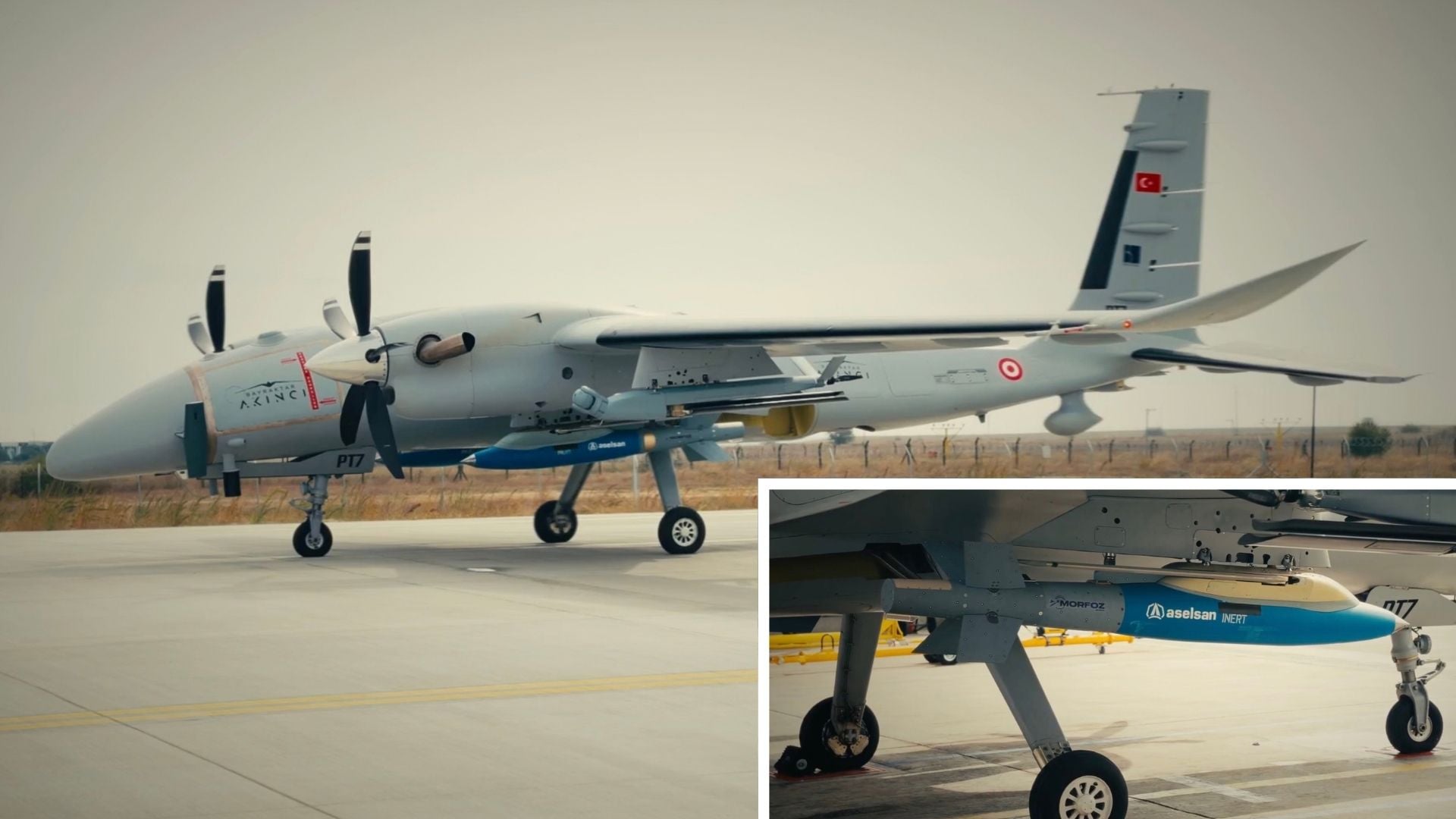
Baykar’s AKINCI unmanned combat aerial vehicle (UCAV) scored a direct hit on its first live firing of Aselsan’s MORFOZ Guidance Kit (MGK) on October 8, 2026, over the Gulf of Saros in northwestern Türkiye. According to Baykar, the aircraft took off from the Çorlu Flight Training and Test Center in Tekirdağ carrying the MGK alongside an ALPAGUT loitering munition developed by Roketsan and STM, struck the designated target with the MGK, and returned to Çorlu.
The shot adds a winged, satellite-guided glide weapon to a drone that already integrates more than 20 Turkish-made munitions. Aselsan has spent more than a decade converting legacy Mk 80-series general-purpose bombs into precision weapons through its LGK laser kits, the HGK precision guidance kit and the GÖZDE kit co-developed with TÜBİTAK SAGE. MORFOZ pushes that effort into the stand-off glide category, in which the launch aircraft releases from outside the engagement envelope of hostile short-range air defenses instead of overflying them.
MORFOZ Guidance Kit Architecture: Deployable Wings and Anti-Jam Navigation
Aselsan describes MORFOZ as a long-range winged guidance kit that turns an unguided bomb into a precision munition. A deployable wing assembly opens after release and generates lift for the unpowered weapon, converting the carrier’s launch altitude and airspeed into glide range. Guidance comes from an integrated inertial navigation system (INS) coupled with Global Positioning System (GPS) satellite navigation, and the kit can follow preprogrammed waypoints rather than a straight line to the target, letting mission planners route the weapon around defended areas or terrain.
An eight-channel controlled reception pattern antenna (CRPA) protects the satellite receiver. A CRPA combines several antenna elements to steer reception nulls toward jamming sources, preserving the GPS solution in a contested electromagnetic environment. The feature targets the main weakness of satellite-aided glide weapons, which in the war in Ukraine have been reported to lose accuracy under Russian jamming. If satellite signals are denied entirely, the INS keeps the weapon on course, with error growing over the time of flight.
MORFOZ offers a selectable impact angle, including a vertical terminal dive that Aselsan says maximizes warhead effectiveness. A steep attack concentrates blast and fragmentation on the aim point and improves penetration against hardened structures. The kit also carries internal telemetry that returns data to the launch platform, and the company rates it for all-weather, day and night use. According to Aselsan, the weapon separated safely from the AKINCI, flew a predetermined maneuver set that validated its autopilot algorithms, and then hit the target.
Several key parameters remain undisclosed. Aselsan has not published the kit’s range, weight or circular error probable (CEP), and neither company has identified the bomb body used in the test.
AKINCI Weapons Integration Moves Into Stand-Off Glide Munitions
Publicly available specifications indicate the AKINCI has a 20-meter wingspan, a maximum takeoff weight of up to 6,000 kg, a payload capacity of up to 1,500 kg and a 40,000-foot service ceiling, with twin turboprop engine options between 450 and 850 hp. The aircraft typically operates around 30,000 feet, an altitude that gives an unpowered glide weapon far more energy at release than a launch from a lower-flying tactical drone. Publicly reported figures show the fleet passed 100,000 flight hours by March 2025, a mature baseline for integrating new stores.
Baykar’s integration list now spans Roketsan’s MAM smart micro munitions, the TEBER and LGK laser kits, HGK-82, the GÖKÇE and GÖZDE guidance kits, KGK-82-SİHA, the İHA-122, İHA-230 and İHA-300 supersonic missiles, the ÇAKIR cruise missile, the EREN loitering munition and the SUNGUR air defense missile. MORFOZ fills a gap between GÖZDE, which Aselsan rates at 28 km on a 500 lb Mk 82 using INS, GNSS and a laser seeker, and powered stand-off weapons such as ÇAKIR. Aselsan has not described a terminal seeker on MORFOZ, so the weapon does not appear to require continuous laser designation, which would free the AKINCI’s electro-optical turret after release.
The load-out also stands out. ALPAGUT, a 45 kg loitering munition first released from an AKINCI off Sinop in August 2025, flew on the same sortie. Pairing a coordinate-guided glide bomb with a seeker-equipped loitering munition points to mixed configurations covering both fixed and mobile targets. Baykar did not say whether ALPAGUT was released during the October 8 flight.
Analysis: If its range matches Aselsan’s description, MORFOZ lets the AKINCI strike without loitering inside an adversary’s short-range air defense envelope, the condition under which medium-altitude, long-endurance drones have taken heavy losses in recent conflicts. Fitting anti-jam satellite guidance to inexpensive legacy bomb bodies follows the same cost logic that drove Western glide-kit programs, but Aselsan controls the chain from navigation hardware to platform integration, which limits exposure to foreign export licensing. For export operators of the AKINCI, Mk 80-series bombs are among the most widely stocked air-delivered munitions, so a cleared export version could turn existing inventories into stand-off weapons without a new missile purchase.
Aselsan has not released a test schedule, a production contract or a delivery timeline. Open questions include maximum range, accuracy under live jamming, and whether the kit will be cleared for crewed aircraft such as the F-16. Those figures will also define where MORFOZ sits relative to Aselsan’s heavier KGK-84, a winged kit for the 2,000 lb Mk 84 that scored its first hit from an F-16 in a firing announced in December 2025.