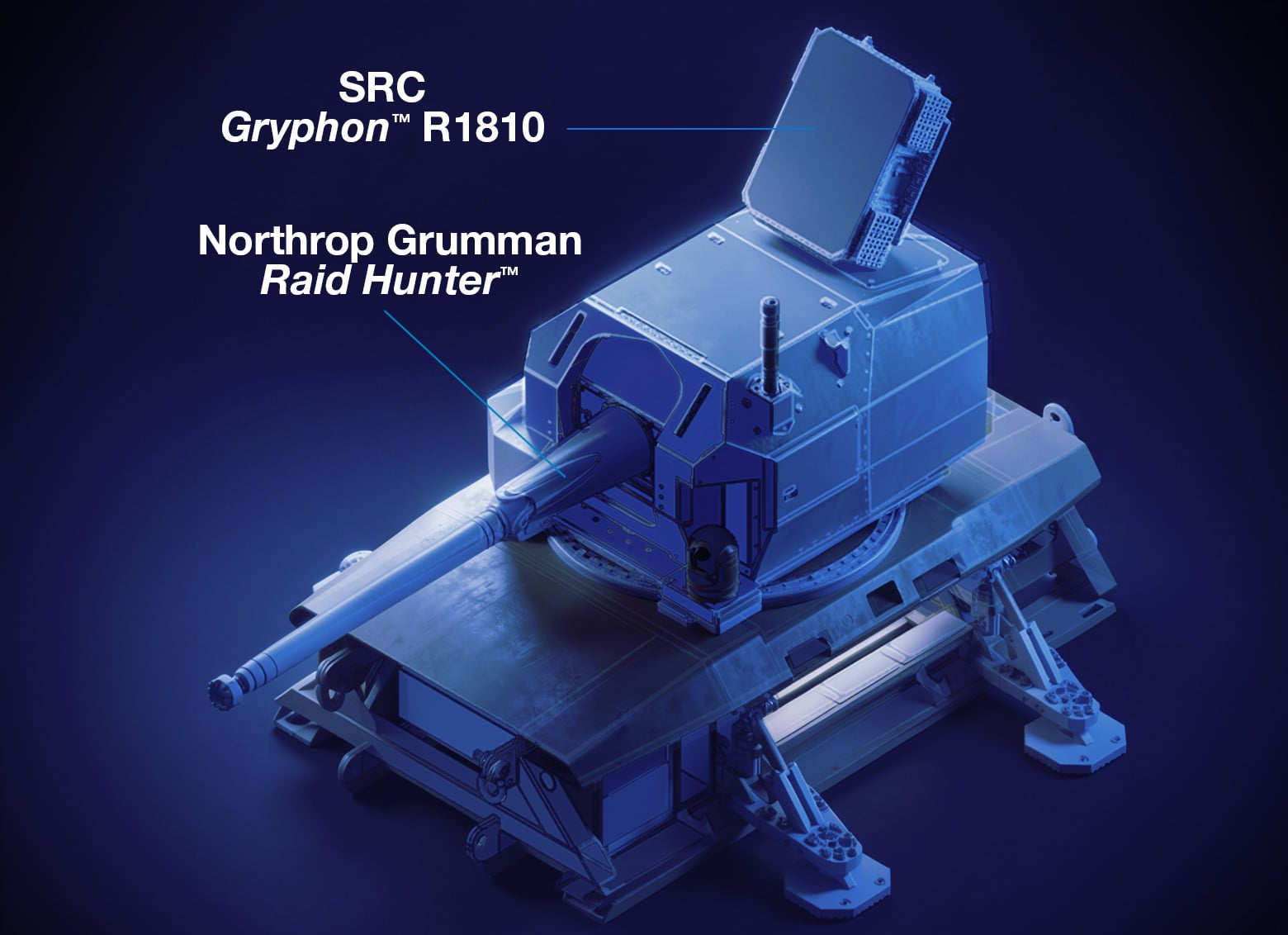
SRC Inc. announced on October 8, 2026 that it has developed a new fire-control radar, the Gryphon R1810, for Northrop Grumman’s Raid Hunter gun-based air defense system. Paired with the system’s turreted 50mm gun, the X-band radar tracks both incoming threats and the rounds fired to intercept them, sustaining precision fire control through engagements against coordinated drone swarms.
The announcement names the sensor at the core of a system Northrop aims to field on an accelerated timeline. The company introduced Raid Hunter, previously known as its 50mm Gun-Based Air Defense (GBAD) concept, on August 11, 2026, positioning it as a short-range terminal layer for bases, airfields and critical infrastructure facing mass raids of drones and cruise missiles. Northrop did not detail the system’s sensors at launch. SRC, a not-for-profit research and development firm, now identifies itself as Raid Hunter’s radar provider, though neither company has disclosed a contract value, quantities or a delivery schedule.
Gryphon R1810 Radar Doubles the R1540 Aperture for Longer Range
The R1810 is a derivative, not a clean-sheet design. It reuses the core electronics and antenna array modules of SRC’s Gryphon R1540, an air-cooled, 3-D active electronically scanned array (AESA) radar, but fills each panel with eight subarrays instead of four. SRC says the larger aperture delivers longer detection range and tighter track accuracy for a more demanding fire-control role.
According to SRC, the R1810 detects Group 1 unmanned aircraft systems (UAS), the Pentagon’s class for drones under 20 pounds, at up to 21.6 kilometers, against 12.7 kilometers for the R1540. Against Group 3 UAS, aircraft of up to 1,320 pounds, range grows from 30.2 to 49.4 kilometers. Those gains of roughly 70 and 64 percent track closely with radar physics: doubling the active array doubles radiated power, transmit gain and receive aperture together, which the radar range equation converts into about 68 percent more range for a fixed dwell time.
The cost is mass. SRC product data lists the single R1810 panel at 148 kilograms and 106.9 by 86.4 by 46.9 centimeters, against 78 kilograms for one R1540 panel. The radar draws 6 kilowatts, covers a 90-degree sector in azimuth and elevation, and is rated to track more than 1,000 targets at once using an Extended Kalman Filter tracker with Interacting Multiple Models. Listed command-and-control interfaces include Forward Area Air Defense (FAAD) and the Integrated Battle Command System (IBCS). Four panels can be linked, in a configuration SRC designates R1840, for 360-degree surveillance.
Tracking Target and Projectile: Closing the Raid Hunter Fire-Control Loop
Raid Hunter combines Northrop’s AiON command-and-control software, Bushmaster chain gun technology and a guided, proximity-fuzed 50mm round that the company describes as steerable through multiple in-flight maneuvers. The gun is the XM913, the 50mm cannon developed for the Army’s XM30 Mechanized Infantry Combat Vehicle effort; publicly available specifications indicate a rate of fire of about 200 rounds per minute. On September 16, 2026, Northrop said it had completed an aeroballistic test of the new projectile at the Potomac River Test Range in Dahlgren, Virginia, with XM913-fired rounds producing high-fidelity data on nearly every shot. The company bills it as the first guided 50mm round, a claim not yet independently verified.
Neither company has explained how course corrections reach the projectile. A radar that tracks both round and target is consistent with a closed-loop architecture in which the fire-control computer updates the intercept solution in flight, and SRC’s Gryphon literature describes recalculating firing coordinates in real time from tracks on outgoing rounds. The guidance mode, any uplink and the engagement envelope remain undisclosed. Kevin Hair, SRC’s president and CEO, said the company built the R1810 “to deliver the precise, longer-range tracking this system needs.”
Raid Hunter is palletized and C-130 transportable, with vehicle-mounted and container variants planned. The 148-kilogram panel adds weight to each, and its 90-degree sector leaves a single fire unit dependent on turret orientation or AiON cueing against threats from multiple axes.
From 30mm to 50mm: How Raid Hunter Compares With Rival Gun Systems
Raid Hunter scales up a gun-based counter-UAS approach the US Army already fields. The Mobile Low, Slow, Small Unmanned Aircraft Integrated Defeat System (M-LIDS) pairs Northrop’s 30mm XM914 chain gun and XM1211 proximity-fuzed ammunition with a Ku-band Radio Frequency Sensor (KuRFS) radar. A 50mm projectile offers room for guidance electronics and a heavier payload, at the cost of fewer rounds per unit of weight and a per-round price Northrop has not published. In Europe, Rheinmetall’s Skyranger 30 relies on programmable airburst ammunition from a 30mm revolver cannon rather than a steerable projectile.
SRC’s case rests on production maturity. The company described the R1540 in May 2025 as extensively deployed with the US military and delivered its 100th R1540 panel on October 14, 2025. Deriving the R1810 from the same modules lets SRC draw on an established production line and supply chain rather than qualify new hardware. The R1540 stays in the catalog for missions that do not require the added range, giving integrators a choice between a lighter sensor and a heavier fire-control panel.
Analysis: The R1810 shows where gun-based swarm defense will be decided: in the sensor-to-round loop, not the caliber. A guided 50mm projectile is only as effective as the track quality feeding it, and building the radar from a fielded R1540 lowers schedule and supply-chain risk. Geometry is the constraint. One 90-degree panel per gun means defending a site against a 360-degree saturation raid will demand several fire units, a four-panel R1840 surveillance layer or external cueing through IBCS or FAAD. Radar count per defended site, not gun count alone, is likely to drive Raid Hunter’s real cost.
Northrop plans further Raid Hunter testing through the rest of 2026 to support accelerated fielding with unnamed government and allied partners. No customer, program of record or production contract has been announced. The next markers are a live intercept pairing the R1810 with guided 50mm rounds against representative drones, and disclosure of the guidance architecture and the vehicle-mounted variant’s sensor layout.