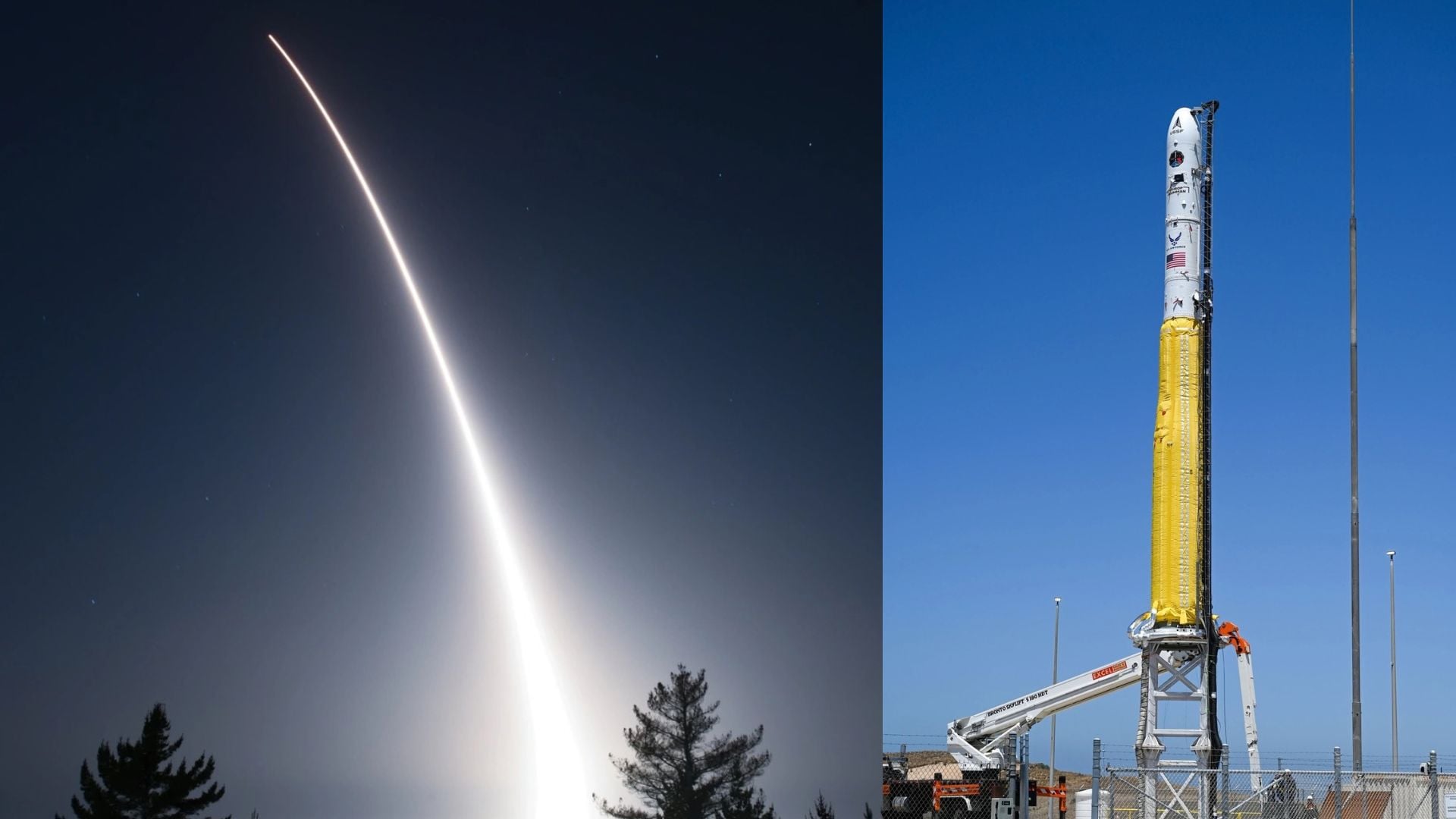
The U.S. Air Force flight-tested an unarmed Mk21A reentry vehicle on the morning of October 9, 2026, launching it from Vandenberg Space Force Base, California, aboard a Northrop Grumman Minotaur I rocket. The Air Force Nuclear Weapons Center (AFNWC) described the launch as an in-flight environmental test supporting development of the Mk21A, the reentry vehicle (RV) Lockheed Martin is building to carry the W87-1 warhead on the LGM-35A Sentinel intercontinental ballistic missile (ICBM).
The flight comes as Sentinel, the Northrop Grumman-built successor to the LGM-30G Minuteman III, nears the end of a restructuring triggered by a critical Nunn-McCurdy breach in January 2024. The Pentagon later put the program at $140.9 billion, 81% above its September 2020 Milestone B estimate, and rescinded that approval. The Air Force expects to regain Milestone B by the end of 2026, and Northrop Grumman vertically assembled a fully integrated inert Sentinel at Vandenberg in September 2026 ahead of a first flight planned for 2027. The Mk21A is a separate acquisition program, but its schedule is tied to the missile it will ride.
Mk21A Reentry Vehicle Flight Test: Launcher, Objectives, and Open Questions
The Space Force’s Rocket Systems Launch Program oversaw the Minotaur I, a vehicle used to fly new payload technologies in operationally realistic conditions. Publicly available specifications indicate the Minotaur I pairs an M55A1 first stage and SR19 second stage drawn from decommissioned Minuteman II missiles with Orion 50XL and Orion 38 upper stages, and can place roughly 580 kg (1,280 lb) into a 185 km low Earth orbit in its space launch configuration.
Tests of this type typically expose flight hardware to the vibration, acoustic, thermal, and aerodynamic loads of boost, separation, and atmospheric reentry, conditions ground facilities can only partly reproduce. AFNWC released no performance data. The launch time, booster configuration, trajectory, impact area, and whether the test met its objectives were not disclosed.
The Air Force has publicly announced one earlier Mk21A flight, a June 17, 2024, launch from the same base on the same booster type. Lockheed Martin said at the time that the flight evaluated its design components, including the arming and fuzing subsystem and support equipment. Maj. Gen. William Rogers, Air Force portfolio acquisition executive for ICBMs and AFNWC director of ICBM systems, framed the latest flight in strategic terms: “The Mk21A is crucial to modernizing our ICBMs in response to the rapidly changing global threat picture posed by our adversaries.”
From Mk21 to Mk21A: Airframe Heritage and W87-1 Warhead Integration
The Mk21A is a modification, not a clean-sheet design. The original Mk21, developed as the Advanced Ballistic Reentry Vehicle, entered service on the LGM-118A Peacekeeper, which carried up to 10 W87 warheads from 1986 until its retirement in 2005. Under the Safety Enhanced Reentry Vehicle program, the Air Force moved the Mk21 and W87 onto Minuteman III in a single-warhead configuration beginning in 2006. Publicly available specifications describe the Mk21 as a cone roughly 55 cm (21.8 in) in base diameter and 175 cm (68.9 in) long.
Lockheed Martin’s 2019 risk-reduction contract set the goal: a low-risk, affordable modification of existing Mk21 airframes able to deliver the W87-1. The most consequential new element is the arming and fuzing subsystem. Air Force budget documents have stated that the legacy Mk21 fuze is three times past its design life, which places the fuze, more than the airframe, at the center of the qualification effort.
The W87-1 will replace the W78, carried in Mk12A reentry vehicles on part of today’s Minuteman III force. The National Nuclear Security Administration (NNSA) says the W87-1 reuses previously tested nuclear components from the W87-0 design, adds an insensitive high explosive primary and improved safety and security features, provides no new military capability, and will be certified without underground nuclear testing. It also requires newly manufactured plutonium pits; NNSA verified the first W87-1 production pit, built at Los Alamos National Laboratory, on October 1, 2024.
Lockheed Martin Mk21A Contract Growth and Production Timeline
Lockheed Martin won a $108.3 million technology maturation and risk reduction contract in October 2019, followed by a $51.2 million modification in August 2021 for arming and fuzing engineering. On October 30, 2023, AFNWC awarded the company a $996.2 million sole-source engineering and manufacturing development contract, with work in King of Prussia, Pennsylvania, running to October 20, 2039. A $453,960,636 modification announced November 13, 2025, raised the contract’s cumulative face value to $1,482,875,038.
Air Force budget documents published in 2024 projected procurement of 426 reentry vehicles, with deliveries starting in fiscal 2028 and continuing through 2039. NNSA has scheduled the W87-1 first production unit for fiscal years 2030 to 2032. AFNWC leads the acquisition on behalf of Air Force Materiel Command, supporting Air Force Global Strike Command as the operational user.
Analysis: Flying the Mk21A on a surrogate Minotaur I lets the Air Force mature the weapon system’s front end independently of the missile. Sentinel’s cost breach originated mainly in its ground segment, and the service structured the RV as a low-risk derivative of a flight-proven airframe to keep it off the critical path. That approach pays off only if the new arming and fuzing subsystem is qualified before Sentinel’s own flight test campaign, so the RV reaches missile integration as a known quantity rather than a second source of schedule risk. With W87-1 production and Sentinel initial capability both targeted for the early 2030s, the margin is narrow, and Minuteman III must cover any gap.
The next markers come quickly: the Sentinel Milestone B decision and cost estimate the Air Force has targeted for the end of 2026, then the missile’s first flight, planned by the service for 2027 but placed in March 2028 by a February 2026 Government Accountability Office report. Still unknown are the results of the October 9 flight, the number of Mk21A flight tests left before production, and the status of the Next Generation Reentry Vehicle, once slated for a fiscal 2026 contract award.