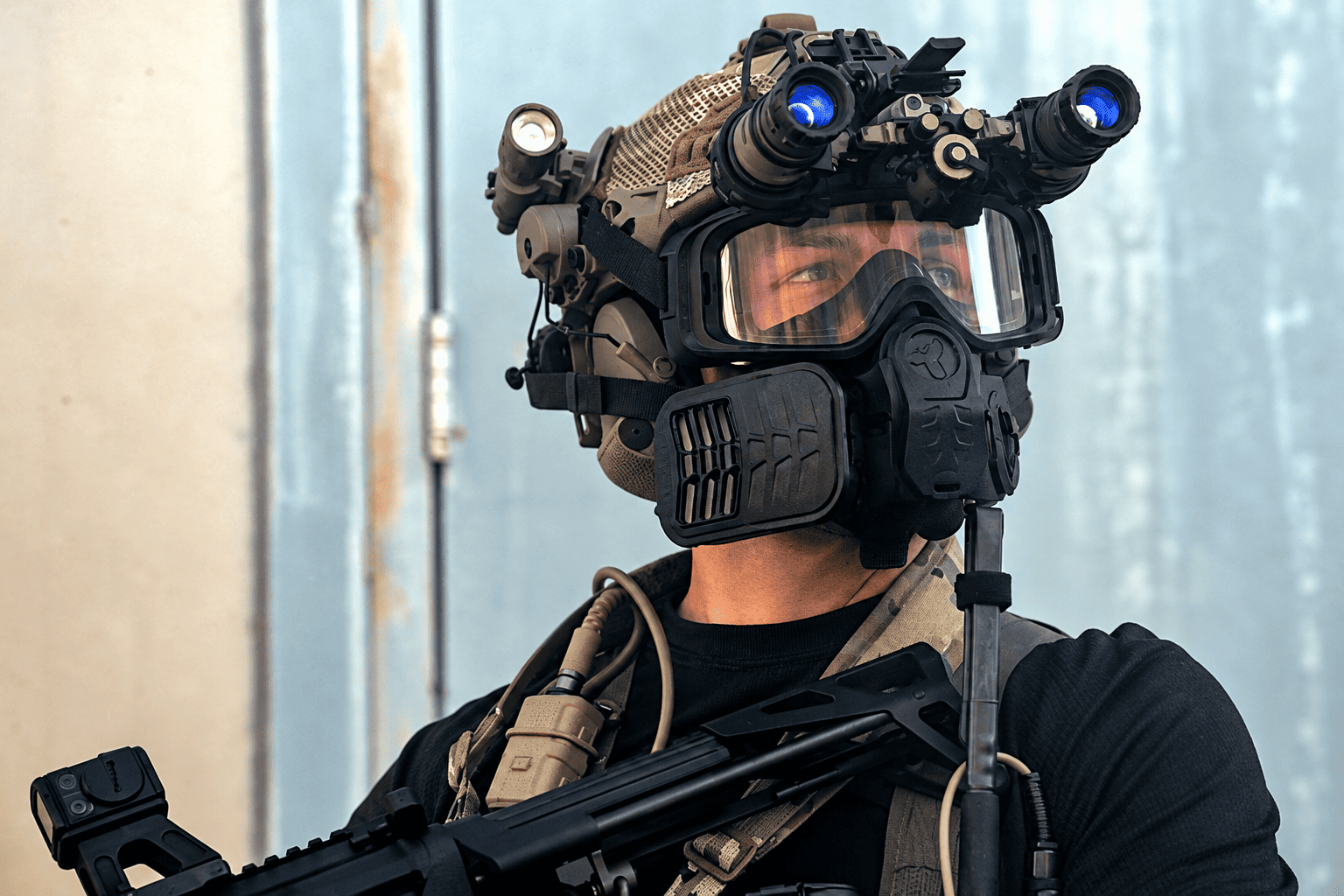
The US Department of War has ordered Avon Protection’s MITR-M1 Half Mask and MITR-PG1 Powered Goggle for its Special Operations Forces (SOF), the company announced on October 9, 2026. The order also covers the MITR-PF particulate filter and the MITR-RF riot filter, along with helmet-integration and communications accessories. Avon did not disclose the contract value, quantities, the contracting command or a delivery schedule.
The buy makes the United States the second Five Eyes (FVEY) nation to adopt the MITR-M1, five months after Canada, and adds a lightweight tier beneath the full-face chemical, biological, radiological and nuclear (CBRN) respirators special operators already carry. It also deepens Avon’s ties with the Department of War, the secondary title the Pentagon adopted under a September 2025 executive order: the company’s Cadillac, Michigan, operation is sole supplier of the M50 Joint Service General Purpose Mask and builds the M53A1 used by special operations units.
Inside the Avon MITR System: Half Mask, Filters and Powered Goggle
The MITR-M1 is a single-filter elastomeric half mask covering the nose and mouth. With the MITR-PF filter fitted, it weighs 250 grams (0.55 lb) and measures 113 by 148 by 95 millimeters, per Avon’s published specifications, small enough to ride in a cargo pocket. It comes in three sizes, with the filter mountable on either side. The National Institute for Occupational Safety and Health (NIOSH) approved the mask and filter on September 23, 2025, under approval TC-84A-9852; the pairing also holds European EN 140 and EN 143 P3 R certification and is rated from minus 25 to 120 degrees Fahrenheit.
A helmet mount kit clips the mask to accessory rails, so an operator can don it without removing a ballistic or bump helmet. Avon says the curved, flush profile preserves weapon sighting, while voice amplification and projection units keep communications intact; a dedicated MITR-M1 communications unit appeared in concept form at DSEI in September 2025.
The two filters define the mission set. The MITR-PF uses a pleated high-efficiency element rated P100, stopping more than 99.97 percent of airborne particulates, including biological and pharmaceutical agents. The MITR-RF adds an activated carbon layer for riot-control agent vapor.
The MITR-PG1, unveiled at the same DSEI show, closes the ocular gap. A battery-powered filter and blower continuously purges the air inside the goggle, keeping out CS, CN and OC agents while limiting fogging. It straps to ballistic and bump helmets without obstructing night vision devices, a requirement for night raids and other low-light operations, and Avon says it can be worn for more than eight hours at a time.
How MITR Complements the M53A1 in the SOF Respirator Lineup
MITR does not replace the M53A1. The M53 family was designed with direct input from the special operations community, which is why it carries a single side-mounted filter to clear the rifle stock and can interface with powered air-purifying respirators and self-contained breathing apparatus. The M53A1 holds both NIOSH CBRN and military certification and reached full operational capability in September 2023, after fielding of roughly 15,000 masks across SOF, close combat forces and the Army National Guard, according to the Joint Program Executive Office for Chemical, Biological, Radiological and Nuclear Defense (JPEO-CBRND).
The weight difference explains the new tier. Avon lists the M53A1 facepiece at 1.6 pounds without a filter, roughly three times the MITR-M1 with its filter attached. The trade-off is protection. MITR’s NIOSH approval covers particulates, with the RF variant adding riot-agent vapor filtration; it does not cover chemical warfare agents, and as a half mask it is not suited to oxygen-deficient atmospheres.
The hazards it targets are routine rather than exotic. Avon says users have employed the MITR-M1 against explosive and gunfire residue, lead, asbestos, fentanyl and riot-control agents in both training and live operations. Those exposures recur in breaching, live-fire training on enclosed ranges and site exploitation, tasks where carrying a full-face CBRN respirator on every mission is impractical.
Five Eyes Adoption Follows Canada’s May 2026 Framework Contract
Canada opened the FVEY door on May 13, 2026, with a five-year framework agreement covering the MITR-M1, the MITR-PF filter and accessories for the Canadian Armed Forces. The US order goes further, adding the PG1 goggle and riot filter for the full scalable system rather than a particulate-only kit.
The path from product launch to a second FVEY customer has been short. Avon opened pre-orders for the MITR-M1 at SHOT Show in January 2025, began first deliveries in May 2025, including to select military users, and secured NIOSH approval that September. Steve Elwell, president of Avon Protection, said the US award “culminates nearly four years of working collaboratively with end-users.” He presented the system as a way to cut operators’ cumulative exposure to hazardous particulates over a career, not only on a single mission.
The order also strengthens a parent group already embedded in US soldier protection. Avon Technologies plc owns helmet maker Team Wendy, which booked a $20.3 million Defense Logistics Agency delivery order for Advanced Combat Helmet Generation II helmets on September 2, 2026, while Avon Protection holds three November 2024 contracts under the Advanced System for Protection and Integrated Reduction of Encumbrances Hood/Mask Interface (ASPIRE HMI) effort to improve how the M50 and M53A1 seal with CBRN suit hoods.
Analysis: The order signals that US special operations now treats chronic, low-level airborne exposure as a force-health problem distinct from battlefield CBRN defense, and is buying dedicated equipment to address it. For the industrial base, it moves Avon from incumbent full-face respirator supplier to provider of tiered respiratory protection, from a 250-gram half mask up to the M53A1 with powered air. The open question is whether MITR stays a SOF-specific purchase or migrates into a JPEO-CBRND program of record for wider issue.
Beyond the undisclosed value and quantities, the receiving units remain unnamed. The next markers are whether the purchase grows into a multi-year framework like Canada’s, whether the MITR-M1 communications unit matures beyond concept, and whether the United Kingdom, Australia or New Zealand become the next FVEY customers.