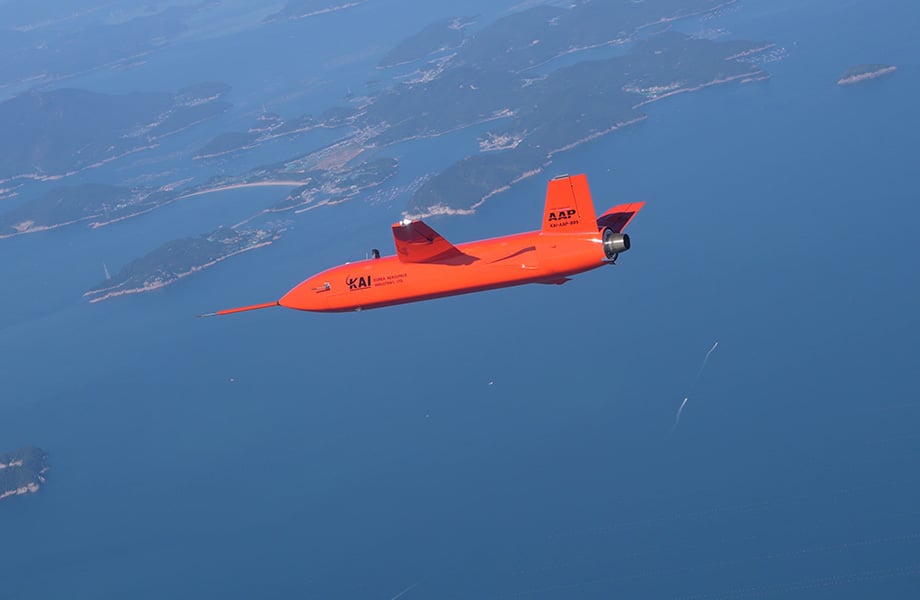
Korea Aerospace Industries (KAI) has flown its FA-50 light combat aircraft in close formation with the Adaptable Aerial Platform (AAP), a company-funded jet-powered drone, in what the company describes as South Korea’s first manned-unmanned teaming flight. Announced on October 8, 2026, the 20-minute sortie took place at about 7,000 feet (2.1 kilometers) over the sea south of Goheung, South Jeolla Province, with the two aircraft holding a separation of 30 to 100 feet (9 to 30 meters).
The test is the first airborne proof point for KAI’s Next-Generation Aerial Combat System (NACS), a two-tier manned-unmanned teaming (MUM-T) architecture in which small attritable drones support larger unmanned combat aircraft operating under a crewed fighter. KAI chief executive Kim Jong-chul said the flight was the first in Korea to “confirm the possibility of manned and unmanned complex system operation” with real aircraft. In 2024, KAI targeted a 2028 demonstration of one FA-50 controlling four AAPs.
Inside the KAI AAP Drone: Airframe, Propulsion, and KAiLOT Autonomy
The AAP is a 150-kilogram, jet-powered unmanned aircraft that KAI has developed with internal funds since 2024. The airframe measures 3.1 meters in length with a 2.2-meter wingspan and pairs a straight, high-mounted wing with a V-tail. KAI flew a subscale prototype, reportedly about 20 percent smaller, in 2024 before the full-scale aircraft made its first flight in October 2025.
Publicly available specifications indicate the AAP is powered by a single turbojet producing about 250 pounds of thrust (1.1 kilonewtons), carries a payload of roughly 24 kilograms, and has a ferry range of about 400 kilometers. KAI now rates its top speed at 790 km/h, above the 730 km/h figure listed in company show material in late 2025; the company has not explained the difference. KAI intends the AAP to fly reconnaissance, jamming, deception, and strike missions within mixed formations of crewed fighters and drones, absorbing high-threat tasks that would otherwise expose a crewed jet.
Autonomy is the program’s center of gravity. The AAP is the flight testbed for KAiLOT, KAI’s in-house artificial intelligence (AI) pilot. Earlier trials showed the software flying waypoint routes and avoiding obstacles autonomously. To compress the schedule, KAI contracted in March 2025 to use Shield AI’s Hivemind Enterprise toolkit to verify KAiLOT’s autonomous flight functions, and took a 9.87 percent stake in Seoul-based GenGenAI to generate synthetic training data.
The demonstration was flown at a deliberately conservative 360 km/h, a speed KAI selected for flight stability and operational feasibility. That is less than half the AAP’s rated maximum and a fraction of the FA-50’s Mach 1.5 top speed.
How the FA-50 Flight Feeds KAI’s MUCCA and SUCA Programs
The FA-50 is a logical host for early teaming trials. Derived from the T-50 supersonic trainer, the light combat aircraft is powered by a single General Electric F404-GE-102 afterburning turbofan rated at about 17,700 pounds of thrust (78.7 kilonewtons) and has a maximum takeoff weight of 12.3 tonnes, according to publicly available specifications. Its tandem two-seat cockpit offers a natural station for a rear-seat operator to direct unmanned aircraft without loading the pilot flying the jet.
KAI has not disclosed which FA-50 block flew the test or how the AAP was commanded during the sortie. The company’s stated next step, controlling the AAP from the FA-50 while executing a mission, indicates this flight validated formation keeping and flight safety rather than airborne command and control.
The data feeds directly into KAI’s Medium Unmanned Collaborative Combat Aircraft (MUCCA), which the company calls an unmanned fighter. Unveiled in October 2025, the MUCCA has a planned maximum takeoff weight of 5,420 kilograms and is designed as a reusable, attritable platform for air-to-air combat, with ground attack under study. Configured for air defense, it would carry an active electronically scanned array (AESA) nose payload and air-to-air missiles, according to KAI engineers. The smaller Small Unmanned Combat Aircraft (SUCA), a 220-kilogram derivative of the AAP, is designed to reach targets out to 300 nautical miles and to operate in swarms.
Both are meant to fly with the KF-21 Boramae as the NACS command node, with KAiLOT as the common autonomy layer. The FA-50 trial is a low-cost pathfinder, generating formation data on a mature, widely exported airframe ahead of KF-21 integration.
Analysis: The flight is modest in its parameters and meaningful in its sequencing. A 20-minute pass at 360 km/h does not prove combat teaming; it proves that a 150-kilogram drone can hold station 30 to 100 feet from an aircraft with roughly 80 times its maximum takeoff weight, the prerequisite for every later step. The more consequential choice is the host. By maturing MUM-T on the FA-50 rather than waiting for the KF-21, KAI is building a potential retrofit path for an export fleet sold to customers including Poland, the Philippines, and Malaysia, offering drone-augmented combat mass at light-fighter cost. With its 2025 agreement with US firm Kratos on joint MUM-T development, KAI is positioning itself as a collaborative combat aircraft supplier, not only a fighter exporter.
KAI will use the data to expand KAiLOT-based multi-aircraft demonstrations, raise the AAP’s speed and operating radius, and move to in-mission control of the drone from the FA-50. It has not disclosed a test schedule, its datalink architecture, or the autonomy level used in the sortie, nor whether the Republic of Korea Air Force (ROKAF) will fund an FA-50 teaming capability. The 2028 four-AAP demonstration goal is the next public benchmark.