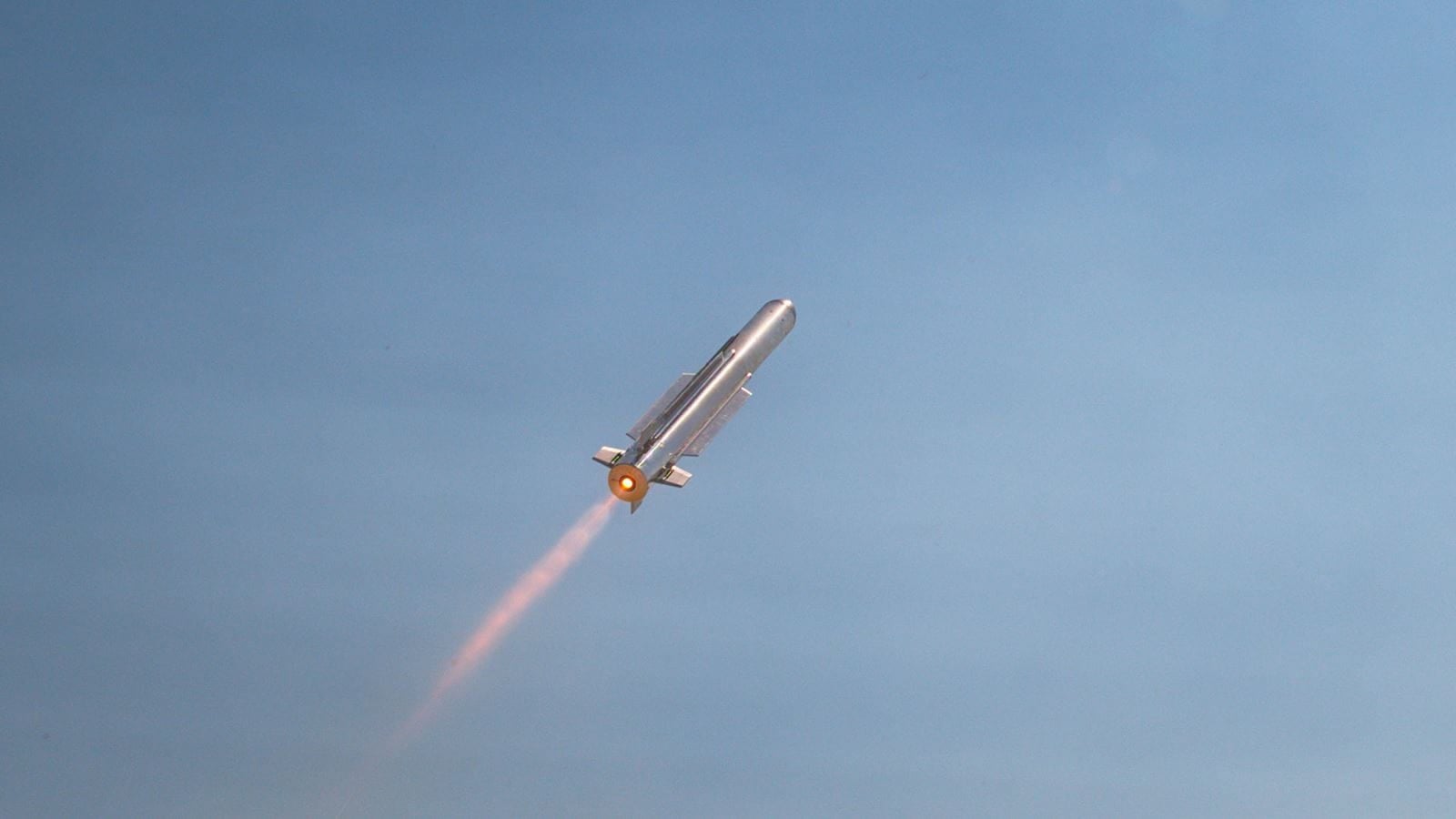
Raytheon has completed three developmental tests of its Coyote Block 2C+RM interceptor upgrade, taking the counter-drone effector from concept to testing in 15 months, the RTX business announced from Tucson, Arizona, on October 12, 2026. The company-funded series included the first launches of a Coyote fitted with a tactical rocket motor and confirmed initial integration with the existing U.S. counter-drone architecture.
The upgrade arrives as Coyote shifts from niche effector to high-volume consumable. In July 2026, the U.S. Army approved disclosure of 600 Coyote combat intercepts linked to Operation Epic Fury, the U.S. military campaign against Iran that began on February 28, 2026. Raytheon tied Block 2C+RM to an urgent joint U.S. counter-drone mission without naming the requiring organization; the Pentagon stood up Joint Interagency Task Force 401 (JIATF-401) in August 2025 to synchronize such efforts across the services.
Rocket Motor, Seeker, and Warhead: Inside the Coyote Block 2C+RM Upgrade
Raytheon describes Block 2C+RM as a direct evolution of the combat-proven Coyote kinetic variants. The upgrade combines three elements: a rocket motor for faster launch and flight, a new seeker, and a new warhead, intended together to defeat all classes of current and emerging drone threats.
Propulsion is the most consequential change. The fielded Coyote Block 2 leaves its launcher on a boost rocket motor, after which a small turbine engine sustains flight. Publicly available specifications put Block 2 at 555 to 595 km/h (345 to 370 mph), with an engagement range of 10 to 15 km and a fragmentation warhead of roughly 1.8 kg triggered by a proximity fuze. The turbine provides endurance and the maneuverability to chase agile targets, but it also caps top speed and stretches time to intercept.
Raytheon says the tactical rocket motor is meant to shorten threat engagement times and enable faster successive shots. The company has not said whether the motor replaces the turbine sustainer or supplements it, a distinction that determines whether Block 2C+RM keeps the loiter and re-attack behavior that open sources attribute to earlier Block 2 rounds. Raytheon has also not identified the motor supplier, the new seeker’s sensing modality, or the warhead’s mass and type.
The test series validated initial integration with the current counter-drone architecture. For the Army, that means the Low, slow, small-unmanned aircraft Integrated Defeat System (LIDS), which pairs Coyote with Raytheon’s Ku-band Radio Frequency Sensor (KuRFS), an active electronically scanned array radar offering 360-degree coverage, in fixed-site (FS-LIDS) and mobile (M-LIDS) configurations. Test dates, ranges, and targets engaged were not disclosed.
Coyote Production Ramp and the $5.04 Billion LIDS Contract
Block 2C+RM enters a program already sized for volume. On September 29, 2025, the Army awarded Raytheon a $5.04 billion cost-plus-fixed-fee contract for fixed and mobile Coyote launchers, kinetic and non-kinetic interceptors, and KuRFS radars, with work running through September 28, 2033. The Army’s estimated requirement for fiscal years 2025 through 2029 calls for at least 6,000 kinetic interceptors, 700 non-kinetic interceptors, 252 fixed-site launchers, 25 mobile launchers, 118 fixed-site KuRFS, and 33 mobile KuRFS. The non-kinetic line is Block 3NK, a recoverable high-power microwave variant.
That award followed a $75 million rapid acquisition contract on January 16, 2024, for 600 Block 2C interceptors, executed in under 30 days as U.S. forces in the Middle East faced sustained drone attacks, and a $197 million follow-on in September 2024. Raytheon also opened a Coyote final assembly and test facility in Abu Dhabi in May 2025 under an agreement with the UAE’s Tawazun Council.
Funding the upgrade internally lets Raytheon put a tested configuration in front of the joint force rather than wait on a funded requirement. Tom Laliberty, president of Land & Air Defense Systems at Raytheon, said a common backbone lets the company “rapidly scale the Coyote family across counter-drone missions.” In July 2026, he said Raytheon had tripled Coyote output over the prior year and planned to double it again, to about 300 missiles a month.
Cost explains the urgency. The Center for a New American Security has estimated Coyote’s unit price at about $126,500, against $20,000 to $50,000 for a Shahed-136 one-way attack drone and roughly $4 million for a Patriot PAC-3 interceptor. Coyote does not close the exchange gap, but it cuts the cost per engagement by more than an order of magnitude versus missile-class interceptors.
Analysis: The rocket motor is a bet on time over endurance. The turbine-powered Coyote was optimized for Group 1 to 3 drones, where loiter and maneuver matter more than raw speed. Iran’s move toward jet-powered designs such as the Shahed-238, and the large, multi-axis raids seen during Operation Epic Fury, compress the defender’s decision window and penalize any interceptor that needs seconds to accelerate. Faster flyout and quicker follow-on shots raise the number of engagements a single LIDS battery can complete per raid, a throughput gain that matters as much as raw inventory. If the turbine goes, the likely price is reduced range or loiter, which Raytheon has not addressed.
Raytheon has published no schedule for further Block 2C+RM testing, a government-funded qualification phase, or a production cut-in under the existing LIDS contract. Open questions include unit cost relative to the current Block 2C, compatibility with fielded FS-LIDS and M-LIDS launchers, and whether the Navy, which has deployed Coyote aboard at least one Arleigh Burke-class destroyer, will adopt the variant. The next marker will be a government test event or contract modification naming Block 2C+RM.