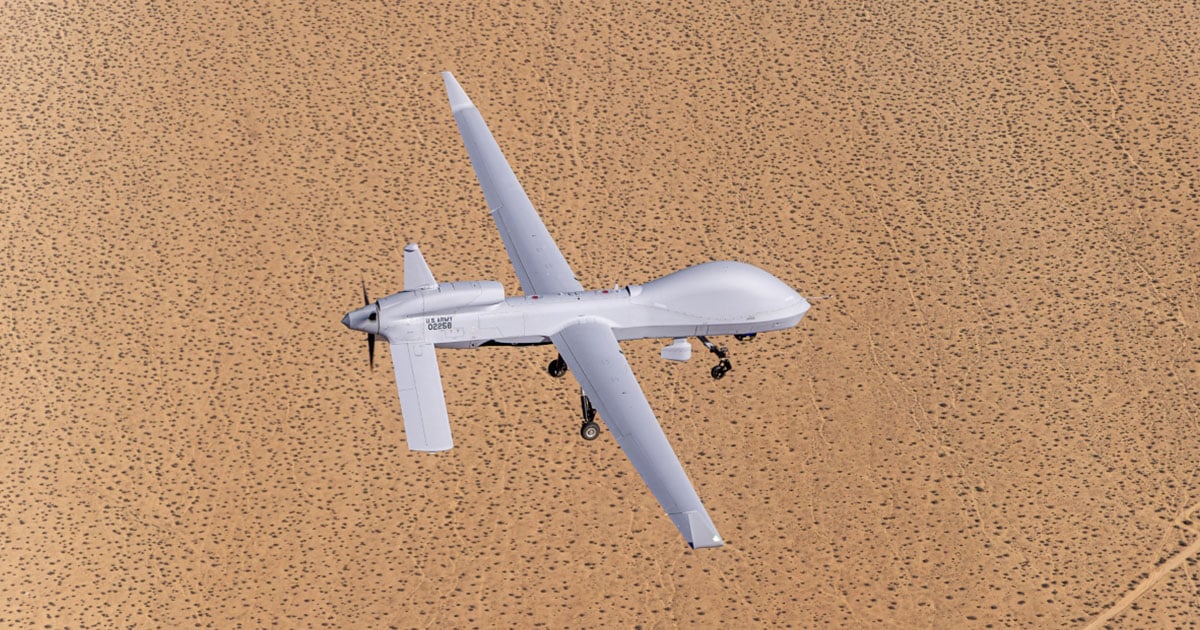
The Arizona Army National Guard (AZARNG) will receive eight Gray Eagle 25M unmanned aircraft systems (UAS) in September 2027, making Arizona the first state to stand up a Gray Eagle 25M unit within the Army National Guard (ARNG), General Atomics Aeronautical Systems, Inc. (GA-ASI) announced on October 12, 2026. Company and AZARNG officials finalized the fielding plan over the summer, and four additional Guard units are scheduled to receive the aircraft by the end of 2029.
The fielding closes a long-standing gap. Every active-component division already operates Gray Eagle aircraft; none of the Guard’s eight divisions does. Congress, not the Army’s budget request, has driven the effort: lawmakers added $350 million to fiscal 2023 appropriations for an initial 12 aircraft, ordered from GA-ASI in May 2024. Later appropriations raised the funded inventory to 28 aircraft, enough for three divisional companies, according to the National Guard Association of the United States (NGAUS).
Gray Eagle 25M Fielding Plan: Eight Aircraft, Five Units by 2029
Arizona’s unit falls under the 40th Infantry Division, a multistate Guard formation headquartered in California. The ARNG aims to field eight divisional UAS companies, one per division, giving each commander organic reconnaissance, surveillance, and target acquisition (RSTA) rather than competing for corps- or theater-level intelligence, surveillance, and reconnaissance (ISR) assets.
The Arizona package is smaller than the 12 aircraft NGAUS described as a full Gray Eagle company when the fiscal 2023 buy was announced, and smaller than the nine-aircraft company the Army fielded with the legacy MQ-1C. GA-ASI did not say how the eight Arizona aircraft relate to the original order, which states will host the four follow-on units, or how the company will be manned. The schedule also outruns the money: five units are planned by 2029, but GA-ASI confirms only three are funded and on contract.
GA-ASI says Guard Gray Eagle 25Ms will be able to support combatant commanders worldwide, defend against threats in the Western Hemisphere, and handle domestic missions such as disaster response. The company also pitches the aircraft’s endurance and open architecture for Golden Dome, the administration’s homeland missile defense initiative, although no such role has been assigned. U.S. Northern Command (NORTHCOM) has validated plans to employ the aircraft, according to NGAUS.
“The Gray Eagle has a proven record of performance with 1 million hours of safe operations, including automatic takeoff and landing capability,” said Patrick Shortsleeve, GA-ASI vice president of DoD strategic development. He described the aircraft as an enabler for fires, maneuver, network, and intelligence operations that teams with manned rotary-wing aviation.
HFE 2.0, EagleEye Radar and Open Architecture: Upgrades Over the MQ-1C
The 25M is the third step in a lineage that began with the MQ-1C Gray Eagle, a Predator derivative with a 165-horsepower Thielert heavy-fuel engine, a 3,600-pound maximum gross takeoff weight, and 25-hour endurance. The Gray Eagle Extended Range (GE-ER) raised gross weight to 4,200 pounds with a 180-horsepower engine. The 25M, first flown on December 5, 2023, keeps that airframe class, with a 58-foot wingspan according to publicly available specifications.
Its centerpiece is the 200-horsepower Heavy Fuel Engine (HFE) 2.0, developed with General Atomics Europe and Cosworth, which completed qualification on November 13, 2024, against the Federal Aviation Administration’s 14 CFR 33.49 endurance standard. GA-ASI cites a 40 percent longer service life, more than 50 percent more electrical power, and a matched 2,500-hour replacement interval for the engine, gearbox, generators, and high-pressure fuel pump. The payoff is endurance beyond 40 hours and electrical margin for heavier sensor and electronic warfare payloads. Manufacturer figures list a 25,000-foot ceiling and four AGM-114 Hellfire missiles.
The sensor suite pairs an electro-optical/infrared (EO/IR) turret with the EagleEye multi-mode radar, which offers synthetic aperture radar (SAR), ground and dismount moving target indication (GMTI/DMTI), maritime wide-area search, and a Video SAR mode that produces radar-based full-motion video. GA-ASI says EagleEye reaches several times the range of earlier Gray Eagle radars. For a Guard division, that matters most to its Division Artillery (DIVARTY): an all-weather sensor that can locate and track targets at standoff distance is what turns long-range fires into a working kill chain.
The 25M also adopts a Modular Open Systems Approach (MOSA) aligned with the Future Airborne Capability Environment (FACE) 3.0 standard, plus anti-jam GPS, secure satellite communications, and vision-based navigation. A laptop-based control station shrinks the ground footprint for dispersed operations. GA-ASI adds that it can employ Launched Effects from outside enemy weapons envelopes and perform counter-UAS tasks.
Analysis: Arizona’s aircraft arrive in a Guard that is buying what the active Army stopped buying. Under the Army Transformation Initiative, Army leadership canceled MQ-1C Gray Eagle procurement in May 2025, listing it among obsolete systems, and service officials have said older Gray Eagles will retire around fiscal 2028. Congressional additions have made the ARNG the near-term operator of the newest variant. That inversion ties training, depot support, and spares to continued congressional funding rather than the Army’s base budget, and three funded units against an eight-division requirement show how thin that support remains. Sustained, it gives Guard divisions an organic sensor-to-shooter link.
Arizona’s September 2027 delivery is the next milestone, followed by four more unit fieldings through 2029. Open questions include which states host those units, how the two unfunded units get paid for in fiscal 2027 and later appropriations, and whether the Army integrates Guard Gray Eagle 25Ms into its post-transformation UAS architecture or treats them as a congressional exception.