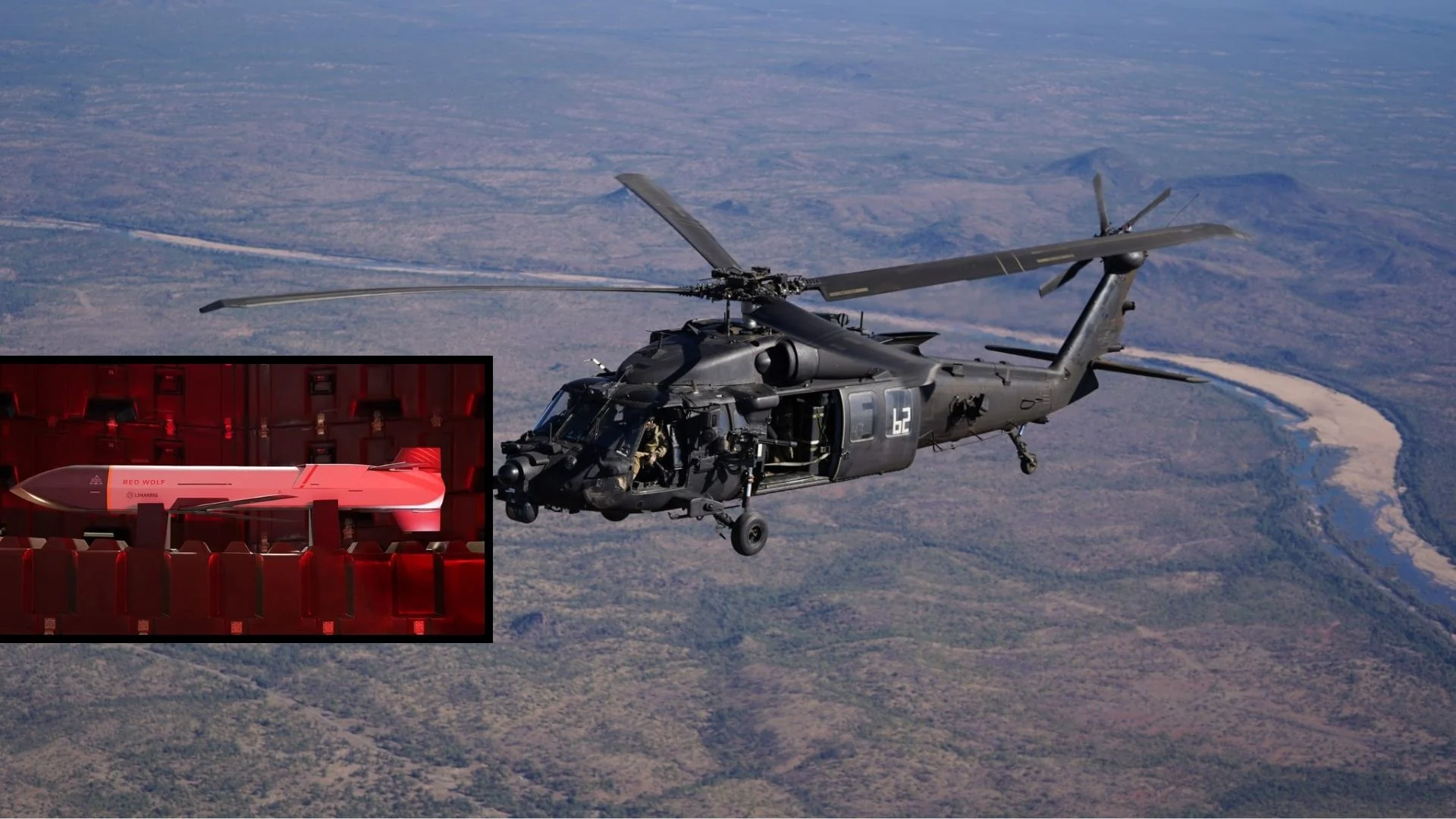
L3Harris Technologies and the U.S. Army Special Operations Aviation Command (USASOAC) have flown a Red Wolf air-launched effect from an MH-60 Black Hawk for the first time, the company announced on October 13, 2026. The demonstration, conducted with USASOAC’s Systems Integration Management Office (SIMO), validated launch system compatibility and the vehicle’s flight characteristics in an operational setting, and opens a route for integrating L3Harris launched effects with Black Hawks and other H-60 variants.
The flight adds the Army’s most numerous helicopter family to a launch envelope that already spans fixed-wing aircraft, the U.S. Marine Corps AH-1Z Viper and ground launchers. It also lands as the Army pushes its own air-launched effects (A-LE) capability onto the H-60M. Service aircrews launched and controlled multiple medium-range launched effects from a single H-60M at Fort A.P. Hill, Virginia, in June 2026, then repeated the event at Project Convergence Capstone 6 (PCC6) at Fort Irwin, California, in July. The Army did not identify the vehicles used in either test.
What the Red Wolf MH-60 Launch Validated for Army Special Operations
L3Harris released few details. The company did not give the date of the flight, the MH-60 variant involved, the test range or the carriage and release hardware. The announcement carries a Yuma, Arizona, dateline, home to the Army’s Yuma Proving Ground, where Red Wolf previously flew from an AH-1Z; L3Harris has not confirmed the MH-60 test took place there.
The vehicle flew with a test payload, not a warhead or an electronic warfare package. That makes it an integration milestone, not a weapons test, centered on safe separation from a utility helicopter and stable powered flight. Release from a helicopter poses different problems than release from a fixed-wing pylon, because rotor downwash and low launch airspeeds shape the separation envelope.
L3Harris has described Red Wolf as roughly 1.8 meters (6 feet) long, with wings that deploy immediately after launch. That length sits close to the AGM-114 Hellfire, about 1.63 meters according to publicly available specifications, which armed Black Hawks already carry on their stub wings.
Quinlan Lyte, President of Advanced Effects at L3Harris, framed the flight as part of a platform expansion strategy.
“By pushing the boundaries of what our launched effects vehicles can do and expanding the platforms from which they operate, we are staying ahead of the threat to remain mission ready.”
L3Harris again cites 60 Wolf Pack flights, the same total it reported on October 9, which suggests the MH-60 launch already counts among the three rotary-wing launches in that tally. The company has not confirmed this.
Why the 160th SOAR MH-60M Fleet Matters for Launched Effects
SIMO serves as the user representative and requirements office for Army special operations aviation at Fort Campbell, Kentucky, home of the 160th Special Operations Aviation Regiment (Airborne), the Night Stalkers. It coordinates with U.S. Special Operations Command’s (SOCOM) Program Executive Office Rotary Wing, the milestone decision authority for the regiment’s aircraft. Launched effects are not new to that enterprise: SOCOM industry briefings in 2020 and 2021 listed integration of the ALTIUS-600 small unmanned aircraft onto the H-60.
The regiment received 72 MH-60Ms between February 2011 and October 2015, and its Direct Action Penetrator (DAP) fleet now consists solely of that model. In DAP configuration, the MH-60M carries M134 7.62 mm miniguns, the M230 30 mm chain gun, 70 mm rocket pods, AGM-114 Hellfire missiles and AIM-92 Stinger air-to-air missiles, mounted on Multi-Station Lightweight Armament Support Structure (MLASS) stub wings.
Hellfire reaches roughly 8 kilometers, per publicly available specifications. L3Harris credits Red Wolf with more than 200 nautical miles (about 370 kilometers) of range, more than 40 times that figure. For a regiment that has acknowledged it must adapt to operate in more heavily defended airspace, the ability to launch a strike vehicle from outside air defense engagement ranges, then continue an escort or assault mission, changes how a direct action package can be sequenced. Green Wolf, the electronic warfare variant, shares the same host air vehicle, so the MH-60 result should in principle apply to it; L3Harris has not said so.
How Red Wolf Fits the Army’s H-60M Air-Launched Effects Push
The conventional Army is moving on a parallel track. In August 2025, Sikorsky received a $43 million Army contract to integrate a digital backbone allowing UH-60 Black Hawks to carry and launch launched effects. The Army’s Increment 1 A-LE capability on the H-60M can launch and control multiple vehicles in a fully networked configuration, according to the service, and the PCC6 event fast-tracked the Long-Range Precision Munition (LRPM), the lethal member of the Army’s Launched Effects portfolio.
L3Harris describes the MH-60 flight as a pathway to “Black Hawks and other H-60 variants,” not only special operations aircraft. The Army operates more than 2,300 UH-60s and plans to keep the UH-60M in service beyond 2050. The MH-60M is a modified UH-60M, so a clean release from one reduces aerodynamic unknowns on the other. It does not certify Red Wolf on the conventional fleet, whose A-LE launcher and network architecture follow separate Army efforts.
Analysis: The demonstration matters less for what Red Wolf did than for who flew it. SIMO sits closest to the operator and the requirement, so a first launch run through that office signals special operations aviation interest in a long-range strike option for a fleet whose heaviest precision weapon today is Hellfire. SOCOM’s separate acquisition authorities often let it field capability ahead of the conventional force, a plausible early route to a production customer. The limits are equally clear: the announcement names no contract, no follow-on funding and no live-fire event. Until SOCOM or the Army funds carriage, fire control and network integration on the MH-60M, the flight is a compatibility proof, not a fielded capability.
The next markers are disclosure of the test date and aircraft configuration, a live-fire or Green Wolf follow-on from an MH-60, and any SOCOM rotary-wing funding line for launched effects integration.