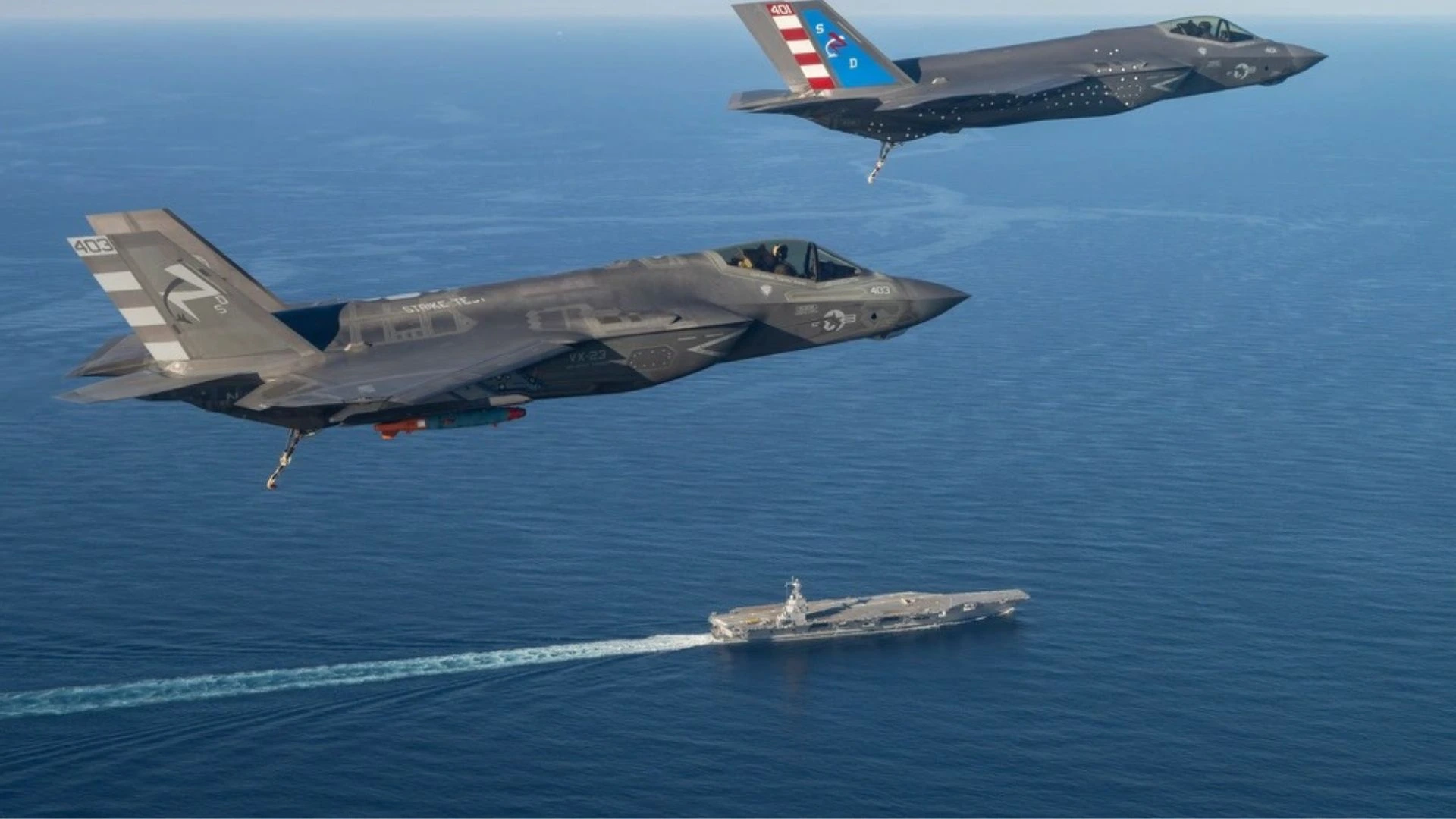
Two US Navy F-35C Lightning II test aircraft landed aboard the future USS John F. Kennedy (CVN 79) in the Western Atlantic on October 13, 2026, the first time the carrier variant of the stealth fighter has recovered aboard a Gerald R. Ford-class aircraft carrier. The jets were flown by test pilots from Air Test and Evaluation Squadron Two Three (VX-23), part of Naval Air Warfare Center Aircraft Division (NAWCAD), and made arrested landings on the Pre-Commissioning Unit’s flight deck.
The milestone closes a gap that has trailed the Ford class since its lead ship entered service. The F-35C made its first carrier arrested landing aboard USS Nimitz (CVN 68) off San Diego on November 3, 2014, and reached initial operational capability in February 2019, but USS Gerald R. Ford (CVN 78) was delivered without the modifications needed to operate and sustain the jet. When Ford completed its own compatibility trials in January 2020, the test matrix covered the T-45 Goshawk, F/A-18F Super Hornet, EA-18G Growler, E-2D Advanced Hawkeye and C-2A Greyhound, but not the F-35C.
First F-35C Ford-Class Landing Tests EMALS and Advanced Arresting Gear
A Patuxent River F-35 Integrated Test Force (ITF) team detached to the ship is running Aircraft Compatibility Testing (ACT) with a specially instrumented F-35C. According to the Navy, ACT assesses how a ship’s aircraft launch and recovery equipment performs with fleet aircraft. On a Ford-class carrier, that means the Electromagnetic Aircraft Launch System (EMALS) and the Advanced Arresting Gear (AAG), which replace the steam catapults and Mk 7 hydraulic arresting engines of the Nimitz class.
AAG is the more consequential test article. The system absorbs landing energy through water twisters and an electric motor that actively controls cable run-out, and it is designed to arrest a wider range of aircraft weights than legacy gear. Its maturity has been a recurring issue: Pentagon test officials reported AAG reliability well below its design requirement during Ford’s early trials, and Navy budget documents for Fiscal Year 2026 attribute Kennedy’s delivery slip from July 2025 to March 2027 partly to completing AAG certification.
The F-35C places specific demands on that equipment. Publicly available specifications indicate a 43-foot wingspan with folding wingtips, reinforced landing gear, a strengthened tailhook, roughly 19,750 pounds of internal fuel and a maximum takeoff weight in the 70,000-pound class. Its Pratt & Whitney F135-PW-100 engine produces about 43,000 pounds of thrust in afterburner. Instrumented arrestments and launches across weight and wind conditions generate the launch and recovery bulletins the fleet needs before operational squadrons embark. The Navy has not disclosed how many traps or catapult shots the test period includes.
Single-Phase Delivery and the F-35C Modifications Aboard CVN 79
Kennedy’s readiness for the jet stems from a 2020 acquisition decision. The Navy originally planned a two-phase delivery, under which F-35C modifications would have been installed after the shipbuilder handed over the hull. In February 2020, then-Assistant Secretary of the Navy for Research, Development and Acquisition James Geurts approved a single-phase strategy, folding the F-35C alterations, the Enterprise Air Surveillance Radar and the warfare system into Huntington Ingalls Industries’ Newport News Shipbuilding construction work. The change answered a congressional requirement that CVN 79 be able to deploy with the F-35C before completing its post-shakedown availability.
Publicly reported F-35C integration work on carriers extends well beyond the flight deck: secure spaces for the jet’s logistics and mission data systems, low-observable maintenance facilities, handling for lithium-ion batteries and F135 engine modules, and upgraded power and cooling. Ford is slated to receive comparable modifications during a later maintenance period. Kennedy first went to sea for builder’s trials on January 28, 2026, and went through Navy acceptance trials in August.
Analysis: The landing matters less as an aviation first than as a schedule signal. The F-35C has operated from Nimitz-class decks since 2014; what the Navy lacked was evidence that its newest launch and recovery architecture can handle the fighter it intends to field across every carrier air wing. With USS Nimitz having completed its final planned deployment and Ford still awaiting its own upgrades, Kennedy is the hull that converts the Ford-class investment into fifth-generation striking power. Every data point gathered on AAG and EMALS with the F-35C also feeds directly into Enterprise (CVN 80), whose delivery has slipped to 2030.
Kennedy remains scheduled for delivery in March 2027, followed by a post-shakedown availability. Key unknowns include the length of the current test period, how much of the F-35C launch and recovery envelope it will clear, and when the Navy will certify the ship for operational F-35C squadrons. Those answers will determine how quickly Kennedy can deploy as the first Ford-class carrier with a stealth fighter on deck.