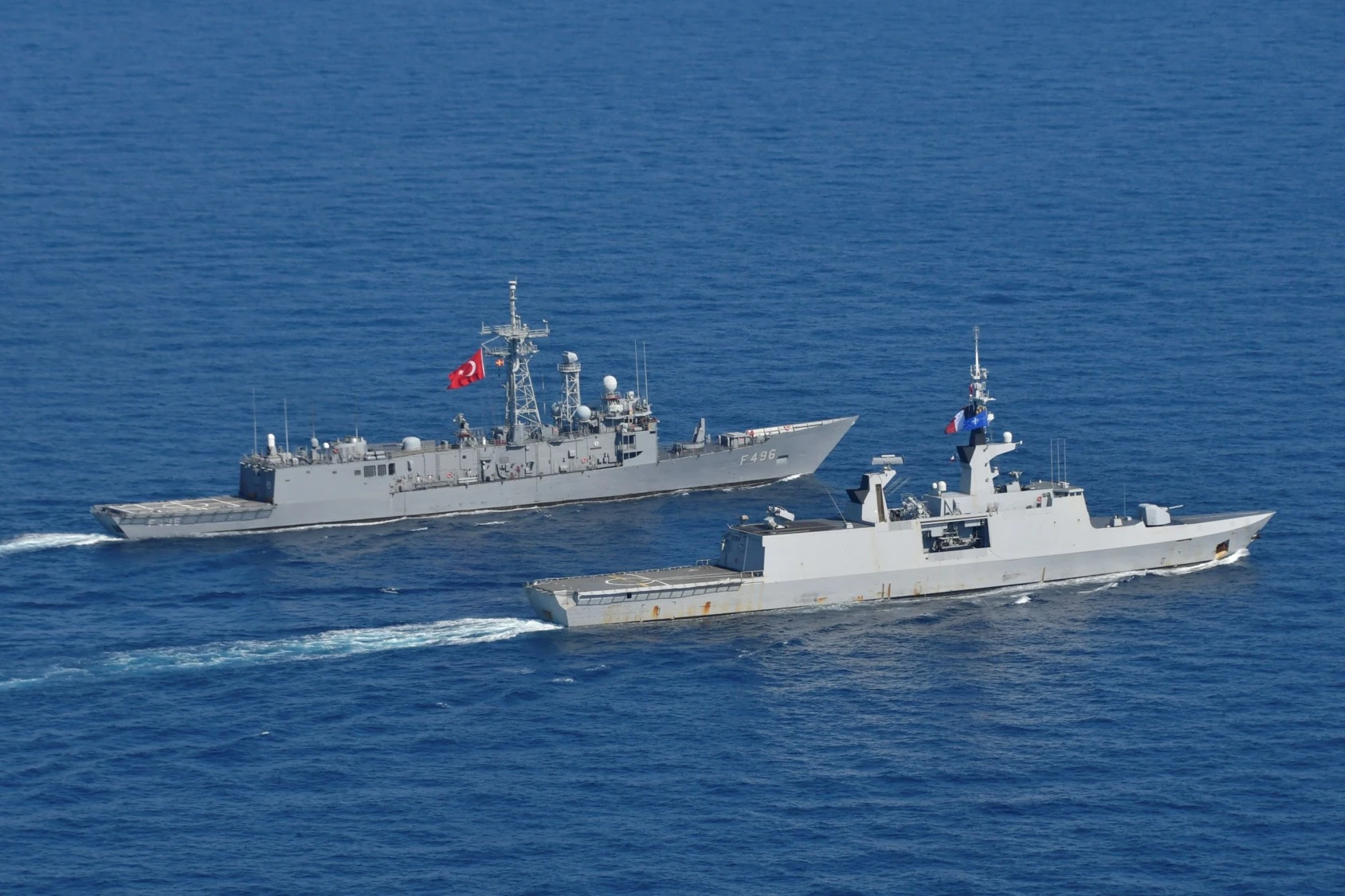
A French Navy La Fayette-class light stealth frigate sailed under NATO operational control with Standing NATO Maritime Group 2 (SNMG2) in the Eastern Mediterranean from September 20 to October 12, 2026, the French Navy announced on October 14, 2026. The service presented the three-week integration as part of the reinforcement of NATO’s deterrence and defense posture, but did not identify the ship by name or pennant number.
SNMG2 is one of NATO’s four Standing Naval Forces and answers to Allied Maritime Command (MARCOM) in Northwood, United Kingdom. Hellenic Navy Commodore Georgios Kypriotis has led the group since June 29, 2026, when he relieved Italian Rear Admiral Cristian Nardone in Taranto, with the Elli-class frigate HS Kountouriotis (F462) as flagship, according to the Hellenic Navy. The deployment comes as the French Navy stretches an aging second-line frigate fleet while its first Defense and Intervention Frigate (FDI), Amiral Ronarc’h (D660), completes the final steps before admission to active service.
How the La Fayette Frigate Integrated Into NATO’s SNMG2 Task Group
Once under NATO control, the frigate joined Task Group 441.02, the formation through which SNMG2 operates. The French Navy tied the mission to the knowledge and anticipation strategic function of the French armed forces and the Alliance, carried out through observation of activity in the Eastern Mediterranean.
The second objective was procedural. According to the French Navy, the integration allowed the crew to master NATO command and control procedures to facilitate future missions. La Fayette-class frigates often deploy alone or in national task groups, so periodic insertion into a standing NATO formation keeps crews current on Alliance communications plans, data link practice and reporting chains.
The French Navy stated that the deployment demonstrated the ability of its ships to integrate into an inter-allied force and operate in coalition, which it described as a prerequisite for any major engagement at sea. The hull involved, the embarked helicopter, the other SNMG2 units present and the Turkish ports visited remain undisclosed.
FLF Mid-Life Upgrade: KingKlip Sonar, Mistral 3 and New Combat System
The La Fayette class, designated Frégate Légère Furtive (FLF) in French service, comprises five ships homeported in Toulon: La Fayette (F710), Surcouf (F711), Courbet (F712), Aconit (F713) and Guépratte (F714). The lead ship entered active service in 1996. Publicly available specifications indicate a length of about 125 meters, a beam of 15.4 meters, a displacement of about 3,200 tonnes standard and 3,800 tonnes at full load, and a crew of more than 160. Four diesel engines in a CODAD arrangement drive two shafts for a top speed generally cited at 25 knots. Armament combines eight MM40 Exocet anti-ship missiles and a 100 mm gun, with a hangar for a medium helicopter, typically the AS565 Panther. Inclined superstructure faces and radar-absorbent materials reduce the radar cross section.
In 2017, the French defense procurement agency (DGA) selected Naval Group to modernize three hulls: Courbet, La Fayette and Aconit. The program, valued at about EUR430 million, ran from October 2020 to the end of 2023. It added a Thales KingKlip Mk2 hull-mounted medium-frequency sonar, the class’s first genuine anti-submarine warfare sensor, and a combat management system derived from the one aboard the aircraft carrier Charles de Gaulle. Two SADRAL launchers firing Mistral 3 missiles replaced the Crotale CN surface-to-air system, while new electro-optical fire control, upgraded data links and torpedo decoy launchers completed the package. Displacement grew by about 80 tonnes.
For an SNMG2 commander, an upgraded FLF contributes to the undersea picture with its hull-mounted sonar. Its air defense, however, remains a short-range point-defense layer, which makes the ship dependent on Allied escorts under a serious missile threat. Surcouf and Guépratte did not receive the mid-life upgrade; their withdrawal dates, initially set for 2027 and 2031, were pushed back to 2032 and 2036 respectively after the service life of the class was extended to 35 years in early 2026. Because the French Navy did not name the ship, it is unclear whether a modernized hull made the deployment.
Replenishment Drills With Turkish Gabya-Class Frigates Gökçeada and Gökova
The crew used the SNMG2 period and two port calls in Türkiye to conduct two training events with Turkish Navy frigates. Imagery released by the French Navy shows replenishment-at-sea training with TCG Gökçeada (F-494) and the French ship sailing in company with TCG Gökova (F-496). Both belong to the Gabya class of former US Navy Oliver Hazard Perry-class frigates: Gökçeada is the former USS Mahlon S. Tisdale (FFG-27) and Gökova the former USS Samuel Eliot Morison (FFG-13). Open-source data indicate that Gökova carries an eight-cell Mk 41 vertical launch system for RIM-162 ESSM missiles and a Thales SMART-S Mk2 3D radar, alongside the indigenous GENESIS combat management system.
Replenishment at sea between two navies tests shared procedures, rigging compatibility and shiphandling, and underpins coalition endurance. The French Navy said the drills strengthened mutual knowledge and interoperability between the two Allies, a key factor in coalition operations.
Analysis: In June 2020, Paris accused Turkish warships of illuminating the frigate Courbet with fire-control radar three times during NATO’s Operation Sea Guardian off Libya, then temporarily suspended its participation in that operation; Ankara denied the charge. Six years later, a ship of the same class is conducting replenishment drills with Turkish frigates and calling at Turkish ports under a NATO flag. That does not resolve Franco-Turkish divergences, but it shows both navies keeping tactical channels open. The deployment also illustrates the bridging role of the FLF: a 30-year-old design kept relevant through incremental upgrades while the FDI fleet builds up.
The next milestone is Amiral Ronarc’h, scheduled for a technical stop in Brest between September and December 2026 ahead of admission to active service. Four more FDIs, from Amiral Louzeau to Amiral Cabanier, are due by 2032 under the 2024-2030 military programming law. The pace of those deliveries, and the extended service of Surcouf until 2032, will determine how often La Fayette-class hulls remain available for NATO standing force rotations.