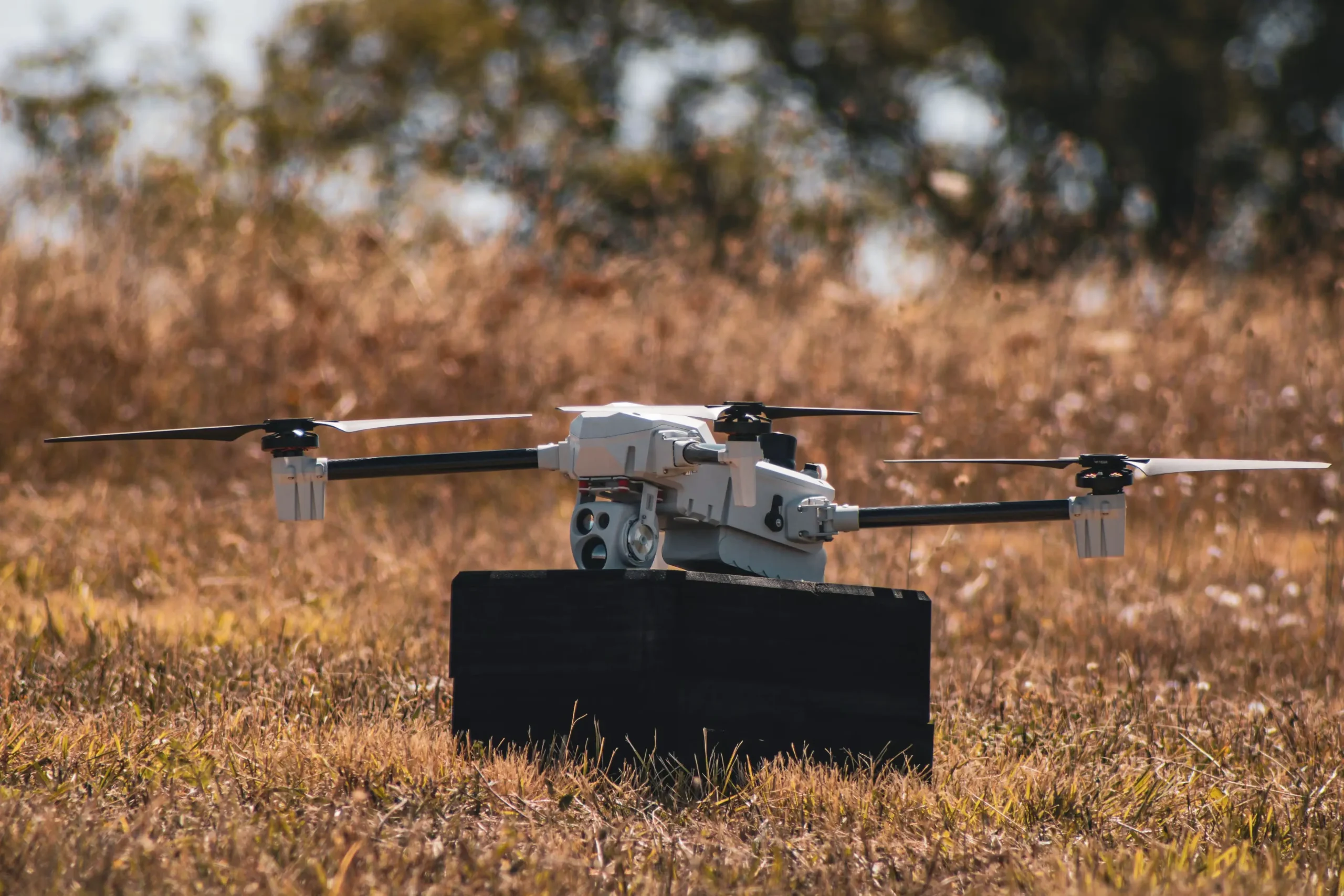
France’s Direction Générale de l’Armement (DGA), the national defense procurement agency, has ordered an additional batch of MX-10 Damocles loitering munitions from KNDS France and drone maker Delair, exercising an optional tranche of the contract signed in July 2024. KNDS announced the order in Versailles on October 13, 2026, without disclosing the quantity, the contract value, or the delivery schedule.
The order arrives less than a year after first deliveries to the French Army in December 2025, and it moves the system from initial fielding toward sustained production. Damocles is the product of the Munition Téléopérée Courte Portée (MTO-CP) short-range loitering munition program, an outgrowth of the Colibri call for projects launched in 2022 by the Defense Innovation Agency (AID) and the DGA. The July 2024 contract has been reported as a framework covering up to 2,270 munitions, with an initial firm batch of 460 units. Neither figure was restated in the October 13 announcement.
MX-10 Damocles Specifications: Range, Warhead, and EW Resilience
The MX-10 Damocles pairs a Delair quadcopter airframe with a warhead produced by KNDS Ammo France, the group’s munitions arm. Publicly available specifications indicate a takeoff weight of 3.5 kg, an 80 cm span, electric propulsion, and vertical launch, with a maximum range of 10 km and a flight endurance of 40 minutes. The payload is a 550 g explosive incendiary fragmentation warhead fitted with an arming safety device, which KNDS says provides a high level of safety for the operator. The system can be deployed in under five minutes.
Those figures define the munition’s tactical niche. A 10 km reach places Damocles at the infantry company and battalion level, beyond the effective range of most direct-fire weapons but well short of the 25 km MV-25 Oskar or the 100 km MV-100 Veloce in the same family. The quadcopter architecture gives up the cruise speed of fixed-wing designs, but it allows the munition to hover, observe, and wait for a target, which the October 13 release describes as a target search capability. Operators receive real-time video until impact, enabling an abort or a retarget in the terminal phase.
Electronic warfare resilience is the second pillar of the design. KNDS states that Damocles uses a jam-resistant datalink and can navigate in GNSS-denied environments, and the company claims resilience against the latest electronic warfare capabilities. That claim has not been independently verified in open sources, but it addresses the central lesson of Ukraine, where Russian jamming has neutralized large numbers of commercial-grade drones. KNDS officials said in early 2025 that around 100 MX-10s had been supplied to Ukraine.
KNDS lists infantry and light vehicles as the core target set; the latest release extends this to protected vehicles. A 550 g charge will not defeat a main battle tank, however. Within the family, that mission falls to the 2.5 kg anti-armor warhead of the MV-100.
How KNDS and Delair Are Scaling Damocles Production for France
The industrial arrangement splits responsibilities cleanly. Delair, a Toulouse-based drone manufacturer with more than 200 employees and a forecast 2025 turnover of €60 million, builds the airframe. KNDS France supplies the warhead.
The program has moved quickly by French procurement standards. The DGA qualified the first standard of Damocles on November 21, 2025, and delivered the first munitions on December 2, 2025, about 18 months after the development contract. In mid-2025, KNDS France cited an annual production capacity of around 2,000 short-range munitions. The October 13 release states that the new tranche will increase production capacity but gives no target rate.
The order also anchors Damocles within MATARIS, which KNDS presents as France’s first sovereign family of loitering munitions. The range covers the MT-10, an onboard munition for armored vehicles expected from mid-2027; the MX-10 Damocles; the fixed-wing MV-25 Oskar; and the MV-100 Veloce, developed with EOS Technologie. The DGA has acquired 17 Veloce 330 munitions for experimentation involving all three services. KNDS added a ground loitering munition, the MTO-T, at Eurosatory in June 2026.
The release names both the French Army and the French Navy as users, but it does not specify the Navy’s employment concept or how quantities are split between the two services. KNDS also says Damocles is the subject of several export campaigns, without naming prospective customers.
Analysis: Exercising an option rather than negotiating a new contract is the fastest lever the DGA has to accelerate deliveries, and the choice indicates that the French Army’s first ten months of service with Damocles have satisfied the procurement agency. The scale, however, remains modest. A reported framework of 2,270 munitions is a training and early-equipment volume, not a wartime consumption rate; Ukrainian drone production alone is measured in the millions of units per year, according to Kyiv’s own figures. France has chosen a qualified, safety-certified munition with a sovereign warhead over cheap commercial FPV drones, trading unit cost and volume for reliability and safe handling. The test of that model is whether KNDS and Delair can convert capacity into surge production if a crisis demands it.
The next markers are the size of the new tranche, which may surface in French budget documents, and the delivery cadence that follows. The 2024 contract is structured in tranches, leaving room for further orders. On the industrial side, the MT-10 onboard variant is due from mid-2027, and a first export contract for Damocles would provide the volume needed to justify a step change in production capacity.