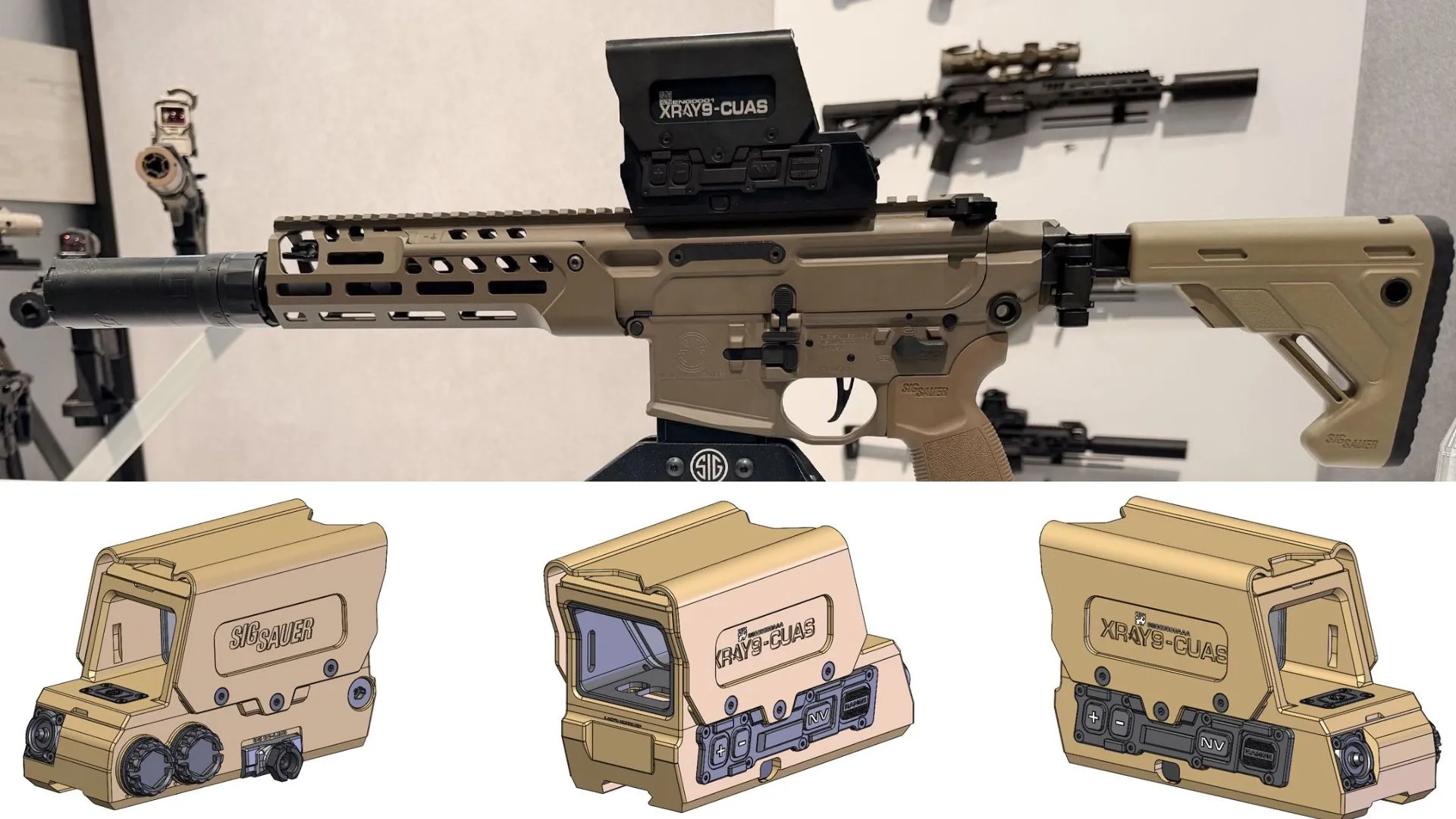
SIG Sauer unveiled the XRAY9-CUAS, a weapon-mounted electro-optic fire control unit built to help soldiers engage small drones with direct fire, at the Association of the United States Army (AUSA) Annual Meeting and Exposition in Washington, D.C., on October 13, 2026. The New Hampshire-based manufacturer says the sight computes a drone’s range, speed and vector in real time and generates a disturbed reticle showing the shooter where to aim, out to 300 yards (about 274 meters) depending on target size.
The launch comes as the US Army pushes counter-unmanned aircraft systems (C-UAS) capability down to the squad and vehicle-crew level, where quadcopters and first-person-view drones now pose a persistent threat. Hitting a small, maneuvering airframe with unaided small arms remains difficult. The Army has already fielded weapon-mounted fire control for this mission, including SmartShooter’s SMASH 2000L, and its Armaments Center tested a counter-drone fire control solution for remote weapon stations at Aberdeen Proving Ground in April 2026.
SIG Sauer XRAY9-CUAS Specifications: SWIR Ranging and Disturbed Reticle
At the core of the XRAY9-CUAS is a proprietary short-wave infrared (SWIR) laser rangefinder paired with onboard slew-rate sensors. The laser measures distance while the slew-rate sensors capture how fast the shooter is tracking, allowing the optic to calculate the drone’s distance, speed and vector and to build a dynamic disturbed reticle. In practice, the aim point shifts to account for lead and bullet drop, so the soldier tracks and fires rather than estimating holdover against a fast-crossing target.
SIG Sauer says the optic can be integrated with CMOS and thermal sensors, giving a day, night and fused-imagery fire control capability. The company has not disclosed the thermal channel’s resolution, the SWIR laser’s maximum ranging distance, or whether image fusion is processed onboard or in an attached module.
Published specifications include:
- Dimensions: 5.25 x 2.5 x 3.3 inches (L x W x H), roughly 133 x 64 x 84 mm
- Weight: 24 ounces, about 680 grams
- Display: 640 x 480 resolution behind a 48mm clear aperture window
- Battery life: up to 50 hours of continuous use
- Engagement range: up to 300 yards, varying with drone size
At 24 ounces, the unit is heavier than a standard red dot but manageable on a rifle or light machine gun. The 50-hour runtime suits base defense and convoy overwatch, where sights stay live through long alert periods. Andy York, President of SIG Sauer Electro-Optics, said the company fast-tracked the program because the capability is needed on today’s battlefield, adding that a soldier can “point and shoot to combat drones” while the optic compensates for multiple variables.
From Pitbull RCWS to the Rifle: SIG Sauer’s Counter-Drone Fire Control Lineage
SIG Sauer describes the XRAY9-CUAS as bringing the targeting logic of its remote-controlled weapon station into a mounted optic. That station is the Pitbull RCWS, developed by Israel’s General Robotics, which SIG Sauer acquired in March 2023. The Pitbull’s software already offers predictive lead calculation for moving and aerial targets.
Moving that logic into a sight changes the distribution equation: a remote weapon station needs a vehicle, fixed site or tripod, while an optic can in principle reach every designated gunner. The company states only that the optic mounts to a counter-UAS weapon system; it has not named compatible weapons, the mounting interface, or any ammunition pairing.
Analysis: The XRAY9-CUAS positions SIG Sauer as a direct challenger to SMASH-type fire control, but with a different architecture. SMASH relies on image-based target tracking and gates shot release until the firing solution is valid. SIG Sauer’s published description emphasizes laser ranging and shooter-motion sensing, with no mention of automated tracking or shot-release control. A disturbed reticle still depends on the soldier holding the solution under stress. For the Army, which has signaled it wants recurring C-UAS competitions, another fire control supplier adds pressure on price and performance.
SIG Sauer has not announced a customer, contract, unit price or production timeline, and no independent test data has been published. Key markers are entry into Army or Marine Corps C-UAS evaluations and disclosure of the thermal and fusion module specifications. Until live-fire results against Group 1 drones are released, the 300-yard engagement figure remains a manufacturer claim.